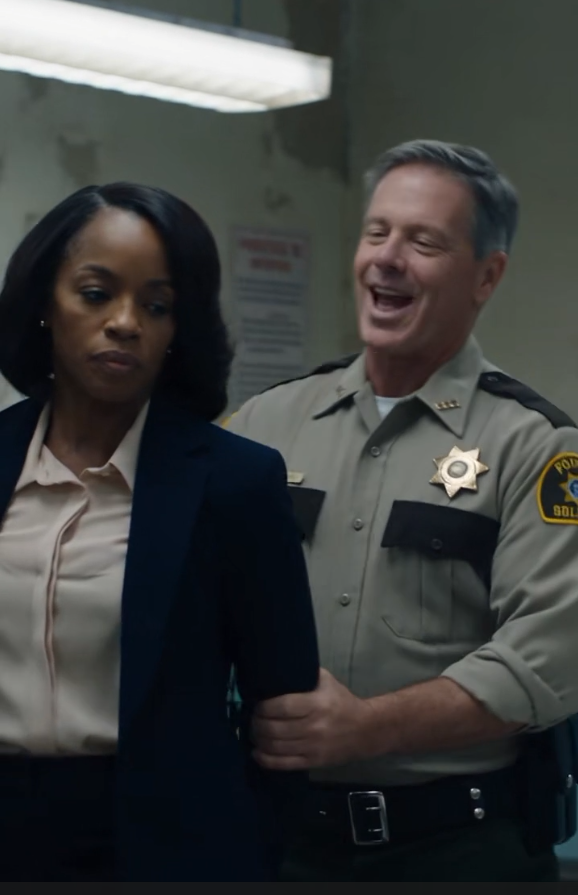
Then a technician noticed something.
The unit had recorded Sarah’s car at forty-four.
But Cleary had manually tagged the reading as fifty-eight twelve seconds later.
The system preserved both.
The prosecutor called the technician.
“Can an officer edit the raw radar measurement?”
“No.”
“Can an officer label the entry?”
“Yes.”
“What happened here?”
“The raw measurement was forty-four. A manual annotation was later added stating fifty-eight.”
“When?”
“Twelve seconds after the patrol vehicle began moving.”
Sarah felt the significance before anyone explained it.
Cleary had not merely lied from memory.
He had created a false number before reaching her window.
Before she spoke.
Before she had any “attitude.”
The commission chair looked toward Cleary.
“Sheriff?”
His lawyer whispered urgently.
Cleary ignored him.
“I know what I saw.”
The technician answered, “The machine recorded forty-four.”
“These machines make mistakes.”
“Then why did you tag the reading as fifty-eight?”
Cleary looked at Sarah.
She understood what he had left.
Not evidence.
Not procedure.
Only insistence.
The chair repeated the question.
Cleary said nothing.
Sarah thought back to the billboard.
The cruiser.
The decision made before conversation.
There was the beginning.
Not at her words.
Not at the warning.
Not at the Pentagon call.
Before all of it.
The record had preserved the exact moment.
The commission recessed.
Outside, reporters crowded the steps.
Inside a side hallway, Mercer approached Sarah.
“That was the piece.”
“Yes.”
“Federal prosecutors are going to want him on falsification now.”
Sarah leaned against the wall.
She looked tired.
Mercer lowered his voice.
“You can leave.”
“The decision hasn’t been announced.”
“You don’t need to stay.”
“Yes, I do.”
“Why?”
Sarah glanced toward the hearing room.
“Because walking out before the outcome would make it look like I only cared about proving him wrong.”
Mercer watched her.
“And you don’t?”
“No.”
“What do you care about?”
Sarah took several seconds.
“That the next person he stops doesn’t need twelve digits memorized.”
Mercer looked at her.
Then nodded.
The commission returned at 6:42 p.m.
The chair spoke for nine minutes.
Failure to follow lawful standards.
False statements in official reporting.
Improper evidence handling.
Attempts to alter records.
Patterns requiring referral for further state and federal review.
Then the conclusion.
“Effective immediately, Sheriff Boyd Cleary is removed from administrative authority pending formal termination proceedings. This commission also refers the relevant records to state and federal authorities.”
Cleary stared straight ahead.
No shouting.
No outburst.
No dramatic arrest.
Sarah was glad.
Accountability rarely looked like television.
Sometimes it looked like a man sitting very still while authority drained away from him sentence by sentence.
The chair continued.
“Deputy Toby Miller will serve as acting administrative officer solely to preserve departmental operations until an external interim supervisor is appointed.”
Miller looked up sharply.
That had not been discussed with him.
Sarah almost smiled.
Then the chair added:
“Mr. Miller’s cooperation does not remove questions concerning his delayed reporting of prior conduct. Those matters will also be reviewed.”
Miller nodded.
He deserved that too.
No heroes without consequences.
No villains without evidence.
That, Sarah thought, was closer to justice than the simple version people wanted.
Part VI — Aftermath
Boyd Cleary resigned before the termination vote.
The resignation did not end the investigations.
Three months later, state prosecutors charged him with falsifying official records, obstruction related to evidence preservation, and misconduct in office.
Federal civil rights review continued separately.
His attorney denied that race had motivated his actions and argued that the stop reflected poor judgment rather than discriminatory intent. Investigators did not rely on slogans from either side. They relied on records, videos, timestamps, prior complaints, and testimony.
Sarah preferred it that way.
Toby Miller remained in the department only long enough to complete the transition.
He submitted his resignation six weeks after the hearing.
When Sarah heard, she called him.
He answered on the fourth ring.
“Hello?”
“Deputy Miller?”
A pause.
“General Hayes.”
“Sarah is fine.”
Another pause.
“Okay.”
“I heard you resigned.”
“News travels.”
“In this case, yes.”
He gave a quiet laugh.
She asked, “Why?”
Miller did not answer immediately.
“Because I kept telling myself I was the good guy because I saved copies.”
Sarah listened.
“I thought if I didn’t delete anything, that meant I wasn’t part of it.”
“And now?”
“Now I think I should’ve spoken sooner.”
Sarah looked out her office window.
“You probably should have.”
Silence.
He had not expected forgiveness.
She was not going to offer absolution cheaply.
Then she added, “You spoke when it mattered.”
“Does that balance it?”
“No.”
He breathed out.
“Yeah.”
“But it counts.”
The line went quiet again.
Finally Miller said, “I’m applying somewhere else.”
“Law enforcement?”
“Maybe.”
“Then decide what you’ll do before the hard moment comes.”
He understood what she meant.
“Good advice.”
“It was given to me.”
“By your father?”
Sarah looked at the framed photograph on the bookshelf behind her desk.
“Yes.”
Miller said, “Take care, General.”
“You too, Toby.”
She ended the call.
The Department of Defense completed its own review.
The helicopter response became the subject of more meetings than Sarah believed two helicopters deserved.
The official finding was dry and precise: the response had been justified by the uncontrolled status of a secured communications device and the verified detention of its assigned senior official.
No disciplinary action.
No commendation.
Exactly the right outcome.
General Reed appeared in her office the afternoon the final memo was released.
He dropped it on her desk.
“Congratulations. You have officially survived paperwork.”
“Barely.”
“You know how many people had to sign that?”
“Too many.”
“Twenty-one.”
Sarah looked at him.
“You counted?”
“I was bored.”
She flipped through the memo.
Reed sat.
“Cleary’s attorney is still saying the helicopters prejudiced the county.”
“His attorney is doing his job.”
“Do you ever get tired of being reasonable?”
“Yes.”
“Good. I was worried.”
She closed the folder.
Reed studied her.
“Something else.”
“What?”
“The state wants you at a training conference.”
Sarah frowned.
“For what?”
“Traffic enforcement. Civil rights. Command accountability.”
“No.”
“I told them you’d say that.”
“I’m not turning this into a speaking tour.”
“They asked if you’d talk about procedural escalation.”
“No.”
“What if they don’t advertise your rank?”
“No.”
“What if I tell them you’re very inspiring?”
Sarah looked at him.
Reed grinned.
She shook her head.
“No.”
He stood.
At the door he stopped.
“You know they’re going to teach that video anyway.”
Sarah looked down at her desk.
“I know.”
“The attitude package line is already in three training modules.”
“That phrase should probably ruin his week for the rest of his life.”
Reed smiled.
“There she is.”
Then he left.
Months passed.
Oak Haven stopped appearing on national television.
The satellite trucks disappeared.
The diner changed its sign.
The sheriff’s department hired an interim supervisor from outside the county.
New evidence-retention rules were adopted.
Body-camera files were moved to an external server.
Traffic-stop audits became mandatory.
The county settled several old complaints and reopened others.
Not every accusation proved true.
Not every disputed ticket was dismissed.
The process was slower and less satisfying than outrage.