A gray-bearded biker climbed onto a crowded city bus in the middle of downtown traffic, ordered the driver to stop immediately, and before anyone could understand why, the motorcycles behind him had already surrounded the entire vehicle like they were sealing in a crime.
It was just after four in the afternoon in Dayton, the hour when buses fill with tired people, school bags, grocery sacks, sore knees, and the kind of silence strangers keep when they are all trying to get home without becoming part of anyone else’s trouble.
Then trouble climbed aboard.
He was the kind of man people judged in a single glance and then felt proud of themselves for doing it. White, late fifties, thick through the shoulders, gray beard, scar across one temple, faded black leather vest, old military tattoos on both forearms, boots that hit the floor of the bus like a warning. He didn’t smile. He didn’t apologize. He didn’t ask permission.
He stepped into the aisle and pointed at the driver.
“Stop this bus. Right now.”
The driver, a Black woman in her forties with a transit badge clipped to her jacket, looked at him like she was deciding whether to grab the radio or throw him back out the door herself. Passengers jerked upright in their seats. An elderly woman clutched her purse. A teenage boy started filming. A toddler began to cry before anyone else even raised their voice.
And outside, through the scratched bus windows, more bikers appeared. One. Then three. Then six. White riders. Black riders. Men and women. Most older. All silent. Their motorcycles boxed the bus in so tightly that every passenger inside felt the same cold thought at once: we are trapped.
Someone near the back shouted, “Call the police!”
Someone else said, “This is a robbery.”
But the biker in the aisle never looked at the fare box. Never scanned the seats for valuables. Never once acted like a man interested in money. He kept staring toward the rear of the bus. That was what made it stranger.
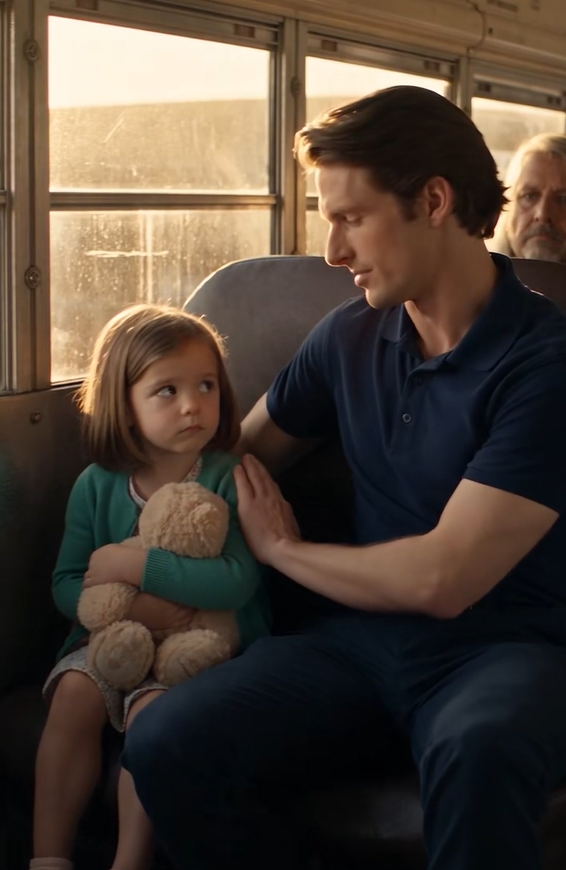
Because three rows from the back sat a clean-cut white man in a navy jacket, the kind of man no one would ever fear at first glance, beside a little girl in a yellow cardigan with one untied shoe and a stuffed animal crushed against her stomach so tightly it looked less like comfort and more like armor.
The biker saw her. Then his whole face changed. Not into rage. Into something worse. Recognition.
The man beside the girl noticed it too and laid a hand on her shoulder with a smile so controlled it felt rehearsed. “She’s tired,” he said to nobody in particular, as if the entire bus needed calming. “She doesn’t like crowds.”
The little girl never looked at him. She kept her eyes on the window. Then, so small that most people missed it, she tugged once at her left ear.
The biker froze. The driver saw it. A woman near the front saw it. And somewhere outside, one of the bikers dismounted and moved toward the rear doors like she had just been given a signal she already understood.
The man in the navy jacket stood halfway, one hand tightening around the girl’s arm. The biker took one step closer down the aisle. Every passenger thought the same thing again: this is the moment it turns violent. Instead, the biker lowered his voice and said something to the girl so gently it didn’t match his face at all.
“Sweetheart, don’t look at me. Just nod if you know your name.”
The man snapped, too fast, too sharp. “Don’t talk to my daughter.”
But the girl flinched at him, not the biker.
And in that instant, the entire bus seemed to tilt. Because the dangerous man no longer looked like the one in the leather vest. He looked like the one smiling. Then the biker reached slowly into his pocket and pulled out a folded piece of paper worn soft from being handled too many times. He held it where only the driver could see.
Her face drained of color. Outside, the line of bikers tightened around the bus. Inside, nobody breathed. And just before the driver hit the emergency alert, the little girl finally lifted her eyes, looked straight at the biker, and whispered:
“My name is Emma. And he’s not my daddy.”
The silence that followed was heavy, suffocating the air out of the bus. The man in the navy jacket didn't yell. Instead, his hand clamped down on Emma’s shoulder with a strength that turned her knuckles white. His controlled smile vanished, replaced by a cold, predatory stillness.
“She’s confused,” the man said, his voice dropping an octave, slicing through the tension. “She’s off her medication. Now, get out of our way.”
But the biker didn't move. He stood like an oak tree rooted in the aisle. “Open the back doors, Sarah,” he said to the driver. “And don't let anyone else off this bus.”
The driver’s hand hovered over the controls. She looked at the paper—a missing person’s flyer. The face of the laughing girl on the flyer matched the terrified child in the yellow cardigan perfectly.
“Open them!” the man in the navy jacket barked, lunging toward the rear exit with Emma tucked under his arm.
*Clack-shhh.*
The rear doors hissed open, but the man didn't find the street. He found a wall of leather. Two more bikers—a woman with a silver braid and a man as wide as a refrigerator—were standing on the bottom step, blocking the exit. Behind them, the low, rhythmic throb of twenty idling engines sounded like a mechanical growl warning the world to stay back.
“Let her go,” the biker in the aisle said. His voice was a flat, dangerous fact.
The man in the navy jacket reached into his waistband. Passengers screamed, diving for the floorboards. But before his hand could clear his jacket, the biker was there. He pinned the man’s arm against the window, the glass groaning under the pressure. “Not today,” the biker growled.
The silver-braided woman reached out and gently uncoupled Emma from the man’s grip. The moment the girl was free, the "tough" biker—the one who had terrified the whole bus—dropped to one knee. The hardness in his eyes shattered into tears.
“I’m your Uncle Pete, Emma,” he choked out. “Your mom hasn't stopped looking. We’ve been riding every city, every bus route, every playground for six months. We promised her we wouldn't come home without you.”
The little girl looked at the scarred face and the rough leather. She didn't see a criminal. She saw a shield. She threw her small arms around his neck, burying her face in his gray beard, and finally, she sobbed.
Minutes later, the blue and red lights of police cruisers bathed the bus. The man in the navy jacket was led away in handcuffs—a predator who had been hiding in plain sight.
Uncle Pete walked back onto the bus and took off his worn leather cap. “I’m sorry for the fright, folks,” he said to the passengers. “But sometimes you have to make a little noise to find a quiet voice that's been lost.”
The passengers didn't grumble about the delay. Instead, one by one, they began to clap. A roar of applause followed the bikers as they formed a ceremonial circle around the police car carrying Emma, acting as a wall of thunder to protect a little girl who was finally going home.
.
.
Please follow us if you like this story 💕🙏✨