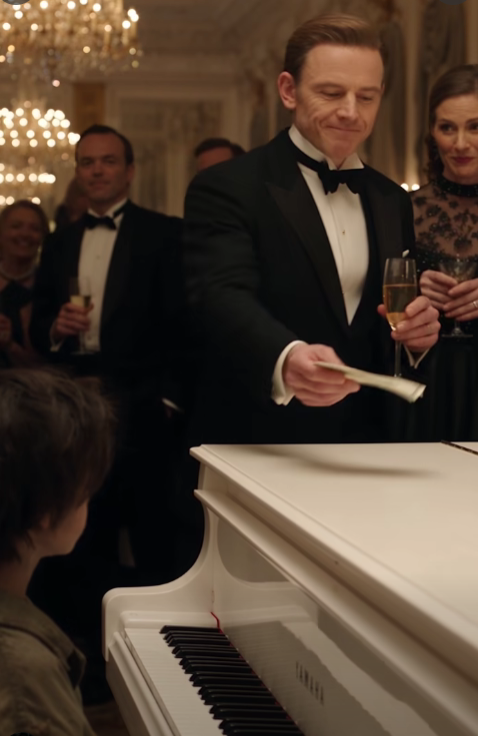
The laughter stopped so suddenly that the last sound in the ballroom was the faint ring of crystal against crystal.
Adrian Mercer stood beside the white grand piano with one hand gripping its polished edge.
A few seconds earlier, he had been smiling.
He had seen a barefoot boy standing near the instrument during a private fundraising dinner and assumed the child had wandered in looking for food. Instead of asking who he was, Adrian had turned the moment into entertainment for his guests.
“Play something worth hearing,” he had said, tossing a folded banknote onto the piano, “and maybe I’ll let you eat tonight.”
Several people had laughed.
The boy had not.
He had looked once toward the long tables behind them, where plates of food sat half-finished beneath silver warming lamps. Then he looked back at Adrian.
“My mother said you’d recognize this one.”
Adrian’s smile had faded.
Then the boy sat down.
Three notes changed the room.
By the fourth, Adrian’s champagne glass had stopped halfway to his mouth.
By the seventh, his fingers were trembling.
“Stop.”
The boy continued.
Not defiantly. Not loudly.
He played the melody almost gently, as though he had practiced it so many times that his hands no longer needed instructions.
“STOP!”
The command echoed through the ballroom.
The boy lifted his fingers.
Silence settled over the guests.
Adrian stared at him.
“That song was never recorded.”
The boy turned on the piano bench.
“I wrote it for one person,” Adrian said.
“I know.”
“Who taught it to you?”
The boy’s expression barely changed.
“She was my mother.”
The woman standing beside Adrian covered her mouth.
No one laughed again.
For several seconds, Adrian appeared unable to speak.
Then he asked the question everyone else in the room was thinking.
“What was her name?”
The boy reached into the pocket of his worn trousers.
“Elena Reed.”
Adrian closed his eyes.
And suddenly, the private melody made sense.
Thirty-two years earlier, long before anyone called Adrian Mercer a genius, a mogul, or one of the wealthiest men in the city, he had been a frightened seventeen-year-old with a secondhand jacket and exactly one pair of dress shoes.
He and Elena Reed had met at a community music center on the east side.
Adrian had been there on scholarship.
Elena was there because she could play almost anything she heard.
She had no formal training when she arrived. She could not always name the chords she was playing, but she could listen to a piece once and find its shape on the keyboard.
Adrian had technique.
Elena had instinct.
They became friends because each possessed what the other lacked.
He showed her how to read difficult scores.
She taught him how to stop treating every mistake as a disaster.
When Adrian froze before his first major conservatory audition, Elena was the one who found him sitting behind the building with his application folded in his pocket.
He had decided not to go inside.
She sat beside him and told him that being afraid of failing was not the same as having failed.
Then she made him get up.
He auditioned.
He won the scholarship that changed his life.
A week later, Adrian wrote a short melody for her.
It had no title.
No lyrics.
No sheet music anyone else had ever seen.
He played it once for Elena in an empty practice room after closing time.
Then he showed her the notes.
It was not meant for an album.
It was not meant for an audience.
It was simply his way of saying thank you.
Years later, after Adrian had left the neighborhood and his career had begun moving faster than either of them expected, that little melody became something else between them.
A promise.
“If you ever really need me,” Adrian had told her during one of their last meetings, “send me this song.”
Elena had laughed at him.
“You’ll probably forget it.”
“I won’t.”
She had raised an eyebrow.
“Thirty years from now?”
“Especially thirty years from now.”
Neither of them knew how literal that promise would become.
Adrian told the story slowly, still standing beside the piano.
The boy listened without interrupting.
Most of the guests had probably expected something more sensational.
A hidden romance.
A secret child.
Some scandal buried beneath three decades of wealth.
There was none.
Elena Reed had been Adrian’s friend before the world knew his name.
She was the person who had pushed him through a door he had been too frightened to open himself.
And the melody had been his promise that if she ever called for him, he would answer.
Adrian looked at the boy.
“How is she?”
The boy looked down.
That was when Adrian understood why he had said she was his mother.
“She died in June.”
The words were quiet.
They landed harder than the shouted command had.
Adrian lowered his head.
The woman beside him—his wife, Catherine—placed a hand against his arm, but he seemed not to notice.
“When?” he asked.
“June eighteenth.”
Adrian swallowed.
“Was she sick?”
“For a while.”
“Why didn’t she call me?”
The boy’s answer came immediately.
“She said she tried once, a long time ago. Someone told her you didn’t take personal calls anymore.”
Adrian looked toward his assistant.
The man’s face changed.
But Adrian did not pursue it.
Not yet.
Instead, he pulled out the chair beside the piano and sat down so that he was no longer towering over the boy.
“What’s your name?”
“Daniel.”
“How old are you?”
“Twelve.”
“And why are you here alone?”
Daniel reached into his pocket again.
This time he removed a small envelope.
It had been folded twice and softened along the edges from being handled.
“My mother told me not to open this unless I found you.”
Adrian stared at the handwriting on the front.
His name was written in blue ink.
Not “Mr. Mercer.”
Not “Adrian Mercer.”
Just Adrian.
He knew the handwriting immediately.
His fingers hesitated before opening it.
Inside was a single sheet of paper.
Adrian read it once.
Then he read it again.
Catherine watched his expression change.
“What does it say?” she asked.
Adrian did not answer.
Daniel did.
“She said I wasn’t supposed to ask him for money.”
Adrian looked up sharply.
Daniel nodded toward the banknote still sitting on the piano.
“My mother was very specific about that.”
A few guests lowered their eyes.
Adrian picked up the banknote he had thrown minutes earlier.
For the first time that evening, he seemed embarrassed to be holding it.
“What did she want you to ask me for?”
“Nothing.”
“That can’t be nothing.”
Daniel looked toward the keys.
“She wanted me to play.”
Adrian returned to the letter.
Elena had written it months before she died.
She