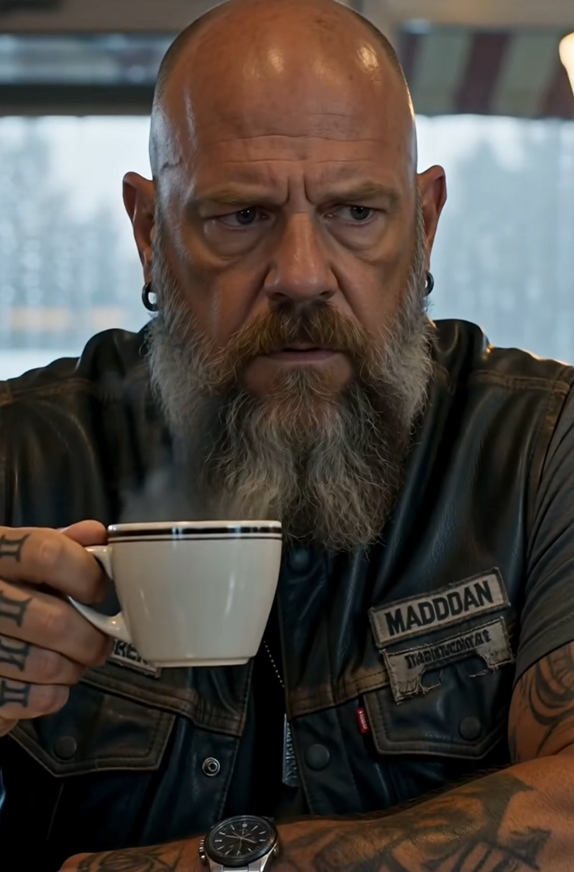
Thin.
Deflated.
“I need to report an emergency at my home.”
Colt watched him carefully.
Karen’s tone changed.
“What kind of emergency?”
Raymond looked at Liam.
The boy flinched.
Colt’s gaze sharpened.
Raymond looked away.
“There have been concerns about the children.”
Colt stepped forward one inch.
Raymond swallowed.
“About my treatment of the children.”
The line went silent.
Then Karen said his name softly, as if the shape of it had changed in her mouth.
“Raymond, are the children safe right now?”
Raymond could not answer.
Colt did.
“They are being kept away from him.”
Karen inhaled.
“Who is this?”
“Colt Matthews.”
There was a pause.
No doubt she knew the name or at least the patch.
“We need law enforcement and child services notified,” Colt said.
“Immediately.”
Raymond glared, but the glare no longer had force.
Karen’s professionalism returned quickly.
“Stay on the line.”
“No,” Colt said.
“Send who needs to come.”
He looked at Raymond.
“He will not leave.”
Raymond gave a broken little laugh.
“You can’t hold me.”
Tiny looked at the truck.
Red looked at the road.
Wrench looked at Raymond.
No one spoke.
Raymond lowered his eyes first.
That was the moment the street understood the truth.
Not all cages had locks.
Some were made of witnesses.
Some were made of consequences.
Some were made of the fear finally moving from the child to the adult who had caused it.
The siren grew louder.
Liam leaned into Joy.
Colt lowered his voice.
“You’re doing good, buddy.”
Liam’s eyes filled.
“I didn’t tell.”
Colt’s chest tightened.
The boy thought survival had required secrecy.
“No,” Colt said.
“Marcy was brave.”
Liam trembled.
“And you were brave for staying.”
The child’s face twisted with confusion.
Staying had never felt brave.
It had felt like being trapped.
Colt understood.
Adults gave names to things children only endured.
Fear became quiet.
Pain became clumsiness.
Neglect became discipline.
And rescue, when it finally arrived, felt so unreal that children apologized for needing it.
Raymond heard Colt’s words and looked away.
The first patrol car turned onto Alder Lane.
The blue lights spilled over wet pavement and chrome.
Behind it came a county vehicle with a white door seal.
Tess’s car appeared too, because Tess had refused to remain behind once another waitress arrived to sit with Marcy.
The diner owner parked at the curb and hurried through the rain with Marcy wrapped in a blanket.
Colt’s expression changed when he saw the girl.
She had insisted on coming.
That much was obvious.
Her small face looked terrified, but her chin was lifted.
Tess kept one hand around her shoulders.
Raymond saw her and went still.
Marcy did not move toward the house.
She stayed beside Tess, across the lawn, close enough for Liam to see her.
Liam pressed both hands to the window.
“Marcy,” he whispered.
She lifted her hand.
Not the bruised one.
The other.
That tiny wave shattered the last illusion that this was a misunderstanding.
A uniformed officer stepped out of the patrol car, hand resting near his belt, eyes moving over the bikers with caution.
Colt turned slowly, palms open.
“Officer.”
The man looked at the porch.
Then at Raymond.
Then at Liam in the window.
“Who’s in charge here?”
Raymond opened his mouth.
Colt answered before the lie formed.
“That depends on whether you mean the house or the truth.”
The officer frowned.
Tess stepped forward through the rain.
“I’m Tess Holloway.”
Her voice shook, but every word came out clear.
“The little girl came into my diner this morning with bruises on her arm.”
Marcy shrank behind her.
Tess held steady.
“She said her stepfather did it.”
Raymond snapped, “She’s confused.”
Marcy flinched.
That was when the officer’s face changed.
He saw it.
Everyone saw it.
The body believed what the mouth was too afraid to say.
The county woman hurried to the sidewalk with a clipboard uselessly clutched against her coat.
Her eyes fixed on the children.
“Where is the boy?”
Joy opened the front door a little wider.
“Here.”
Liam stood half hidden behind her.
The county woman’s face softened with professional sorrow, the kind that comes from seeing too much and still having to ask careful questions.
“Hi, Liam.”
The boy looked at Colt instead.
Colt nodded once.
Only then did Liam answer.
“Hi.”
Raymond’s face sagged.
All his power had depended on rooms without witnesses.
Now there were too many eyes.
Too many voices.
Too much light.
The rain had thinned into a silver mist, and the morning seemed to be holding its breath.
Colt stepped back from the porch.
He let the officer and the county worker move forward.
He had no interest in replacing one control with another.
Protection meant knowing when to stand between danger and a child.
It also meant knowing when to let the right doors open.
But he did not leave.
None of them did.
Tiny remained near the driveway.
Wrench folded his arms beside the porch steps.
Red and Gage stayed wide.
The Angels formed no threat on paper.
Only a circle of certainty.
Raymond was asked to sit on the porch bench.
He refused at first.
Then Tiny looked at the bench.
Raymond sat.
His hands trembled on his knees.
The officer asked him questions.
Raymond answered in pieces.
Denials.
Excuses.
Stress.
Work pressure.
Discipline.
Misunderstanding.
Every word sounded smaller than the last.
Tess listened with tears in her eyes and fury pressed flat behind them.
Marcy stood beside her, looking at the ground.
Liam stood at the doorway, one hand around Joy’s fingers, the stuffed dog tucked under his arm.
The county worker knelt to their height.
She did not force them to speak loudly.
She did not ask them to perform pain for the adults.
She took what they could give and treated each word as if it mattered.
For Marcy, that was nearly unbearable.
People had heard her before.
But they had heard her as noise.
Now they heard her as evidence.
At one point, Raymond leaned forward and said, “I didn’t know what I was doing.”
Colt looked at him.
The street went quiet again.
“You did,” Colt said.
Not loud.
Not cruel.
Just certain.
“That’s why you waited until doors were closed.”
Raymond’s mouth fell open.
No answer came.
Because some truths did not need proof in that instant.
They only needed someone brave enough to say them where the child could hear.
Marcy’s shoulders shook.
Tess pulled her closer.
Liam looked at Colt like he had just witnessed a wall crack open.
The county worker asked Raymond for names, contacts, relatives, any place the children might stay safely.
He gave answers slowly, unwilling to surrender the map of his control.
Each delay made Wrench’s gaze harder.
“You have one chance to do this right,” Wrench said.
The officer glanced at him.
Wrench did not move.
“One chance,” he repeated, softer.
The officer should have objected.
Maybe on another morning he would have.
But he looked at Liam, at Marcy, at Raymond’s pale face, and said nothing.