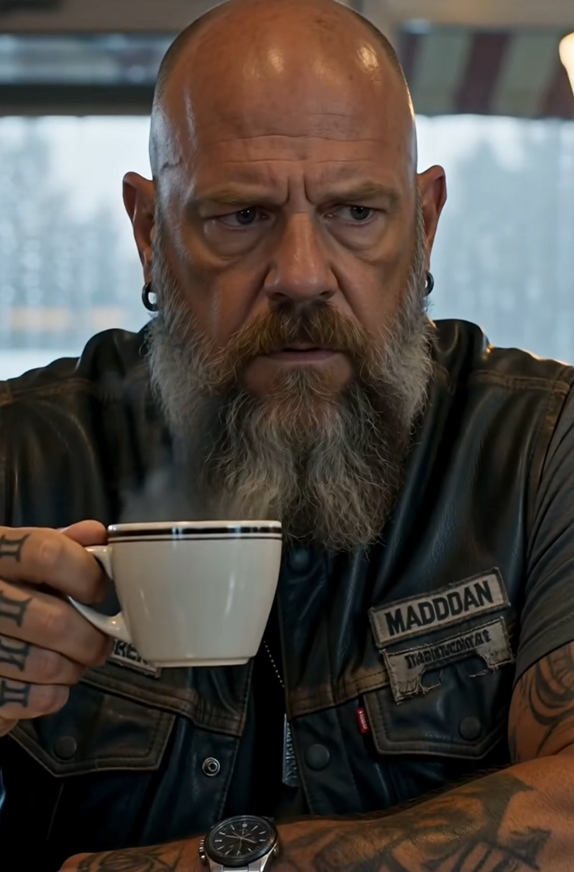
Then he looked at the houses lining Alder Lane.
Several neighbors were still outside.
Some looked ashamed.
Some looked shaken.
Some looked grateful in a useless, late way.
Colt did not lecture them.
He only let the bike idle long enough for every one of them to understand the silence they had kept.
The lesson did not need words.
Engines carried it better.
The convoy rolled out under clearing skies.
Sunlight struck the puddles along the curb, turning each one bright as broken glass.
The green house shrank behind them.
The porch, the truck, the curtains, the tidy shrubs, the false face of respectability all faded into the rearview mirrors.
But the morning did not fade from Willow Ridge.
By noon, Tess reopened the diner.
People came in quieter than usual.
The old man from booth four left a twenty under his coffee cup and did not order anything.
The cook cleaned the grill twice.
A woman from the pharmacy brought muffins no one had asked for.
Tess left Colt’s cup where it had been until the coffee went completely cold.
She did not know why.
Maybe because it marked the moment somebody chose action over comfort.
Maybe because every town needed an altar to the second everything changed.
Marcy and Liam did not return to that house that day.
They did not return the next day either.
Their story was not healed by one morning.
Fear does not vanish because engines roar once down a street.
Children do not forget the sound of a dangerous step just because safer footsteps arrive.
But something had shifted.
When Marcy sat later in a clean room with a blanket over her knees, she still held her sleeve.
Only now, when a woman asked if she wanted water, Marcy answered aloud.
When Liam woke from a nap and reached for Dewey, he found the stuffed dog tucked beside him.
When he asked where Marcy was, she was only across the room.
Close enough to see.
Close enough to believe.
That night, Tess received a call from the county worker.
The children were safe.
Temporary, yes.
Complicated, yes.
But safe.
Tess cried so hard she had to sit on the diner floor between the counter and the pie case.
The next morning, she washed Colt’s coffee cup herself and set it on the top shelf instead of putting it back in rotation.
Some objects stop being objects after the right kind of pain passes through them.
A cup.
A sleeve.
A patched toy dog.
A motorcycle key.
A diner stool.
A screen door.
A phone held on speaker while a powerful man finally ran out of rooms to hide inside.
Weeks passed.
Willow Ridge tried to become normal again.
Small towns are skilled at smoothing over the places where truth has ripped the wallpaper.
But this time, the seam showed.
Neighbors began talking.
Not gossiping, exactly.
Talking.
Mrs. Vale admitted she had heard shouting before.
Denton Bell admitted he had seen Liam sitting alone on the porch too late at night.
The pharmacy woman remembered Marcy buying bandages with coins.
The school secretary remembered excuses.
The difference was painful.
Not because one memory was enough.
Because all of them together were.
A community had failed in pieces.
It would have to repair in pieces too.
Colt did not come back for applause.
He hated applause.
But three Fridays after the rainstorm, he stopped at the diner near closing.
Tess saw the bike through the window and poured coffee before he reached the door.
This time, Marcy and Liam were not there.
That was good.
Children deserved lives that did not require dramatic entrances.
Colt sat at the same stool.
The cup was placed in front of him.
“Fresh,” Tess said.
He glanced at the top shelf, where the old cup sat.
“You keep trophies now?”
“Reminders.”
Colt nodded.
“Those can be heavier.”
Tess leaned on the counter.
“They ask about you.”
Colt wrapped both hands around the mug.
“Kids?”
She nodded.
“Marcy asked if men like you always stop for strangers.”
Colt stared into the coffee.
“What did you say?”
“I said not always.”
Tess’s voice softened.
“But the right ones do.”
Colt drank this time.
The coffee was too hot.
He drank it anyway.
Outside, Willow Ridge glowed under a clear evening.
The rain had washed the town weeks ago, but truth had done the harder cleaning.
Not finished.
Never finished.
But begun.
One month later, a drawing arrived at the diner in an envelope.
It was addressed in careful child lettering to The Biker Who Didn’t Drink His Coffee.
Tess called Colt before opening it.
He came alone.
Inside was a crayon picture of a diner, a line of motorcycles, two children, and a huge man with a beard standing beside a smaller stick figure.
Above them, in wobbly letters, Marcy had written, We are safe today.
Liam had added a brown shape beside them.
Dewey.
Colt stared at the drawing for a long time.
Tiny would later claim he saw Bear blink too much.
Wrench would deny seeing anything at all.
Red would say the room got dusty.
Gage would quietly frame a copy.
Colt folded the drawing carefully and placed it inside his vest, near the pocket where he kept his phone.
The same pocket he had tapped that morning when a child showed him the truth adults had avoided.
There are people who think justice must arrive wearing a uniform.
Sometimes it does.
There are people who think protection must speak softly and look harmless.
Sometimes it does.
But in Willow Ridge, on a rain soaked morning, justice arrived wearing leather.
It smelled like gasoline and coffee.
It came with scars, road names, discipline, and a code older than anyone in that diner wanted to understand.
It did not ask whether the town was comfortable.
It did not wait for permission from the man who had caused the fear.
It did not finish its coffee.
And because one little girl found the courage to lift her sleeve, a locked house opened, a boy stepped into sunlight, and a quiet town learned the cost of looking away.
Years later, people would still argue about the details.
Some would say there were ten bikes.
Others would swear there were twenty.
Some remembered thunder.
Some remembered silence.
Some remembered Raymond’s face when he realized the world had finally entered his house.
Tess remembered the coffee cup.
Marcy remembered the words.
No one’s going to hurt you here.
Liam remembered the engines.
Not as noise.
As a promise.
And Colt Matthews remembered the arm.
A child’s arm, shaking beneath diner lights, carrying the map of everything that had gone wrong.
He remembered setting down the cup.
He remembered the exact sound it made against the counter.
He remembered thinking that some mornings divide a life into before and after.
For Willow Ridge, that sound was the divide.
Before, people suspected.
After, they saw.
Before, a house at the end of Alder Lane hid behind trimmed shrubs and polite excuses.
After, its porch became the place where silence lost.
Before, Marcy thought showing the bruises might make things worse.
After, she learned that truth, when placed in the right hands, could become a door.
Before, Liam thought footsteps meant danger.
After, he learned some footsteps stop at the threshold and say no further.
That was the real ending.
Not the bikes leaving.
Not Raymond trembling.
Not the sirens or paperwork or the neighbor statements.
The real ending came quietly, in the days after, when two children began learning ordinary things again.
How to sleep without listening for anger.
How to laugh without checking a hallway.
How to ask for water without apologizing.
How to believe an adult might mean what they said.
Healing did not roar.
It breathed.
It came in small mornings, clean blankets, patient voices, and doors that stayed open.
But whenever Liam heard a motorcycle somewhere far off, he would stop and listen.
Marcy would too.
Not because they were afraid.
Because the sound reminded them of the morning someone believed them before the coffee cooled.
And somewhere on the highway, Colt Matthews rode with that crayon drawing folded inside his vest.
The paper wore soft at the edges over time.
The colors faded slightly.
The words stayed clear.
We are safe today.
For a man like Colt, that was more than thanks.
It was proof that presence could become protection.
It was proof that a single decision could break a chain.
It was proof that the world did not have to be kind everywhere to become kind somewhere.
And sometimes, somewhere is enough to save a child until tomorrow.
That was why, whenever Colt stopped for coffee after that, he always chose the stool near the door.
He watched who came in.
He watched who flinched.
He watched sleeves pulled too low and backpacks held too tightly.
He watched the adults who looked away too fast.
Most mornings, nothing happened.
Most mornings, he finished his coffee.
But on the mornings when someone needed him, the cup could wait.
It had waited before.
It would wait again.