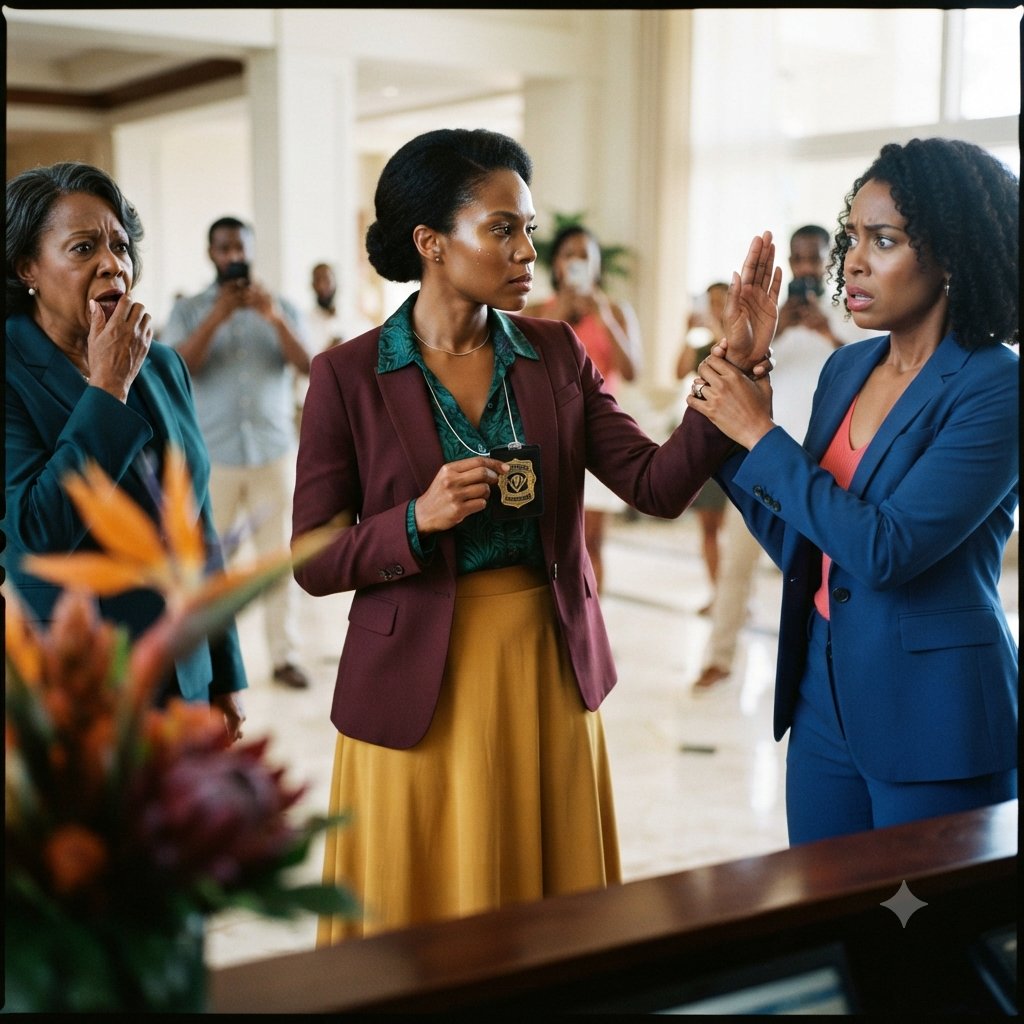
Damian was on the phone with Marcus before I finished reading the message.
"How long ago?" A pause.
"Which files — patient records or financial?" Another pause, longer.
"Don't let him leave the city."
He ended the call and stood very still for a moment in the way of someone deciding how much to say.
"Voss is trying to destroy the paper trail," he said.
"Can he?"
"The physical files, maybe.
But financial transfers leave records that don't disappear because a man panics and starts shredding." He picked up his jacket from the back of the chair.
"I need to go.
Marcus has someone at the clinic but I need to be there."
"I'm coming with you."
He looked at me.
"Nina—"
"She's my daughter," I said.
"Whatever is in those files is about me.
I'm coming."
He didn't argue.
Mrs.
Holt stayed with Leah.
The little girl watched me from the top of the stairs with her rabbit under her arm, and I looked up at her and said, "I'll be back soon."
She nodded once.
Solemn.
Certain.
The clinic was forty minutes away — a converted Victorian building set back from a quiet street, the kind of address that didn't advertise itself.
A brass plaque by the door.
A receptionist who looked up with practiced calm when we walked in and then looked at Damian and lost the calm immediately.
"Mr.
Caruso.
I — do you have an appointment—"
"Where is Dr.
Voss?"
"He's — he stepped out for a—"
"His car is in the lot," Marcus said from behind us.
He had materialized from somewhere without making a sound.
"He hasn't left the building."
Damian walked past the reception desk.
We found Voss in his office on the second floor.
He was standing at a shredder with a stack of folders.
He heard us in the doorway and turned, and his face did something that confirmed everything before a single word was spoken.
"Damian." His voice was measured.
Practiced.
The voice of a man who had talked his way through difficult rooms before.
"I wasn't expecting—"
"Stop the machine," Damian said.
Voss didn't move.
Marcus stepped forward and pulled the power cord from the wall.
The shredder wound down into silence.
Voss set the folders on his desk.
His hands were steady but his eyes were moving — to the door, to Marcus, to me.
"Who is this?" he said, looking at me.
"You know who I am," I said.
"You signed my daughter's d*ath certificate."
Something shifted in his face.
Not guilt.
Calculation.
"That was a very difficult night," he said.
"Tragic circumstances.
I understand you may have questions, but patient records are confidential and I'm not in a position to—"
"Dr.
Voss." Damian's voice was quiet.
That particular kind of quiet that people who have real power use when they no longer need volume.
"My attorney is filing a crjminal referral this afternoon.
The financial transfers between your clinic and the Caruso Foundation have already been pulled.
The witness who overheard your phone call with my mother has agreed to provide a statement."
Voss went very still.
"Mrs.
Holt," I said.
His jaw tightened.
"Whatever Vivienne told you," Damian continued, "she told you it was contained.
She was wrong.
So here is what happens next.
You can speak to my attorney voluntarily and provide a full account of what occurred on March fourteenth two years ago.
Or you can wait for the referral to move forward and explain to a prosecutor why you were shredding files this morning."
"You're making a serious accusation—"
"I'm describing what I can prove," Damian said.
"The accusation was made two years ago.
Against a woman who was told her child was d*ad.
That's the accusation that matters."
Voss looked at the folders on his desk.
Then at the shredder.
Then at me.
"I want immunity," he said.
"That's not my offer to make," Damian said.
"But cooperation tends to matter.
You know that."
Voss sat down slowly in his chair.
"Elena's baby d*ed," he said.
"That was real.
I want that on record first."
"Noted," Damian said.
"Vivienne came to me that night.
She had seen both women's files.
She knew the situation — one mother gone, one baby gone, one baby alive, one mother alone with no support." He paused.
"She said it was the most humane solution.
That the child would have a family, resources, a future.
She made it sound almost reasonable."
"And the money made it sound completely reasonable," I said.
He didn't deny it.
"She handled the paperwork herself," he said.
"I signed where she told me to sign.
I told myself the outcome was the same — the child was alive and cared for."
"You told a mother her baby d*ed," I said.
"You looked at me in that hospital room and you told me she was gone."
Voss looked at his desk.
"Yes," he said quietly.
"I did."
The word sat in the room like something that couldn't be taken back.
Because it couldn't.
Damian's phone rang.
He glanced at the screen.
"It's my attorney." He stepped into the hallway to take it.
I stood in the office alone with the man who had signed my daughter's d*ath certificate, and I didn't say anything else, because there was nothing left to say to him that the next few months wouldn't say more permanently.
When Damian came back, his expression had changed.
"Vivienne just called Daniel's office," he said.
"She's hired her own attorney."
"She's going to fight this."
"She's going to try." He looked at me steadily.
"She doesn't know about Mrs.
Holt yet.
And she doesn't know we have the financial records."
He looked at Voss.
"Write it down," he said.
"Everything.
Tonight.
My attorney will contact you in the morning."
We left Voss sitting at his desk with the unplugged shredder beside him and the folders still in his hands.
In the car, I looked out the window and said nothing for a long time.
"She's going to say she did it out of love," I said finally.
"Yes," Damian said.
"She will."
"Will anyone believe her?"
He considered that for a moment.
"Some people will want to," he said.
"That's different from believing her."