Part I — The Stop
The first thing Major General Sarah Reynolds noticed was not the flashing blue light in her mirror.
It was the time.
3:31 p.m.
She glanced once at the dashboard clock, then eased the rented sedan toward the shoulder of Route 119.
Twenty-nine minutes until the secure briefing.
Enough time, she thought.
A routine traffic stop. License. Registration. A warning, maybe a citation. Five minutes, ten at worst.
Sarah had spent most of the previous seventy-two hours inside the Pentagon coordinating a Department of Defense logistics operation whose details had been discussed in rooms where personal phones were not allowed and names were sometimes replaced by function codes on briefing sheets. She had slept in fragments, eaten standing up twice, and spent the early part of Friday morning watching senior officers argue over transportation windows measured in minutes.
She knew what pressure looked like.
A deputy approaching her rental car on a quiet Georgia highway did not qualify.
Not yet.
Sarah lowered the window and placed both hands where they could be seen on the steering wheel.
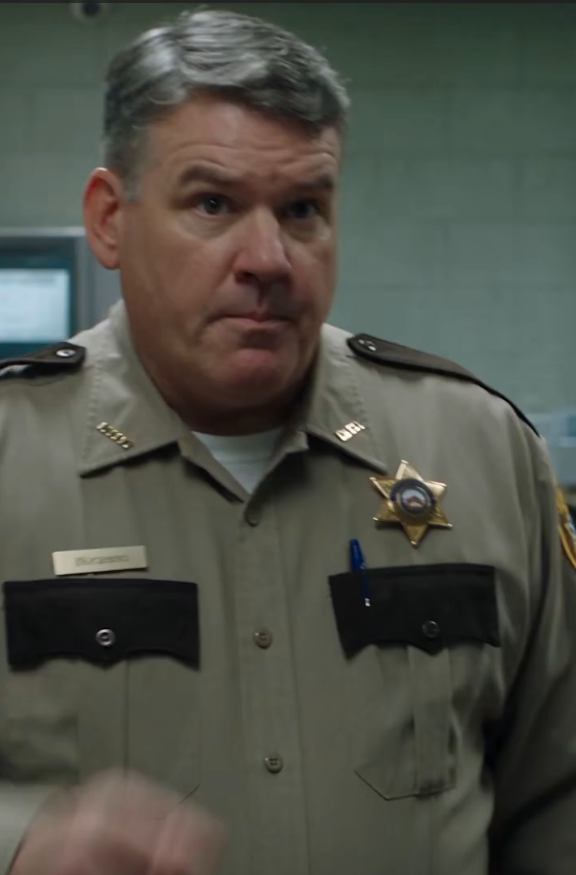
The deputy stopped beside the rear door before moving forward. Young enough that his uniform still looked stiffer than he did. Narrow face. Sunglasses. Badge.
Sarah read the number.
She remembered it.
“License and rental agreement.”
No greeting.
Sarah handed them over.
The deputy looked at the license, then at her.
“Where you headed?”
“To visit family outside Savannah.”
“You been drinking?”
“No.”
“Medication?”
“No.”
“You know why I stopped you?”
“I don’t.”
“You crossed the center line.”
Sarah considered correcting him.
She had not crossed the center line. She knew that because she had been watching the road carefully while dictating mental notes for Monday’s schedule. But she also knew roadside arguments rarely improved roadside stops.
“I understand.”
The deputy glanced into the passenger compartment.
There was nothing remarkable inside. A leather overnight bag. A light jacket. A paper coffee cup. A government-issued secure phone powered off and stored in Sarah’s travel case.
“Sit tight.”
He walked back toward his cruiser.
Sarah watched him in the side mirror.
She had learned years ago that memory was unreliable under stress unless you gave it structure.
Time.
Badge number.
Position.
Words.
She repeated them silently.
3:31.
Route 119.
Center line.
No alcohol.
No medication.
The deputy remained in his cruiser longer than expected.
Sarah checked the clock again.
3:37.
Twenty-three minutes.
She picked up her civilian phone, saw no missed calls, then set it back down.
At 3:40 another vehicle arrived.
It was not another patrol cruiser.
It was a sheriff’s vehicle.
The man who stepped out moved with the unhurried confidence of someone accustomed to watching conversations change when he entered them.
Sheriff Thomas Ryker.
Sarah did not know his name yet.
She noticed his badge first.
Then his face.
Late fifties, maybe. Thick through the shoulders. Sun-reddened skin above the collar. A mouth that looked almost amused before anything funny had happened.
Deputy Jared Miller met him behind Sarah’s car.
They spoke too quietly for her to hear clearly.
Sarah watched the angle of their bodies in the mirror.
Miller gestured toward her vehicle.
Ryker glanced directly at Sarah.
Then smiled.
He walked toward her window.
“You Sarah Reynolds?”
“Yes.”
“Step out of the car.”
“Can you tell me why?”
His smile remained, but something behind it hardened.
“Because I told you to.”
Sarah looked at the dashboard clock.
3:42.
She unfastened her seat belt.
“All right.”
She stepped onto the shoulder.
Heat pressed against her immediately. The white blouse she had put on that morning after barely four hours of sleep suddenly felt too formal for the road and too informal for the situation.
Ryker pointed toward the rear of the vehicle.
“Stand over there.”
She complied.
He studied her in the way some people studied an object they had already decided was suspicious.
“You give my deputy trouble?”
“No.”
“Miller says you were argumentative.”
Sarah looked toward the deputy.
Miller’s expression did not change.
“I answered his questions.”
“That so?”
“Yes.”
Ryker glanced at the car.
“Pop the trunk.”
Sarah paused.
“For what purpose?”
“There it is.”
“What?”
“The attitude.”
Sarah said nothing.
Ryker stepped closer.
“You people come through here, think because you’re from somewhere else you can tell us how to do our jobs.”
Sarah registered the phrase.
You people.
She did not respond to it.
Instead she said, carefully, “Sheriff, I’m happy to cooperate with lawful instructions. I do not consent to a search of the vehicle.”
The smile left his face.
Miller shifted his weight behind him.
Ryker stared at her for several seconds.
“You got something in there?”
“No.”
“Then why not let us look?”
“Because I’m not consenting to a search.”
“You a lawyer?”
“No.”
“You sure talk like one.”
Sarah had stood in rooms with combatant commanders, cabinet officials, congressional staff, contractors responsible for billions of dollars in equipment, and young lieutenants terrified they had just ended their careers.
Tone was information.
Ryker’s tone told her the traffic stop had changed.
Sarah let her arms hang loose at her sides.
“I’m not trying to interfere with you.”
“You already are.”
“How?”
Ryker stepped closer again.
“I told you to open the trunk.”
“And I said I don’t consent to a search.”
He laughed once without amusement.
Then he looked at Miller.
“See?”
Miller said nothing.
Ryker turned back to Sarah.
“Turn around.”
Sarah did not move immediately.
“For what?”
“I said turn around.”
“Am I being detained?”
“You’re about to be arrested if you keep this up.”
“For what offense?”
Ryker’s face changed.
Not much.
A small tightening around the mouth.
Sarah recognized it. Not anger exactly. Offense.
He was not accustomed to being asked to identify his authority before using it.
“I’m done asking.”
Sarah turned around.
The metal cuffs closed around her wrists.
Too tight.
She looked down at the asphalt.
3:46, she estimated.
She heard Miller say something about disorderly conduct.
Then Ryker added, “Resisting.”
Sarah turned her head slightly.
“I have not resisted you.”
Ryker leaned close enough that she could smell coffee.
“You want another charge?”
Sarah faced forward again.
“No.”
“Good decision.”
He guided her toward the sheriff’s vehicle.
Sarah did not tell him she was a major general.
She did not tell him where she worked.
She did not tell him that at four o’clock, officers and civilian officials in a secure Pentagon conference room would be expecting her voice on a classified connection.
The thought occurred to her.
It would have been easy.
One sentence.
Sheriff, I’m Major General Sarah Reynolds, United States Army.
She watched Miller open the rear door.
No.
Her rank should not determine whether a deputy invented an offense.
Her stars should not transform unlawful behavior into lawful behavior.
If Ryker would treat a tired woman in jeans differently after learning she wore two stars on another day, that was not protection.
It was evidence.
Sarah lowered herself into the vehicle.
Before Miller closed the door, she said, “Deputy.”
He hesitated.
“I want the record to reflect that I asked the reason for the arrest, that I did not consent to a search, and that I did not physically resist.”