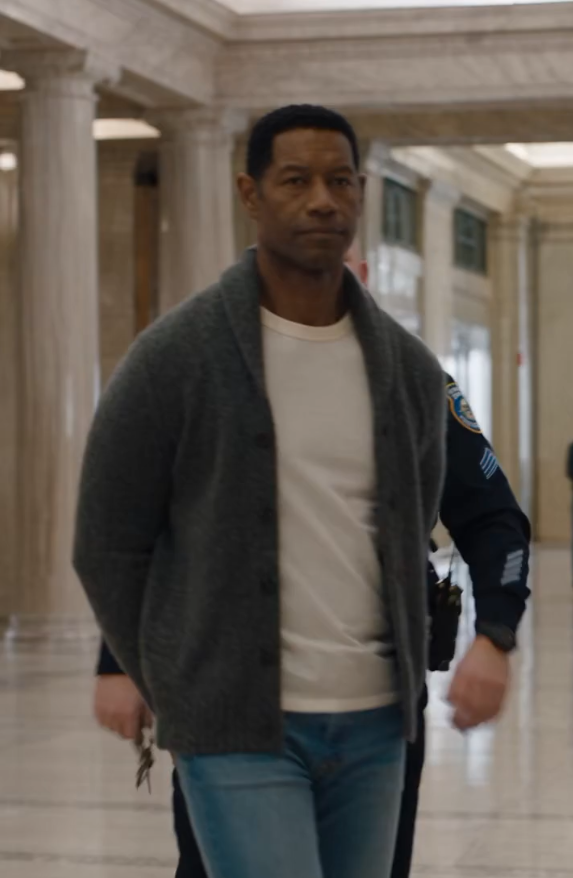
Two residents studied a directory.
An officer helped an elderly woman place her purse on the security belt.
Nothing about the space looked historic.
Maybe that was fitting.
The point had never been to turn the pillar into a monument.
Months earlier, Khloe had jokingly suggested putting a plaque on it.
MAYOR'S FIRST CONTACT WITH MUNICIPAL GOVERNMENT.
I told her absolutely not.
She said history needed humor.
I told her history needed fewer plaques.
Now I touched the stone with the tips of two fingers.
Cold.
Smooth.
Unchanged.
My phone buzzed.
Khloe.
WHERE ARE YOU?
I typed:
Lobby.
Three dots appeared immediately.
YOU HAVE A MEETING.
I answered:
Coming.
Then another message.
AND YOU'RE WEARING A SUIT TODAY, RIGHT?
I looked down.
Navy suit.
White shirt.
No coffee stains.
I typed:
Yes.
Her response:
Miracles happen.
I slipped the phone away.
At the security station, Miller—now officially a sergeant—was speaking with a new officer.
The officer had stopped a young Black man wearing a delivery jacket.
I slowed.
The young man was explaining that he had a package for the executive floor.
The new officer asked for his identification.
He provided it.
Then the officer checked the delivery manifest.
Routine.
Professional.
No assumptions.
No performance.
Miller stood several feet away and watched without interfering.
The young man was cleared.
“Elevators are on your right,” the officer said.
“Thanks.”
He picked up the package and walked past me.
Neither he nor the officer recognized me.
I smiled.
That felt strangely important.
I continued toward the elevators.
A year and a half earlier, I had believed the most powerful moment of that morning was when Jenkins opened the council chamber doors and discovered who I was.
I had been wrong.
The revelation had been satisfying.
Almost cinematic.
The room waiting.
The chief's face.
The cuffs coming off.
But power was not measured by how fast the rules changed when someone discovered they had mistreated the mayor.
Power was measured by whether the rules protected the person whose name nobody knew.
I pressed the elevator button.
Behind me, the security line kept moving.
No shouting.
No phones raised.
No one pressed against marble.
Just people entering a public building to conduct public business.
The doors opened.
Before stepping inside, I looked once more across the lobby.
For months, people had asked me what I wished I had said to Jenkins when he told me he was taking me into the council chamber.
They liked the idea that I had known some perfect line.
Something devastating.
Something worthy of a movie.
The truth was simpler.
I had almost smiled because, for the first time that morning, I knew exactly what was about to happen.
He thought he was marching a stranger toward humiliation.
I knew he was walking himself toward accountability.
But standing there now, watching the ordinary morning unfold, I understood something I had not understood then.
The real victory was not that everyone in that chamber had been waiting for me.
It was building a city where the next person would not need anyone waiting for him at all.