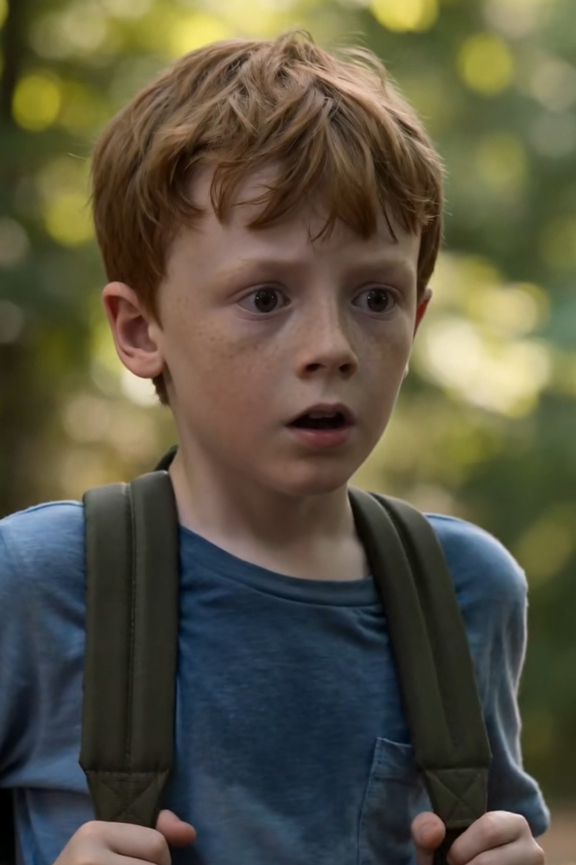
AN 8-YEAR-OLD FOUND A BIKER’S WIFE CHAINED TO A TREE – WHAT HE DID NEXT MADE 3,000 RIDERS ROLL INTO HIS TOWN
They said the boy should have run.
They said no child with sense would walk toward a stranger crying for help in the Tennessee woods.
They said no eight-year-old should have gone anywhere near a woman chained to an oak tree, bleeding through torn leather, wearing the red and white colors that made grown men look away.
But Colt Whitmore was not thinking about motorcycle clubs.
He was not thinking about danger.
He was not thinking about the kind of men who might still be hiding among the pines, waiting to see whether their message had been received.
He was thinking about one thing.
His grandmother had told him never to leave someone hurting if he could help it.
So when that broken voice drifted through the trees behind Sycamore Hollow, Colt did not run.
He stepped closer.
That one step would shake a motorcycle brotherhood to its bones.
Within forty-eight hours, 3,000 riders would thunder into a town that had never seen more than a tractor parade.
And years later, when people asked what really happened in those woods, the answer was never about gangs or revenge or fear.
It was about a little boy, a wounded woman, and the moment courage stood still while the rest of the world would have run.
Sycamore Hollow was the kind of town people forgot unless they were born there.
It sat folded into the hills of eastern Tennessee, tucked between fields, creeks, and old logging roads that had not felt heavy truck tires in decades.
The population sign said 812, though folks joked that depended on who had died, who had moved, and who had come home after Nashville broke their heart.
Main Street was four blocks long.
There was a hardware store with sun-faded signs in the window.
There was a diner called Petton’s, where the Thursday meatloaf tasted the same because Mrs. Petton refused to let anyone change her mother’s recipe.
There was one stoplight.
After nine at night, it blinked yellow because nobody had the patience to wait at a red light when there was not another car for half a mile.
People in Sycamore Hollow liked saying nothing ever happened there.
They said it with pride.
They said it with relief.
They said it the way people say prayers, hoping the words themselves might keep trouble away.
Colt Whitmore had lived all eight years of his life inside that quiet.
He lived with his grandmother, Opal, in a white farmhouse on Willow Creek Road.
The porch leaned on one side.
The paint had faded to the color of old bones.
The roof complained during storms.
But the garden grew strong every summer, and the kitchen always smelled of biscuits, coffee, and something sweet cooling on the counter.
To Colt, that was home.
His mother had left when he was three.
She had packed one bag, kissed him while he slept, and driven toward a life that never had room for him again.
His father was nothing but a name written on a birth certificate and spoken rarely.
That left Opal.
Opal Whitmore was sixty-seven years old, small in body, iron in spirit, and softer than she wanted anyone to know.
She taught Colt to tie his shoes.
She taught him to say his prayers.
She taught him to look people in the eye when he spoke.
Most of all, she taught him two rules.
Do not lie.
Do not leave someone hurting if you can help it.
Colt heard those rules so often they became part of him.
They were in the way he shared his lunch with kids who forgot theirs.
They were in the way he returned lost change to Mrs. Petton.
They were in the way he stopped on the road to move turtles out of the path of pickup trucks, even when Opal scolded him for making her late.
He was not a perfect boy.
He forgot chores.
He tracked mud through the kitchen.
He once put a frog in the laundry basket and nearly sent his grandmother through the ceiling.
But he had a tender streak that made Opal both proud and frightened.
Tender people got hurt.
Opal knew that better than anyone.
That Tuesday afternoon in late August, the heat lay over Sycamore Hollow like a wet quilt.
The grass had gone brittle at the edges.
Cicadas screamed from the trees in waves.
The air smelled of dust, blackberries rotting on the vine, and the faint metallic promise of a storm that never came.
Colt sat on the back porch with his beagle, Sergeant.
Sergeant was a ridiculous dog with floppy ears, short legs, and a bark that sounded like a yodel.
He had been Colt’s shadow since puppyhood.
Where Colt went, Sergeant followed.
When Colt cried, Sergeant laid his head on his knee.
When Colt laughed, Sergeant wagged so hard his whole body twisted sideways.
That afternoon, Colt threw a tennis ball across the yard.
Sergeant chased it with heroic seriousness.
He brought it back covered in spit, dropped it at Colt’s feet, and barked like the fate of the world depended on one more throw.
Colt threw it again.
Then again.
On the seventh throw, the ball hit a root, bounced sideways, rolled beneath the fence, and vanished into the tall grass beyond the property line.
Sergeant shot after it.
He squeezed under the fence with the confidence of a dog who had never considered consequences.
Colt waited.
The grass waved.
No dog returned.
“Sergeant,” Colt called.
Nothing.
He called again, louder this time.
The woods answered with cicadas and silence.
Colt glanced toward the kitchen window.
Opal was inside, probably resting with a crossword puzzle and a glass of sweet tea.
He knew she would tell him not to go past the fence alone.
He also knew Sergeant was the kind of dog who would follow his nose to Kentucky if nobody stopped him.
Colt climbed the fence and dropped into the weeds.
The old logging trail began beyond a strip of wild grass.
It wound through the woods toward Miller’s Creek, where timber men had dragged oak and pine before Colt’s grandfather was even old.
Nobody used it anymore.
Trees had reached across the trail, knitting their branches together until the path felt like a green tunnel.
Colt had walked it before.
He knew the exposed roots, the muddy bend, the flat stone that looked like a sleeping turtle.
But that day the woods felt wrong.
The shade was too deep.
The air beneath the trees felt still and listening.
“Sergeant,” he called.
His voice came back thin.
He followed the trail until it curved left, dipped, and opened into a clearing.
At the center stood an enormous oak tree.
Its trunk was so wide three grown men could not have circled it with their arms.
Its limbs twisted outward like the arms of something ancient and watchful.
Colt stopped because he heard a sound that did not belong.
At first, he thought it was wind pushing through hollow bark.
Then it came again.