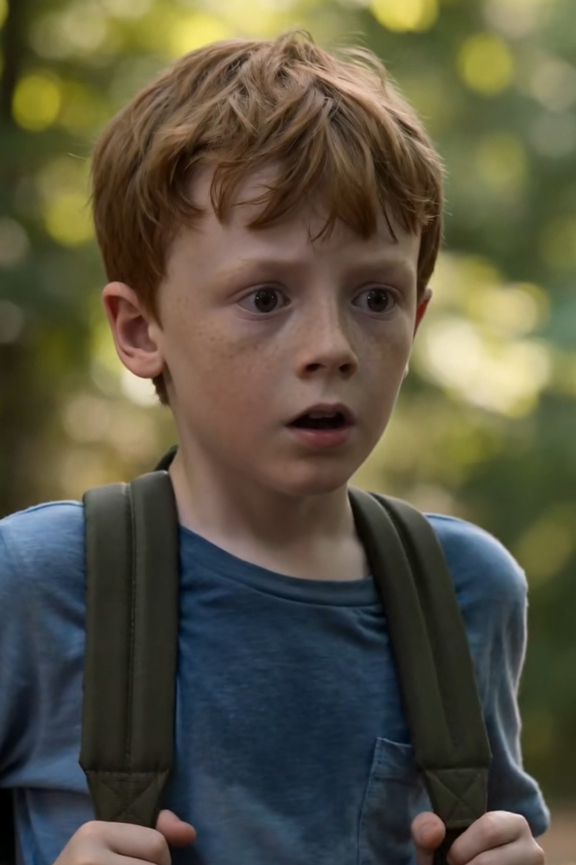
Colt finally whispered, “Is everyone okay?”
Ren stared at him.
Even now, after gunfire and terror, his first thought was everyone else.
“Some of our friends got hurt,” she said honestly.
“But everyone from your town is safe.”
Colt nodded.
Then he looked at her.
“You covered me up.”
“Like I was your kid or something.”
Ren’s throat tightened.
“You held my hand when I was scared.”
“In the woods.”
“When I thought I was going to die.”
She pulled him close.
“Now I got to hold yours.”
The next morning, the riders prepared to leave.
This time, the town did not hide.
People stood on porches and sidewalks.
Mrs. Petton handed out coffee.
Chief Morrison stood with his firefighters.
Dr. Hargrove came out with her clinic staff.
Children held signs at the school fence.
Thank you.
Come back soon.
We remember.
The convoy stopped at Colt’s farmhouse.
He stood on the porch in his vest with Opal’s hand on his shoulder.
Silas climbed the steps and knelt again.
In his palm was a brass shell casing Colt had picked up near the stage and given him after the attack.
“So you remember too,” Colt had said then.
Silas held it now.
“I’ll carry this for the rest of my life.”
“What does it mean?” Colt asked.
Silas closed his fist around it.
“It means courage doesn’t have an age.”
“It means doing right does not require being big or strong.”
“Sometimes the bravest thing you can do is walk toward someone who is hurting when everyone else is running away.”
Ren stepped forward.
Her face was still bruised, but her eyes were clear.
“What you did for me was not about debts,” she told Colt.
“You helped me because I needed help.”
“That is everything.”
She pressed a card into his hand.
“There is a number on there.”
“If you ever need anything, you call.”
Colt looked at it.
“What if I just want to say hi?”
Ren smiled for real.
“Then call and say hi.”
Every rider saluted Colt as they passed the farmhouse.
He waved until his arm hurt.
He stayed on the porch until the last motorcycle disappeared around the bend.
Then Sycamore Hollow was quiet again.
But quiet did not mean unchanged.
In the weeks that followed, the playground became the heart of town.
The fire department’s new equipment saved a family from a kitchen fire three weeks later.
Dr. Hargrove’s new diagnostic tools caught a heart condition in an elderly patient before it killed him.
The remaining money became the Colt Whitmore Fund for Community Improvement.
It paid for scholarships, medical bills, emergency repairs, and quiet help for people too proud to ask.
The Iron Cobras did not recover.
Federal prosecutors had already been building cases.
The attack gave them witnesses, evidence, and public outrage.
Members were indicted.
Several pleaded guilty.
By winter, the organization that had tried to make fear its language had been broken by a town that chose protection instead.
In early October, a bronze plaque appeared at the fairgrounds.
No one saw who installed it.
No one admitted paying for it.
But everyone knew.
The words were simple.
Courage isn’t loud.
It stands still when others run.
In honor of Colt Whitmore and the people of Sycamore Hollow, who reminded us what it means to help without asking why.
Colt stood before the plaque with Sergeant at his feet and Opal’s hand on his shoulder.
“Is this because of me?” he asked.
Opal squeezed him gently.
“It’s because of what you did.”
“It’s because of who you are.”
Colt read the words again.
“I wasn’t trying to be brave.”
“I was just trying to help.”
Opal smiled.
“That’s the only kind of brave that matters.”
Years passed.
Sycamore Hollow grew.
A second stoplight appeared.
A new grocery store opened.
Mrs. Petton kept serving meatloaf on Thursdays.
The clinic saved more lives.
The fire station grew stronger.
And every year on the anniversary of the attack, motorcycles came.
Not three thousand.
A dozen.
Sometimes twenty.
They arrived at dawn, fixed fences, painted buildings, repaired roofs, helped strangers, and left before sunset.
They never asked for thanks.
Colt always came to greet them.
As he grew taller, the vest began to fit.
Honorary Guardian.
Courage Before Fear.
On Colt’s eighteenth birthday, a package arrived at the farmhouse.
No return address.
Inside was a worn leather journal filled with handwriting from riders across the country.
The first page read.
For Colt.
These are stories from the road.
Some happy, some sad.
All true.
We wanted you to know what your courage meant to us.
Not just on that day, but every day since.
Ride safe wherever you go.
The Brotherhood.
Colt read every page.
There were stories from men who had wanted to fight but chose to protect.
Men who had wanted to walk away but stayed.
Men who had remembered a boy in Tennessee and done the right thing when nobody was watching.
Colt started adding his own stories.
Helping a stranger change a tire.
Standing up for a bullied kid.
Sitting beside Opal when she got sick and holding her hand through long hospital nights.
Small courage.
Quiet courage.
The kind nobody filmed.
Opal passed away on a spring morning years later, when the sycamores were blooming.
Colt was twenty-three.
The whole town came to her funeral.
So did twelve motorcycles.
The riders stood outside the cemetery gates, heads bowed, not intruding.
After the service, Colt walked to them.
Silas had aged.
His hair was gray now.
Ren stood beside him, strong and steady.
“She died knowing what you became,” Ren said.
“That’s the best gift any grandmother can receive.”
Colt nodded.
“She taught me everything.”
Silas reached into his vest and pulled out the shell casing.
The brass had worn smooth from years of handling.
“I told you I’d carry it for the rest of my life,” he said.
“But I think it belongs with you now.”
He placed it in Colt’s palm.
“Pass it on when someone needs to remember.”
Colt closed his fingers around it.
“What about you?”
Silas touched his chest.
“I don’t need the reminder anymore.”
“I carry it here.”
Then he touched his temple.
“And here.”
The motorcycles left after the reception.
Colt stood on the same sagging porch where he had stood as a child and listened to the engines fade into the hills.
Sergeant was gone by then.
A rescue mutt named Scout sat at his feet, floppy-eared and ridiculous in her own way.
Colt slipped the shell casing into his pocket beside his heart.
He would carry it for the rest of his life.
The plaque still stands at the Sycamore Hollow Fairgrounds.
Weather has darkened it.
Time has softened its edges.
But the words remain clear.
Courage isn’t loud.
It stands still when others run.
Tourists sometimes come looking for the oak tree, the stage, the places where people hid, bled, prayed, and survived.
The locals point them kindly.
But they know the real story is not in the landmarks.
It is in the fire station still saving lives.
It is in the clinic still treating people with equipment paid for by men society feared.
It is in the playground where children laugh without knowing who built the swings.
It is in the fund that still helps families in quiet trouble.
It is in the annual riders who arrive before dawn and leave before praise can catch them.
And it is in Colt Whitmore.
He became a paramedic.
Then a firefighter.
Then chief of the Sycamore Hollow Volunteer Fire Department.
He married a woman who loved his kindness more than his legend.
He had children who knew their father was special, though not all the reasons why.
He walked the old logging trail often with Scout at his side.
Past the bend.
Past the creek.
Past the massive oak where one frightened boy heard a wounded woman whisper for help.
Sometimes, when the hills turned gold at sunset and the wind moved through the sycamores, Colt heard motorcycle engines in the distance.
Sometimes it was only traffic.
Sometimes he could almost hear three thousand of them.
Roaring once.
Falling silent.
Roaring again like a heartbeat.
Like a promise.
Like men who had sworn never to forget a boy who did not run.
Whenever he heard it, Colt touched the shell casing in his pocket.
And he smiled.
Because courage is not loud.
It does not need to be.
It just stands still when others run.
And sometimes that is enough to change everything.