Part I — Disruption
The flashing blue lights reflecting off the rearview mirror were a statistical inevitability. Major General Sarah Reynolds had spent three decades engineering supply chain logistics for the Department of Defense; she understood the metrics of probability better than anyone in Washington. A Black woman driving a late-model rental car with out-of-state plates on a rural stretch of Georgia’s Route 119 on a Friday afternoon was a variable that frequently triggered an established pattern.
She pulled onto the gravel shoulder, placing the vehicle in park. At forty-eight, she had spent the last seventy-two hours untangling a critical defense contract failure. She was exhausted, dressed in simple denim and a crisp white blouse, and looking forward to an evening on her aunt’s porch outside Savannah.
In the side mirror, Deputy Jared Miller approached. He kept his right hand resting casually on his duty belt.
"License and registration," Miller said, leaning down to her window.
Sarah handed him the documents. "Is there a problem, Officer?"
"You crossed the center line back by the mile marker."
"I see." She had maintained a flawless trajectory, but arguing the point on the shoulder of a highway was a tactical error. She remained perfectly still, her hands at ten and two on the steering wheel.
Before Miller could return to his cruiser, a heavy SUV pulled up behind him. Sheriff Thomas Ryker stepped out. He moved with the slow, deliberate swagger of a man whose authority had never encountered a hard boundary. Ryker adjusted his belt, stepping up to the driver's side window. He leaned in close enough that Sarah could smell stale coffee and wintergreen.
"Deputy says you were swerving, ma'am. Step out of the vehicle."
"I am perfectly sober, Sheriff, and I do not consent to a search of my vehicle," Sarah said, her voice even and modulated.
Ryker’s eyes narrowed. The subtle shift in his posture communicated everything she needed to know. It wasn't about the center line anymore. It was about compliance. "I didn't ask for your consent. I told you to step out. We don't take kindly to attitude in Oak Haven."
She stepped out. She did not raise her voice. She did not explain that she commanded tens of thousands of personnel, or that she carried a Top Secret clearance. Her military rank was irrelevant; the Constitution was supposed to be the only shield required.
Ryker misread her silence as insolence. "Turn around."
The cold steel of the handcuffs snapped shut around her wrists.
Part II — Pressure
The booking area of the Oak Haven Sheriff's Office smelled of floor wax and old sweat. Sarah sat perfectly still on the wooden bench, her mind operating like a flight recorder.
She cataloged the environment: the peeling paint on the ceiling, the specific make and model of the property lockbox on the counter, and the placement of the three dome security cameras. One above the entrance, one pointed at the booking desk, and one angled directly down the holding cell corridor. The red LED lights on all three were steady. They were recording.
"Disorderly conduct," Ryker dictated to the dispatcher, Brenda Lawson. "Resisting an officer. Let's add reckless driving. She was a hazard on the road."
Brenda typed lazily. "Got it."
"I would like to speak with an attorney," Sarah said.
Ryker ignored her, tossing her belongings onto the counter. Her leather purse, a set of keys, her civilian iPhone, and a bulky, matte-black device that looked like a heavy-duty smartphone but lacked a commercial logo. Ryker shoved it all into a clear plastic property bin.
"You get a phone call when I say you get a phone call," Ryker said, grabbing her by the bicep. He marched her down the hallway.
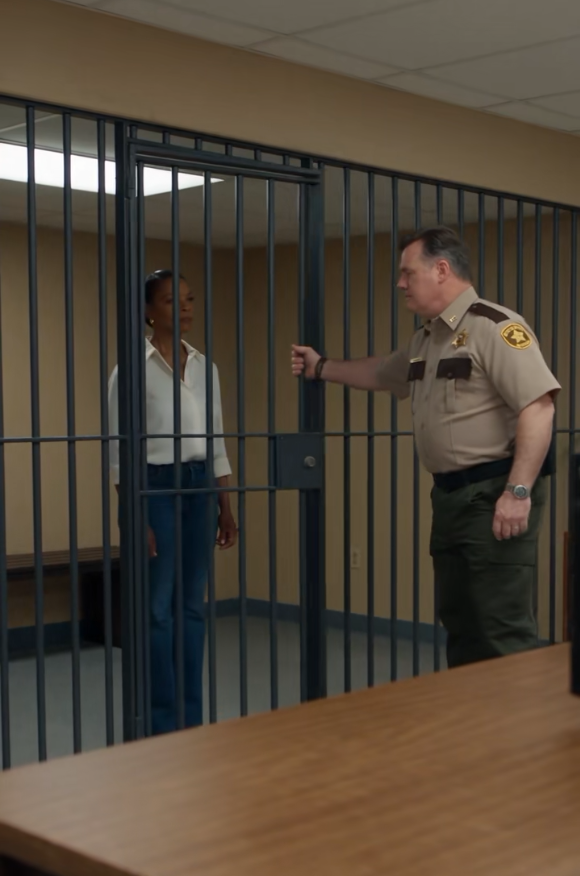
Cell four was a concrete box with a single metal bench. The door slammed shut with a heavy, metallic finality. Ryker stood on the other side of the bars, smirking.
"You can sit in there and think about your tone," he said.
Sarah met his gaze. She didn't look away, and she didn't blink. Ryker held the stare for a few seconds before breaking contact, suddenly uncomfortable with the absolute lack of fear in her eyes. He turned and walked away.
Alone in the cell, Sarah closed her eyes and began constructing her timeline. It was 3:45 PM. She was scheduled to lead a secure teleconference from her encrypted device at 4:00 PM. She knew her executive officer, Colonel David Hayes. Hayes was not a man who tolerated missing pieces.
Part III — Reversal
At the front desk, the next ten minutes passed in the mundane silence of rural law enforcement. Ryker sat at his desk, boots propped up, sipping a fresh cup of coffee. Brenda scrolled through her phone.
Inside the property box on the counter, the matte-black phone vibrated silently. It didn't ring. It flashed a solid, bright amber light—the Department of Defense's highest-priority secure channel indicator. It flashed for exactly two minutes before going dark.
Three minutes later, the main station phone rang.
Brenda picked it up without looking away from her monitor. "Oak Haven Sheriff."
"This is Colonel David Hayes, United States Army, calling from the Pentagon," a sharp, perfectly enunciated voice said. "Am I speaking to the Oak Haven dispatch center?"
Brenda paused, her thumb freezing over her smartphone screen. She sat up straighter. "Uh, yes. Who is this?"
"I need to speak with the commanding officer on duty. Immediately."
Brenda placed one hand over the receiver. The boredom had completely disappeared from her face. She swallowed hard, turning toward the sheriff's office. "Sheriff."
Ryker hardly glanced up. "What is it?"
"There's a colonel calling from the Pentagon. He's asking to speak with Major General Sarah Reynolds."
Ryker froze. His boots slid off the desk, hitting the floor with a dull thud. For the first time that afternoon, the arrogant confidence evaporated from his features. He stared at Brenda. "Who did he ask for?"
"Major General Sarah Reynolds." Brenda’s voice trembled slightly. "He says her secure tracker is pinging from inside this building."
Ryker stood up, the coffee sloshing over the rim of his mug onto his papers. He walked slowly to the dispatch desk and took the receiver.
"This is Sheriff Ryker."
"Sheriff," Colonel Hayes said, his voice stripped of any conversational warmth. "On what lawful grounds are you holding the general?"
Part IV — Reckoning
Ryker looked up. His eyes darted to the clear plastic property bin on the counter. Then, slowly, his gaze drifted upward to the black dome of the security camera mounted above Brenda’s desk.
"There's been a misunderstanding," Ryker stammered. "We pulled over a civilian vehicle. The driver was erratic. She was uncooperative."
"Is she injured?" Hayes demanded.
"No. She's in holding."
"Are her restraints still on?"
Ryker swallowed. "No." A lie. He hadn't removed the handcuffs.
"I am deploying federal liaisons from Fort Stewart. They will be at your location in exactly twenty-two minutes," Hayes said. "Do not touch her belongings. Do not turn off your cameras. We are logging your local network feeds right now."
The line clicked dead.
Ryker stood in the quiet lobby. The red lights on the security cameras suddenly seemed blinding. He realized with a sickening drop in his stomach that the woman in cell four hadn't been acting out of fear, or even defiance. She had been taking notes. She had let him dig his own grave, perfectly aware that every false charge he dictated to Brenda was being permanently recorded.
He grabbed the keys from his belt and sprinted down the hallway.
Part V — Final Confrontation
Ryker arrived at cell four breathless. He jammed the key into the lock, throwing the heavy iron door open.
Major General Sarah Reynolds sat exactly where he had left her. Her hands were still cuffed behind her back. She looked up at him, her expression entirely unchanged.
"Ma'am, there's been a mix-up," Ryker said, his hands shaking slightly as he reached behind her to unlock the cuffs. "We're going to get this straightened out. You should have told me who you were."
The cuffs fell away. Sarah brought her hands forward, rubbing her wrists slowly. She stood up. The physical space of the small cell suddenly seemed entirely dominated by her presence.
"My identity is not the prerequisite for my civil rights, Sheriff," Sarah said quietly.
"I'm willing to drop all the charges," Ryker offered, stepping back to give her room. "We can expunge the arrest record right now. You can take your things and go. No harm, no foul."
Sarah stepped out of the cell. She looked at the camera positioned at the end of the corridor.
"You did not arrest me for erratic driving," she said, her voice echoing slightly in the concrete hall. "You arrested me because I did not shrink when you spoke to me. You fabricated three separate charges to justify an unlawful detention."
"Now wait just a minute—"
"Deputy Miller’s badge number is 442. Yours is 001. Dispatcher Lawson entered the charges at exactly 3:51 PM. You denied my request for counsel at 3:52 PM." Sarah stepped closer to him. Ryker actually took a half-step backward. "You believe your authority is absolute because you operate in a vacuum. You are no longer in a vacuum."
"I was doing my job," Ryker said defensively, though the bluster was completely gone.
"Your job is finished," Sarah replied. "Federal investigators will be here shortly. They will pull the audio and video from the lobby, the hallway, and Deputy Miller's cruiser. You are going to stand at the front desk and wait for them. And when they arrive, you will hand over your badge."
She didn't wait for his response. She walked past him, her footsteps echoing down the hallway toward the lobby.
Part VI — Aftermath
Twenty minutes later, two black government SUVs pulled into the gravel lot of the Oak Haven Sheriff's Office.
Inside the lobby, Sarah was dressed in her jacket, her property returned to her. She held her encrypted phone, tapping out a brief message to her command staff. Ryker sat at his desk, his face pale, watching the military investigators walk through the front door alongside agents from the FBI field office in Savannah.
There was no shouting. There was no dramatic scuffle. The dismantling of Thomas Ryker’s corrupt fiefdom happened with bureaucratic, surgical precision. The investigators secured the servers, confiscated the duty logs, and quietly informed the sheriff of his impending federal civil rights indictment.
Sarah walked out the glass front doors into the humid Georgia evening. The sky was turning a bruised purple over the pine trees.
She walked to her rental car, opened the door, and paused. She looked back at the small brick building. She knew Ryker would face justice, but she also knew the uncomfortable truth: if she had just been a civilian, if she hadn't possessed a direct line to the Pentagon, she would still be sitting in cell four.
She slid into the driver's seat, started the engine, and pulled back onto Route 119, leaving Oak Haven in the rearview mirror.