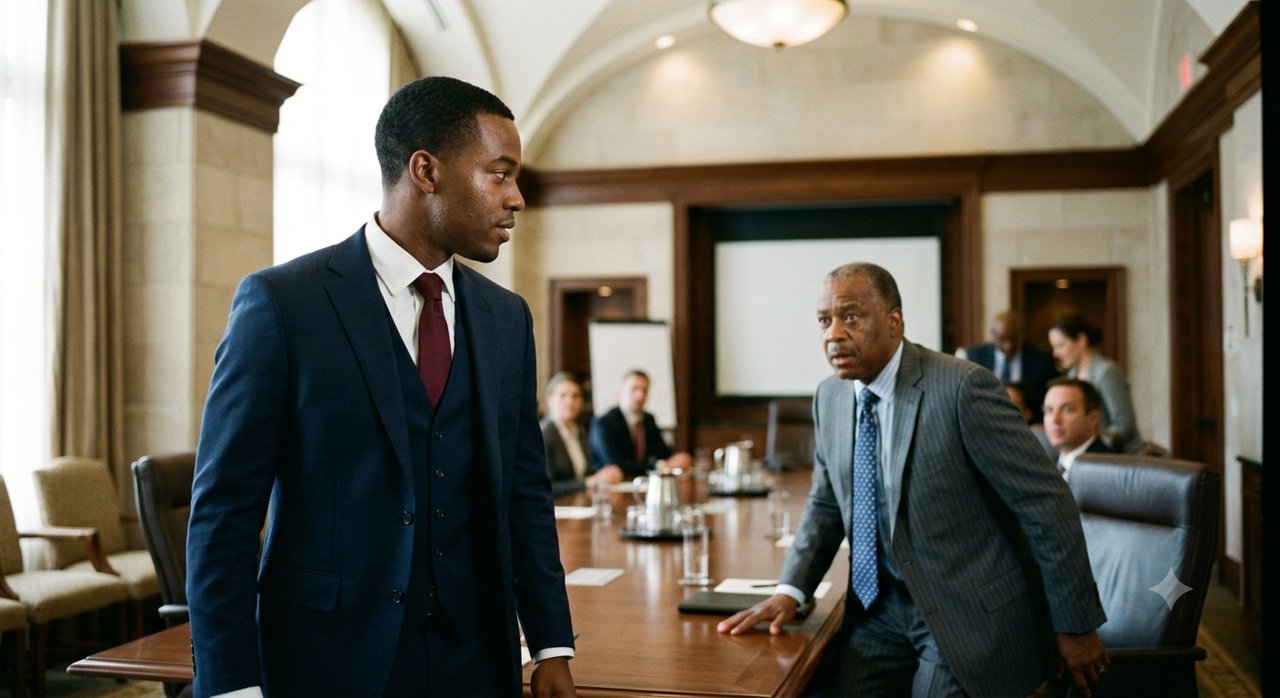
The case moved faster than Clifton expected.
Patricia had anticipated his delay tactics and filed preemptive motions that cut off the most common ones before he could use them.
The attempt to have Eunice's testimony excluded on competency grounds failed — the court-appointed evaluation confirmed her long-term recall was intact.
The attempt to have Douglas Pratt's statement dismissed as self-interested failed when Patricia produced phone records showing that Clifton's lawyer had called Pratt's business line eleven times in the two weeks after Harold's d*ath.
Clifton hired a second legal team.
Then a third.
Marcus stopped calling Andre and started calling Walter's neighbors, asking questions.
Patricia filed a harassment complaint.
It didn't stop Marcus, but it went on the record.
Six weeks after the initial filing, Clifton's lead attorney requested a settlement conference.
Patricia called Andre the morning it was scheduled.
"He's going to make one more offer," she said.
"Probably higher.
He may try to make it conditional on Eunice and Douglas withdrawing their statements."
"They won't," Andre said.
"I know.
But he'll try.
I want you in that room today.
Not to negotiate — just to be present.
Clifton needs to see that you're not going away."
The conference was held in a neutral office — a law firm's conference room, beige walls, a long table, water glasses nobody touched.
Clifton arrived with Marcus and two attorneys.
He was taller than Andre had imagined.
Well-dressed.
The kind of man who had spent decades being the most comfortable person in any room.
He looked at Andre once when he came in.
Just once.
Then he looked away and didn't look back.
Patricia opened.
"My clients are not here to negotiate the core claim," she said.
"The will was executed under conditions that did not meet the legal standard for testamentary capacity, and that execution was facilitated by undue influence.
We have two witnesses, corroborating documentation, and a pattern of similar conduct.
We are prepared to take this to trial."
Clifton's lead attorney — a man named Hargrove, silver-haired and unhurried — leaned forward.
"My client is prepared to offer full transfer of the property and both investment accounts, currently valued at approximately one point four million, in exchange for a full release of all claims and a confidentiality agreement."
The room went quiet.
Patricia didn't look at Andre.
She didn't need to.
"No confidentiality agreement," Andre said.
Hargrove looked at him.
"I'm sorry?"
"We'll accept the transfer of the property and the accounts.
We will not sign a confidentiality agreement." Andre kept his voice even.
"The other families Clifton did this to deserve to know what happened here.
We're not going to sign something that makes it easier for this to happen to someone else."
Marcus's jaw tightened.
Clifton, for the first time, looked directly at Andre.
"You're a young man," Clifton said.
"You have no idea what you're—"
"Clifton." Hargrove put a hand on his arm.
Clifton stopped.
He sat back.
He looked at the table.
Patricia spoke.
"My clients will accept full transfer of all assets named in the original estate.
They will not sign a confidentiality agreement.
In exchange, they will not pursue criminal referral at this time." She paused.
"At this time."
Hargrove conferred quietly with his client.
Marcus leaned toward his father and said something Andre couldn't hear.
Clifton didn't respond.
He was looking at his water glass.
"We'll need twenty-four hours," Hargrove said.
"You have until five o'clock today," Patricia said.
"After that, we proceed to trial."
They left first.
Andre and Patricia and Walter walked out into the hallway and stood by the elevator.
Walter leaned against the wall.
He looked tired in a way that had nothing to do with his illness.
"He didn't fight back," Walter said.
"I expected him to fight back."
"He knows what's on those financial records," Patricia said.
"And he knows what Eunice and Douglas will say on the stand.
He's been doing the math for six weeks." She pressed the elevator button.
"He'll accept."
"And the other families?" Andre said.
"Once there's no confidentiality agreement, the record is public.
The other families' lawyers will see it.
What they do with it is up to them." She looked at Andre.
"What you did in there — refusing the confidentiality clause — that was the right thing.
It was also the harder thing."
"Rose didn't get a confidentiality agreement," Andre said.
"She just got nothing."
The elevator opened.
They stepped in.
At 4:47 PM, Hargrove called Patricia.
Clifton accepted.