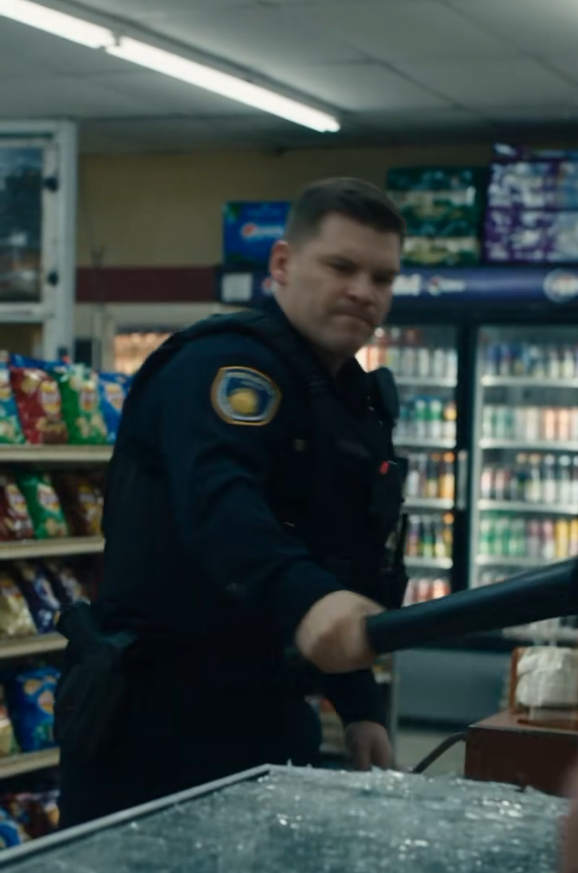
A traffic light changed at an empty intersection.
A bus rolled through the next avenue.
A delivery truck passed the corner without slowing.
Inside the convenience store, the two men stood ten feet apart.
One had a badge, a service weapon, a radio, and six months of confidence built on the certainty that nobody would challenge him.
The other had a swollen lip, a broken counter, an empty cash drawer, and a black remote control in his hand.
Trent lowered his voice.
“You’ve made a very serious mistake.”
Mr. Chen placed the remote on the counter.
“No.”
He looked at the steel shutters.
“I made my mistake six months ago.”
“When?”
“The first time I gave you money.”
Trent’s expression tightened.
Mr. Chen saw it.
That was when he knew the officer was afraid.
Not of the shutters.
Not of being trapped.
Of the sentence.
The first time.
Because it meant there had been a second.
And a third.
And more.
It meant Mr. Chen remembered every one of them.
Outside, the first siren began to rise in the distance.
Part II — Six Months
The first time Trent had taken money from the store, he had not broken anything.
That was why Mr. Chen had spent so long blaming himself.
It had been late.
Not one in the morning, but close to eleven.
Mr. Chen had been standing behind the register with a cup of tea cooling beside him when Trent walked in wearing the same dark uniform and the same expression of impatient authority.
He bought nothing.
Instead, he asked for a business license.
Mr. Chen handed it over.
Trent studied it longer than necessary.
Then he asked for a fire inspection certificate.
Mr. Chen found that too.
Then food-service paperwork, tobacco sales authorization, lottery paperwork.
Each time Mr. Chen produced one document, Trent requested another.
Finally the officer set everything on the counter.
“You’ve got problems.”
“What problems?”
“I can write them up, if you want.”
Mr. Chen had looked at the papers.
“You said my license was current.”
“Your license is current.”
“Then what is wrong?”
Trent looked around the store.
“Things.”
That had been the first warning.
The vagueness should have told Mr. Chen exactly what was happening.
Instead, he asked the question Trent wanted.
“What do I need to do?”
The officer glanced toward the register.
“Maybe nothing.”
Two minutes later, two hundred dollars was missing from the cash drawer.
No receipt.
No citation.
No report.
Trent walked out telling him to “stay cooperative.”
Mr. Chen had stood behind the counter for a long time afterward.
He had told himself it was easier.
Two hundred dollars was less expensive than hiring a lawyer.
Less expensive than missing a day of business.
Less expensive than having police cars parked outside while customers watched.
He told himself that paying once would end it.
Three weeks later, Trent came back.
Then again.
Sometimes he used inspections.
Sometimes complaints.
Once he said a delivery truck had blocked an alley.
Another time he claimed teenagers had been seen gathering near the storefront.
Mr. Chen asked what either issue had to do with cash.
Trent stared at him until the question died.
The amounts grew.
Two hundred became three.
Then four.
By the fourth month, Trent no longer bothered inventing a reason.
He would walk in after the late customers were gone, stand at the counter, and wait.
Mr. Chen would open the register.
He hated himself each time.
Not because of the money.
Because Trent always left taller than he entered.
And Mr. Chen always felt smaller.
That changed after the first offer to buy the property.
A printed envelope appeared beneath the front door one morning.
Inside was a purchase proposal for the store and the narrow lot behind it.
The price was low.
So low that Mr. Chen initially assumed it was a mistake.
Three neighboring properties had already changed hands during the previous year. The plan, according to notices mailed by the city, involved redevelopment across most of the block.
Mr. Chen’s store stood near the center of the remaining parcel.
He read the offer twice.
Then placed it beneath the register and forgot about it.
Three days later, Trent came in.
“You get an offer?”
Mr. Chen had looked up sharply.
“What offer?”
Trent smiled.
That smile remained in Mr. Chen’s mind afterward.
“Don’t play stupid.”
“It is my property.”
“Not for long.”
That was the first time Trent said there were “people” waiting.
He never named them.
He didn’t have to.
From then on, the visits changed.
The money was still part of it.
But now every payment came with a reminder.
Sell.
Leave.
Take what they’re offering.
The neighborhood is changing.
You’re holding everybody up.
Once, Trent stood by the coffee station and said, “Eventually, a man has to know when he’s in the way.”
Mr. Chen had answered, “In the way of what?”
Trent had smiled.
“Progress.”
That night, after locking up, Mr. Chen called the number printed on the most recent inspection notice Trent had left behind.
The city employee who answered the next morning searched the system.
There was no inspection.
No violation.
No open enforcement case against his store.
Mr. Chen asked the employee to check again.
The result was the same.
He looked at the paper in his hand.
The header appeared official.
The formatting was close.
But one department name was outdated.
It had been replaced two years earlier.
Mr. Chen sat in the stockroom for nearly an hour.
Then he stopped paying blindly.
Not immediately.
He knew better than to make a sudden change.
Instead, he began keeping records.
Dates.
Times.
Amounts.
Every word he could remember after each visit.
He saved copies of every false warning.
He photographed the cash in his register at the beginning and end of each night.
Most important, he changed the security system.
The old cameras had recorded to a small box beneath the office desk.
Anyone who found the box could destroy the recordings.
The new system did not depend on the box.
The visible cameras remained.
But the video no longer stayed inside the building.
Mr. Chen never told Trent that.
He also installed the shutters.
The contractor who measured the doors assumed they were for robbery protection.
Mr. Chen allowed him to think that.
In part, it was true.
But Mr. Chen had another requirement.
Every shutter had to close simultaneously.
Every exit.
One switch.
Fast.
The contractor had asked why.
Mr. Chen had answered, “If I ever need them, I will not have time to walk around.”
The man had nodded.
No more questions.
For two months, Mr. Chen waited.
Trent came five more times.
Mr. Chen paid him each time.
He disliked every dollar.
But now he photographed the bills first.
Not because a serial number alone would prove extortion.
Because patterns mattered.
Because evidence mattered.
Because memory became weak when it stood across from a uniform and was told it had imagined things.
Mr. Chen wanted something that could not be intimidated.
Tonight, Trent had finally gone further than ever before.
The flashlight.
The broken counter.