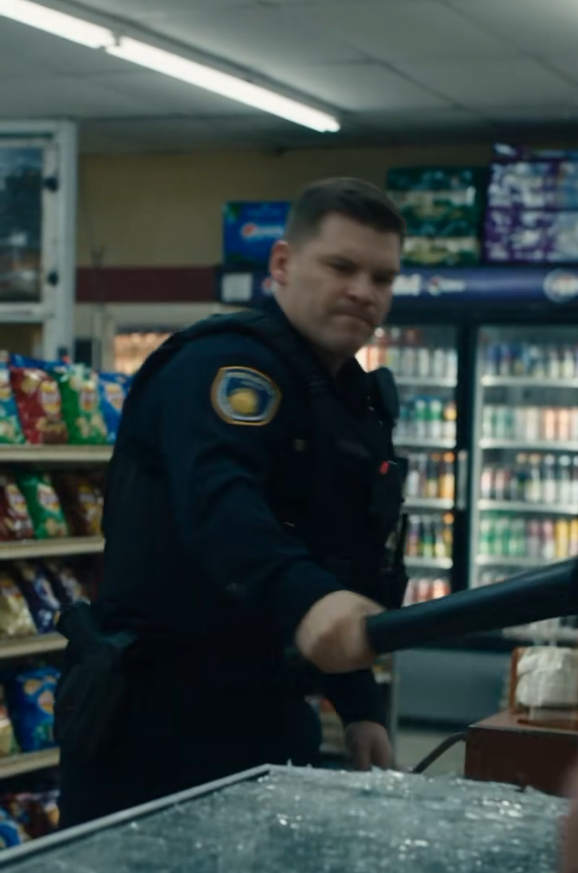
Trent stepped forward.
“Sergeant—”
“Stay there.”
Mr. Chen continued.
“There are six months.”
No one spoke.
Mr. Chen looked at Trent.
“Not every night. Only when he came.”
The officer near the entrance turned his head toward Trent.
The supervisor’s expression remained controlled.
“What do you mean, when he came?”
Mr. Chen pointed at the plastic folder on the counter.
“He came asking for money.”
Trent laughed once.
“That is a lie.”
Mr. Chen did not look at him.
“He said the money was for violations. The city says there were no violations. Then he told me to sell my property.”
The supervisor looked at the folder.
“He threatened tonight that the block would be bulldozed next week.”
Trent spoke over him.
“This guy has been in a dispute over redevelopment for months. He’s trying to turn it into something criminal.”
The supervisor’s eyes moved from Trent to Mr. Chen.
Mr. Chen said, “The money he took tonight is in the front pocket of his vest.”
For the first time, the responding officers visibly reacted.
Not with drama.
Just attention.
Every gaze went toward the pocket.
Trent’s hand moved there reflexively.
“Keep your hands away from your vest,” the supervisor said.
Trent froze.
“I have my own money.”
Mr. Chen said, “Count it.”
Trent stared at him.
The supervisor did not.
He stepped forward.
“How much did he take?”
“Six hundred and forty dollars.”
Trent gave a disbelieving laugh.
“You memorized it?”
Mr. Chen looked at him.
“Yes.”
The supervisor held out his hand.
“Trent, empty that pocket onto the counter.”
“This is ridiculous.”
“Do it.”
Trent looked around.
Three officers.
The open entrance.
Mr. Chen behind steel.
For half a second, the old confidence returned.
“You’re really going to search me on the word of some store owner?”
The supervisor’s tone remained level.
“I’m asking you to remove cash from one pocket because he just identified that pocket and gave me an exact amount.”
“I don’t consent to a search.”
“I didn’t ask for consent to search you.”
The distinction landed.
Slowly, Trent reached into his vest.
He removed a fold of bills.
Set it on the counter.
The supervisor did not touch it.
“Anything else?”
“No.”
“Step back.”
Trent did.
One of the officers put on gloves and counted.
Mr. Chen watched his fingers separate the bills into twenties.
Twenty.
Forty.
Eighty.
One hundred.
The count continued.
Trent looked toward the front entrance.
Nobody blocked it.
Nobody needed to.
Four hundred.
Five hundred.
Six.
The officer finished.
“Six hundred forty.”
The store seemed smaller after that.
Trent shook his head.
“I told you. It’s my money.”
Mr. Chen said nothing.
The supervisor looked at him.
“Can you identify those specific bills?”
“No.”
Trent seized on it.
“There. Exactly.”
Mr. Chen continued.
“But I can show you the drawer twenty minutes before he arrived.”
Trent stopped talking.
“I photograph the register every night before I close.”
The supervisor looked toward the open cash drawer.
Mr. Chen nodded.
“Tonight’s photograph shows the amount and denominations.”
“Photograph where?”
“Uploaded with the video.”
Trent stared at him.
The supervisor asked, “Why?”
Mr. Chen answered after a moment.
“Because he has done this before.”
That was when Trent’s voice changed.
“Okay.”
Everyone looked at him.
He spread his hands slightly.
“Okay. He gave me money before.”
The supervisor’s eyes narrowed.
“Gave you.”
“Yes.”
Mr. Chen almost spoke.
The supervisor stopped him with a small gesture.
“Why did he give you money?”
Trent took a breath.
“He asked me for help.”
“With what?”
“The neighborhood. Problems around the property. He wanted extra patrol.”
Mr. Chen watched the lie assemble itself.
It was better than his earlier lies.
That made it more dangerous.
“I told him there were no private patrol arrangements,” Trent continued. “He insisted. He would hand me money. I should’ve refused it.”
“You accepted cash from a business owner while on duty?”
Trent hesitated.
“I’m saying it got informal.”
“Six months informal?”
“It wasn’t six months.”
Mr. Chen finally spoke.
“February ninth.”
Trent’s head turned.
“February twenty-eighth.”
“Stop.”
“March twenty-second.”
“Stop talking.”
“April seventh.”
The supervisor watched Mr. Chen.
“April twenty-sixth. May eighteenth. June third. June twenty-fourth. July fifteenth. August second.”
Trent stepped toward the partition.
“You think a list proves anything?”
Mr. Chen met his gaze through the metal.
“No.”
He paused.
“The videos do.”
Trent turned to the supervisor.
“You’re seriously letting him run this?”
“I’m listening.”
“To him.”
“To both of you.”
“No, you’re not.”
The supervisor’s voice hardened for the first time.
“Officer, back up.”
Trent stopped.
The title mattered.
Officer.
Not Trent.
A procedural distance had appeared between them.
Mr. Chen saw it.
So did Trent.
The supervisor pointed toward the entrance.
“Sit in the patrol car.”
“You’re kidding.”
“No.”
“You’re putting me in a car based on this?”
“I’m separating witnesses while I preserve a scene.”
“I’m not a witness.”
The supervisor looked at the broken counter.
Then the money.
Then the dead body camera resting in another officer’s hand.
“At this moment, you are.”
Trent’s face flushed.
But he walked.
At the entrance, he stopped and looked back at Mr. Chen.
The old man expected anger.
Instead, Trent smiled.
It was small.
Private.
Confident.
Mr. Chen understood at once.
The officer still believed tonight was survivable.
That meant the problem was larger than the man leaving through the door.
Part V — What the Badge Was Hiding
The store stayed closed until sunrise.
Mr. Chen sat on an overturned milk crate near the stockroom while two investigators reviewed the first available footage on a tablet.
Nobody asked him to clean the blood from his lip.
Nobody touched the broken counter.
The cash remained bagged as evidence.
The remote sat beside it.
Trent was gone.
Not arrested.
Not yet.
Taken to the station separately.
That unsettled Mr. Chen more than he expected.
For six months, he had imagined a moment when somebody would finally see what Trent had been doing.
In those imagined versions, seeing led immediately to understanding.
Understanding led to action.
Reality was slower.
Statements.
Photographs.
Questions repeated in slightly different ways.
What time did he enter?
Was the door locked?
Had Mr. Chen ever voluntarily given him money?
Why had he continued paying?
Why had he installed the shutters?
Had he ever threatened Trent before?
Had he invited him to come that night?
Had they argued previously?
Mr. Chen answered everything.
When he did not remember, he said he did not remember.
When he was unsure, he said so.
That seemed important.
Trent had spent months making statements with certainty.
Mr. Chen had no interest in becoming like him.
Shortly after six, one investigator sat across from him in the stockroom.
“Mr. Chen, we found the first ten video files you flagged.”
“Yes.”
“Some are clear. Some aren’t.”
Mr. Chen nodded.
“The February twenty-eighth video, for example. We see Officer Trent enter. We see you take money from the register. But there’s no audio for part of it.”
“The old microphone failed.”
“And April seventh, he blocks the camera for about forty seconds.”