Chapter 4 — The Cost of Speaking
Dr. Keller’s name glowed on Ellis’s phone beside the scattered papers.
For three rings, Ellis watched it without moving.
The kitchen seemed smaller than it had an hour ago.
Rain ticked at the window.
Mark’s damp footprints still darkened the floor near the front door, a fading trail from the man who had tried to explain away a betrayal with a trembling voice.
On the fourth ring, she answered.
“Ellis,” Dr. Keller said.
Her tone was composed, almost gentle.
It was the voice Ellis had trusted in rooms designed to make honesty feel safe.
“You do not get to say my name like that,” Ellis replied.
“I understand you’re upset.”
“No.
You understand that I saw you.”
A pause followed.
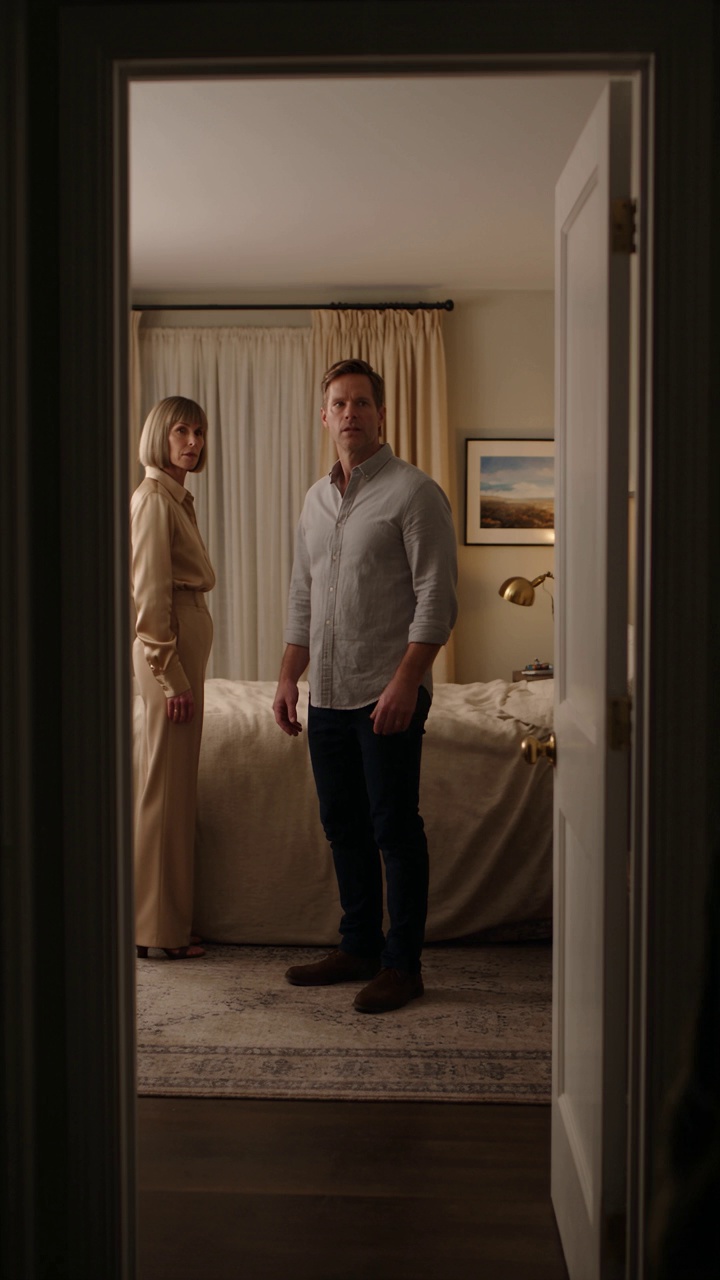
Ellis could picture Keller somewhere warm and orderly, the champagne blouse changed or hanging over a chair, every surface restored to its proper place.
The thought made Ellis’s grip tighten around the phone.
“I called because Mark told me you entered my office,” Keller said.
“And because I’m concerned you may not appreciate the consequences of taking material that contains private treatment information.”
Ellis looked down at the pages.
Keller’s handwriting marched along one margin in narrow, controlled strokes.
Figures had been copied beside notes that belonged nowhere near numbers.
“Private treatment information,” Ellis said.
“That’s what you’re worried about?”
“I am worried about confidentiality.
Yours, Mark’s, and the integrity of a therapeutic process that has already been badly damaged.”
Ellis gave a short laugh that hurt her throat.
“You were in my bedroom with my husband.”
“Please don’t turn this into a public performance.”
The quietness of Keller’s answer frightened her more than a shout would have.
Ellis leaned against the counter, as if the stone could keep her upright.
“You mean don’t tell anyone.”
“I mean that people in this community know one another.
They talk.
They make judgments with incomplete information.
If you begin making accusations while you’re in this emotional state, you may create a version of events that follows you for a very long time.”
There it was: not an apology, not even a denial.
A warning dressed in concern.
“You’re threatening me.”
“I’m telling you that confidentiality is not a weapon you can use selectively.
If you circulate records from my office, I cannot continue to protect the privacy you were afforded in treatment.
You would be forcing a response.”
Ellis’s stomach dropped.
She remembered every private sentence she had offered Keller: the fears she had never voiced to Mark, the shame she had been taught to call sensitivity, the fragile hope that counseling might make their marriage survivable.
Keller had heard all of it.
Keller had written it down.
“You would expose me?”
“I would have to defend myself,” Keller said.
“And I would need to correct any false narrative about your stability, your conduct, and the state of your marriage.”
The refrigerator hummed behind Ellis.
Outside, a car passed through the wet street, its tires whispering over pavement.
Ordinary sounds, indifferent to the fact that Keller had just turned Ellis’s own confessions into leverage.
“My stability,” Ellis repeated.
“You arrived at my office without permission.
You removed documents.
You confronted Mark in a heightened state.
I don’t want this to become worse for you.”
Ellis stared at the green sleeves of her blazer.
Earlier, she had thought of them as armor.
Now they felt like evidence that she had walked into Keller’s territory alone and let herself be seen.
“You told Mark to call me,” she said.
“I told Mark that this situation required calm.”
“You knew he’d come here.”
“I knew he was afraid.”
“So am I.”
Keller was silent for a beat.
“Then make the sensible choice.
Return everything you took.
Stop discussing this with people who do not understand the full context.
Let us handle this privately.”
Us.
The word landed harder than any admission.
Ellis moved to the table and lifted the top sheet.
Her eyes passed over a notation she had not understood before, placed beside a figure that had nothing to do with a marriage session.
The page trembled in her hand, but Keller could not see it.
“You don’t get an ‘us’ anymore,” Ellis said.
“Ellis—” “You lost the right to tell me what is sensible when you sat across from me, took my trust, and went home with my husband.”
Keller’s calm thinned at last.
“Be careful.
Once you involve the community, you cannot control what people think of you.”
Ellis looked through the window at the dark houses lining the street.
Behind those doors were neighbors who had smiled at her, acquaintances who had asked how therapy was going, people who might hear Keller’s version first and never question it.
For a moment, walking away seemed almost merciful.
She could put the papers back, change the locks, let Mark and Keller become a closed wound she never touched again.
Then she saw the numbers on the page.
Not just notes.
Not just the wreckage of a marriage.
Something deliberate enough to be written down.
“I’m not giving you anything tonight,” Ellis said.
“That would be a mistake.”
“Maybe.”
Ellis slid the papers into a neat stack.
“But it will be mine.”
She ended the call before Keller could answer.
The silence that followed was not peace.
It was the space after a door had shut and before someone tried the handle.
Ellis carried the documents to the living room, pulled open the drawer beneath the lamp, and found an empty envelope.
One by one, she sorted the pages by date, separating Keller’s treatment notes from the bank statements and the handwritten calculations.
Then she set her phone beside them, screen-down, and began to trace every number Keller had tried to hide in plain sight.