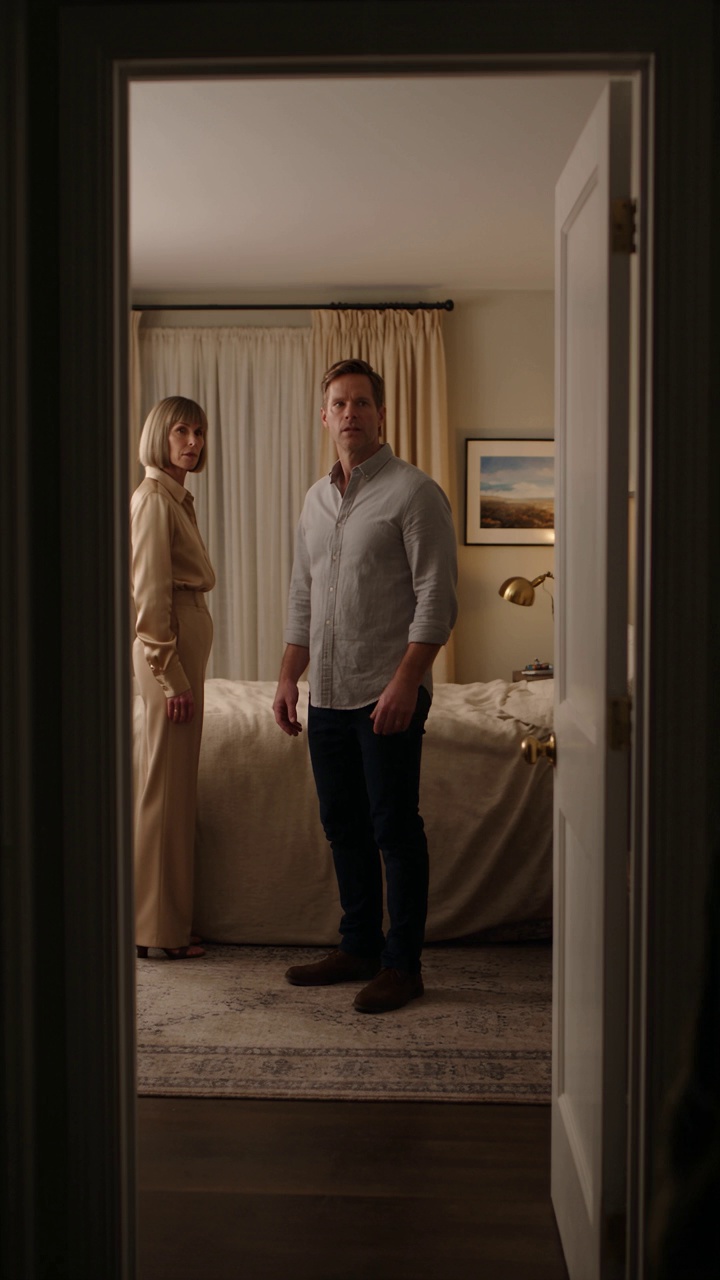
Chapter 6 — The Screen Between Them
Ellis carried the envelope against her ribs as she entered the municipal building, as if the papers could feel the cold leaking through the glass doors.
Her green blazer hung open.
She had not slept, had not changed, and had stopped trying to make her red hair look orderly.
The phone in her pocket held the photographs.
The envelope held the originals.
Between them lay the version of her life Mark and Dr. Keller had expected to keep hidden.
The deposition room was open to observers, its narrow gallery lined with hard chairs and silent people pretending not to listen.
At one table, Dr. Keller sat upright in a dark jacket over her champagne silk blouse.
Her blonde hair was pinned back more tightly than Ellis had ever seen it.
No softness remained in her face.
Keller looked at the envelope before she looked at Ellis.
“You brought them,” she said.
Ellis took the seat across from her.
“You told me to return them.”
“I told you that you did not understand them.”
“That part was true.”
Ellis set the envelope on the table.
“I didn’t understand why my therapist had records about my inheritance.”
Keller’s counsel leaned toward his microphone.
“My client has denied any financial misconduct.
These papers were removed without authorization and lack context.”
“Then provide the context,” Ellis said.
The hearing officer raised a hand before the counsel could answer.
“Dr. Keller is here because the board received allegations concerning professional boundaries and possible misuse of confidential information.
Answer the questions asked.”
Keller’s eyes did not leave Ellis.
“You were in an acute emotional state when you took those documents.”
The old phrase landed exactly as intended.
In sessions, Keller had used it gently, as a way to give Ellis permission to breathe.
Here it became a label, clean and sharp enough to cut her away from her own memory.
Ellis unfolded her hands beneath the table.
“I was in an acute emotional state because I found you with my husband.”
A chair creaked in the gallery.
Keller’s counsel objected, but the hearing officer let the silence remain.
“Did you conduct individual sessions with Mark without Ellis’s knowledge?” the examiner asked.
Keller glanced at her counsel.
“There were limited conversations intended to support the marriage work.”
“Did those conversations include Ellis’s inheritance?”
“No.”
Ellis felt the answer move through the room, almost graceful in its certainty.
Keller had always been good at certainty.
She could make a question sound like a symptom and an answer sound like treatment.
The examiner slid one of Ellis’s photographs across the table.
It showed the handwritten calculations beside Mark’s bank statement.
Keller’s initials sat near the margin.
“Is that your handwriting?”
Keller looked down.
For the first time, her composure delayed.
“It appears to be notes made in preparation for a discussion of household stressors,” she said.
“Two months before the first joint appointment?”
Ellis asked.
Keller’s counsel turned toward her.
“You are not the questioner.”
“No,” Ellis said.
“I’m the person whose life she was preparing to manage.”
The hearing officer called for the next exhibit.
A monitor at the end of the room blinked awake.
Keller’s face changed before the image appeared.
The footage was grainy, taken from a fixed camera in the building hallway outside Keller’s office.
No sound.
A date and time marked the corner.
Mark entered first.
Keller opened the office door herself and looked both directions before letting him in.
Minutes later, she locked the door.
Nearly an hour passed before Mark emerged, his shirt wrinkled, Keller close behind him.
She touched his sleeve, then handed him a folder.
Ellis had watched the clip once before coming in.
Watching it now was worse.
Not because it proved what she had already seen in the bedroom, but because it showed preparation.
Privacy.
Repetition.
A door deliberately secured while Ellis believed counseling was meant to save her marriage.
Keller’s counsel stood.
“This video does not establish an improper relationship.”
“It establishes private access outside the disclosed treatment structure,” the examiner said.
“Dr. Keller, why did Mr. Mark receive records from your office?”
“He did not receive records.”
The monitor froze on Keller’s hand extended toward Mark, the folder between them.
“He received a folder,” Ellis said quietly.
Keller turned to her then, and the calm veneer finally fractured.
“You do not know what was in it.”
“I know it was before you sat across from me and asked what I feared losing.”
The examiner requested the physical copies.
Ellis pushed the envelope forward.
Her fingers trembled only after she released it.
A staff member opened it, cataloged each page, and placed them in a clear evidence sleeve.
Keller watched as though each sheet had been lifted from her skin.
The unsigned transfer draft came last.
The examiner read the date aloud.
Then the matching account reference.
Then the note initialed by Keller about timing.
Keller’s counsel asked for a recess.
The hearing officer granted ten minutes.
In the corridor, Ellis stood by a window, breathing through the ache behind her sternum.
Mark appeared at the far end of the hall in the same grey shirt he had worn when she left him.
He looked smaller than she remembered, but he did not look innocent.
He stopped when he saw the evidence sleeve in the staff member’s hands.
“What did you give them?” he asked.
Ellis met his eyes.
“What you thought I would never find.”
Behind him, Keller’s counsel stepped out of the room and spoke into his phone in a low, urgent voice.
Mark heard only a few words, but they drained the color from his face: “financial fraud” and “separate exposure.”
The recess bell sounded.
Mark remained in the corridor, staring at the closed deposition-room door as if it had become the first locked door he could not talk his way through.