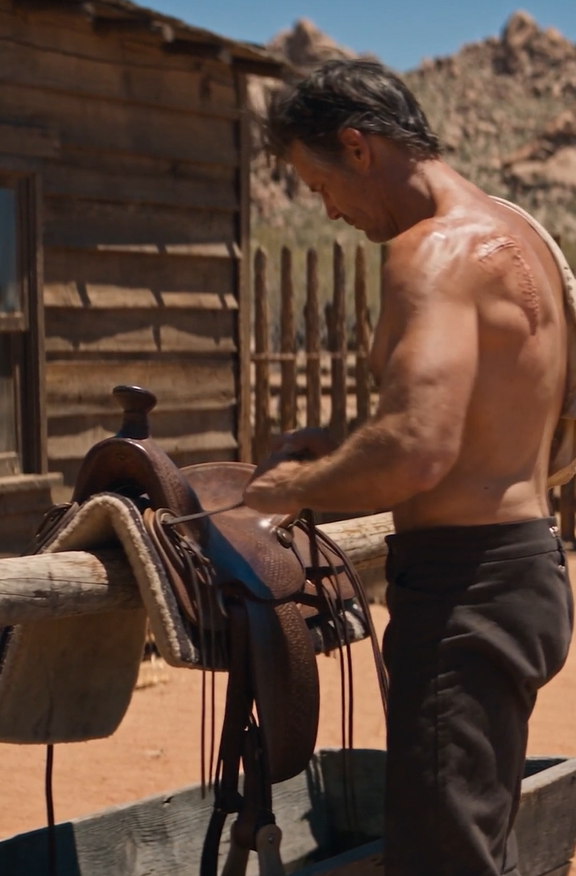
Blood and Dust in the Sangre de Cristos: The Ghost of Silence Valley.
Blood and Dust in the Sangre de Cristos: The Ghost of Silence Valley
The wind in the Sangre de Cristo mountains did not merely blow; it interrogated. It scraped across the jagged slate, rattling the dry sage and whistling through the gaps of unchinked logs with a sound like a dying man’s rattle. For twelve years, that wind had been Ethan Callahan’s only conversation partner.
Folks down in Socorro County, when they spoke of him at all, called him a ghost in boots. They said he was carved from red dust and silence, a man who had traded his soul to the civil war and whatever followed it, burying his remaining pieces in a lonely grave beneath a weeping cottonwood out back. He lived at the jagged edge of the world, where the scrub oak gave up and the sheer, unforgiving rock took over. His world was bounded by two things: the endless, mocking blue of the New Mexico sky and the haunting memory of a life he had deliberately butchered and buried.
He was at the wooden water trough outside the barn, stripped to the waist, scrubbing the alkaline grime from his broad, sun-hammered shoulders. His skin was the color of saddle leather, deeply grooved and mapped with scars. A long, white slash ran diagonally across his ribs—the parting gift of a Bowie knife in a Kansas alleyway he couldn’t even care to remember—and his left hand had a permanent, faint tremor, the lingering nervous twitch of a Winchester ball that had shattered his wrist during the Shenandoah Valley campaign long before he became a bounty hunter.
He reached for a dry rag, pausing as he felt the air pressure drop—that subtle, breathless stillness that precedes a sudden mountain squall.
Then, it came.
It wasn’t the frantic whinny of a spooked mustang. It wasn’t the distant, high-pitched yipping of coyotes circling a dying calf. It was three sharp, deliberate raps against the thick, adzed oak of his front gate.
Ethan froze. His right hand instinctively dropped to the bone-handled Colt strapped loosely to the weathered stool beside him, though it wasn’t buckled on.
No one knocked here.
Not in twelve years. Not since the night the world went black and he had wrapped his blood-slicked hands around a shovel to dig two shallow graves. Not since he threw his badge into the dust of a burning Kansas railhead and rode west until the horses could go no further.
The knock came again. A second series, louder this time, carrying the ragged, desperate cadence of urgency.
Ethan moved with the slow, terrifying grace of a cougar roused from a midday snooze. His bare feet made no sound against the packed earth. He didn’t reach for the Colt; instead, his calloused fingers curled around the cold, checkered steel barrel of the short-barreled 10-gauge double-barrel shotgun resting just inside the doorframe. The old iron felt like an old friend with bad advice, whispering promises of buckshot and sudden peace.
He pulled the heavy wooden door open a scant six inches. The hinges shrieked in protest, slicing through the howl of the canyon wind.
And then he heard it.
Muffled through the gap, but unmistakable. A cadence, a breath, a tongue that had not graced his ears since the night the ash fell.
Apache.
His stomach turned into a cold, heavy lump of river stone.
That language had once meant home. It had once been whispered against his bare neck in the velvet dark by a woman with obsidian eyes and lips that tasted of wild plums and woodsmoke. But the last time he had heard it spoken with that particular urgency, it had meant blood, screaming, betrayal, and the acrid smell of burning lodge poles. It had meant everything he spent a decade trying to outrun.
“Please,” a voice rose from the porch floorboards. It was halting English, but mangled by an accent as old as the mesas, cracked and rasped like sandpaper drawn over raw gravel. “We need… just for the night. Water.”
Ethan pressed his forehead against the splintered edge of the door, his eyes squeezed shut as a wave of dizziness washed over him. His gut twisted. The razor-sharp survival instincts of a man who had hunted down the most violent outlaws in the Arizona Territory told him this was a trap. A decoy. A setup designed to draw him into the open so a half-dozen warriors could fill him full of lead.
Yet, as if the mountain gods themselves were holding their breath, a sudden gust of wind sheared across the porch, shifting the air.
Through the narrow crack between plank and doorframe, a scent hit him. It cut through the smell of horse sweat and gun oil. It was the sharp, unmistakable odor of coagulated blood, sun-baked sweat, wood ash, and something far more fragile: parched cornmeal, human exhaustion, and the sour, hollow reek of profound starvation.
He opened the door a little wider, his knuckles white around the shotgun stock.
There were twelve of them.
They weren’t warriors sent from a war party. They were girls, and young women—some barely out of childhood, the oldest perhaps twenty-five. They were draped in shredded, dust-caked deerskins, their leather belts looped with crude skinning knives, their bone beads tangled with dried blood and burs.
One girl, no older than seventeen, had completely collapsed against the rough cedar fence post, her head lolling back, her lips split open like dry river clay under a July sun. Another was frantically sucking on the dry leather nozzle of an empty canteen, her throat working in dry, desperate swallows as if trying to milk moisture from the empty air.
And then there was the one at the front.
She stood dead center on his porch, her body trembling so violently it looked as though the mountain wind might snap her spine, yet she refused to let her knees buckle. Her hair, once thick and blue-black, was braided down the center and heavily caked with gray alkali dust and dried blood. Across her cheek ran a jagged, still-inflamed scratch, and her eyes—dark, unfathomable, and burning with a cold, desperate defiance—locked onto Ethan’s.
Those eyes didn’t plead. They didn’t beg. They challenged him to make his choice: kill them now or let them in.
And in that fraction of a second, staring into the face of a girl who looked remarkably like ghosts he had buried long ago, Ethan Callahan lowered the barrel of the 10-gauge.
The first hours inside the cabin were filled with a tense, fragile silence, broken only by the bubbling of a iron pot over the hearth and the ragged, shallow breathing of the wounded.
Ethan had dragged them inside one by one, his face set in a grim, unreadable mask. The seventeen-year-old girl, whose name he would later learn was Nizhoni—meaning “pretty,” though right now she looked like a broken doll—was laid out on his own narrow cot in the corner. Her right leg was wrapped in a filthy, blood-stiffened rag where a bullet had grazed the calf, leaving a nasty, purplish trench of torn flesh.
The leader, the one who had knocked at his door, stood watch by the small, grease-papered window, her hand resting near the bone handle of a rusted cavalry saber she had scavenged from somewhere. Her name was Yazhi. She watched Ethan’s every move with the wary vigilance of a cornered wolf.
Ethan didn’t speak. He moved with efficient, practiced economy. He hauled his heavy iron kettle over the flames, tossed in handfuls of dried venison, wild onions, and cornmeal, and let the rich, fatty broth fill the small, gloomy cabin with the scent of civilization—something he hadn’t cared for in years.
He knelt beside Nizhoni’s cot with a basin of warm, salted water and a pair of surgical tweezers he had kept in an old tin box since his soldiering days.
“Hold her shoulders,” Ethan muttered, his voice sounding rusty, like a gate hinge that hadn’t seen grease in a decade. He spoke in the Chiricahua dialect, his accent surprisingly fluent, though thick with the flat cadence of a white man who had learned it in blood and tents.
Yazhi flinched slightly at the sound of her tongue rolling off a white man’s lips, but she stepped forward without hesitation. She dropped to her knees beside the cot, pressing her hands firmly onto the younger girl’s shoulders, whispering low, rhythmic Apache cadences into her ear—words of comfort, grounding, and ancient strength.
Ethan didn’t look at Yazhi’s face as he worked the tweezers into the torn flesh of Nizhoni’s calf. He pulled out a flattened piece of lead no larger than a pea. The girl let out a sharp, choked gasp, her fingers digging into Yazhi’s forearms until the knuckles turned white, but she didn’t scream.
Ethan dropped the bloody lead into the metal basin with a sharp clink. He reached for a jar of rendered bear grease and sulfur, smearing it thickly across the wound before wrapping it tight with clean strips of an old cotton shirt he had torn apart.
“She’ll live,” Ethan said gruffly, standing up and wiping his bloodstained hands on his trousers. “The bone’s not touched. Infection hasn’t set deep yet, but she needs water and sleep.”
Yazhi rose slowly, her obsidian eyes fixing on his. She didn’t say “thank you.” In her world, gratitude was cheap; survival was the only currency that mattered.
“The soldiers at the fort down in the valley,” Yazhi said, her voice like wind over gravel. “They are hunting us. They tracked us from the reservation lines three days ago. They think we carry news of the breakout.”
Ethan turned away, walking over to the hearth to ladle out bowls of steaming broth. “I don’t care about the bluecoats. And I don’t care about the reservation. Up here, there’s only me, the rocks, and the wind. You stay the night, you eat what I give you, and at first light tomorrow, you point your horses south or west. Anywhere away from here.”
Yazhi stepped closer, the firelight catching the sharp angles of her high cheekbones and the dark circles under her eyes. “We have no horses, white man. The cavalry shot them at the crossing of the Rio Puerco. We walked forty miles on bleeding feet through the thorns so the children—the others—could scatter into the hills. We are all that is left of our band.”