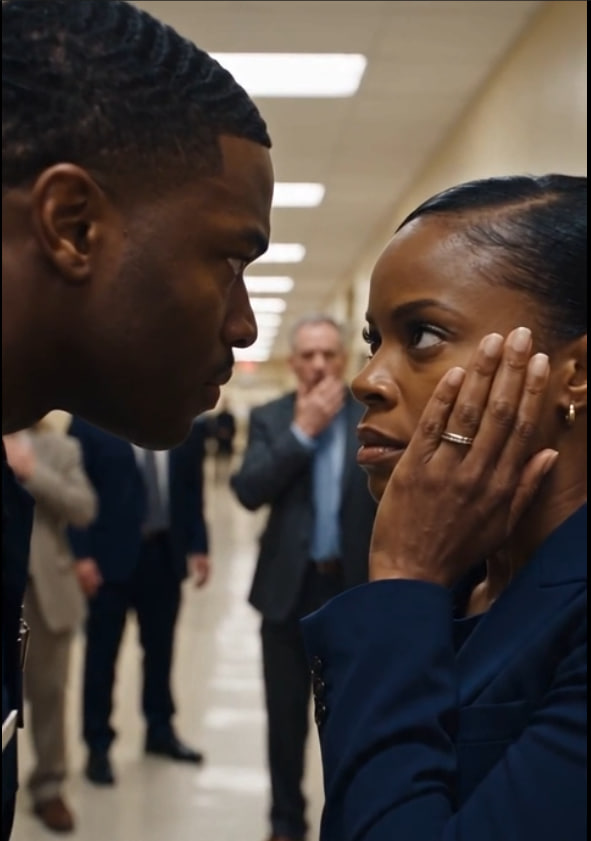
One year after the slap, rain returned.
I noticed it the moment I woke.
Heavy drops tapped against my bedroom window.
For a second, I lay still.
The sound carried me backward.
Broken judicial elevator.
Charcoal suit.
Fourth floor.
A stranger shouting, “Hey!”
My heart sped up.
Then I heard another sound.
Laughter downstairs.
My mother.
Angela.
Someone dropped a pan.
Mom shouted, “That better not be my good skillet!”
Angela yelled back, “Why do you own a skillet nobody is allowed to use?”
I smiled into my pillow.
One year ago, rain had sounded like warning.
That morning, it sounded like weather.
I got dressed.
Not carefully.
Not because I was trying to prove anything.
I simply chose my charcoal suit.
The same one.
Angela noticed immediately.
“You’re wearing it.”
“I am.”
Mom looked up from her coffee.
“Good.”
No dramatic speech.
No worried expression.
Just good.
That was one of the greatest gifts they had given me.
They stopped treating me like something fragile.
At the courthouse, the private elevator was working.
I stood in front of it.
Then I walked past.
Walter, who had apparently forgotten the meaning of retirement, was waiting near the public elevator.
“What are you doing here?”
“Visiting.”
“At eight in the morning?”
“I’m old. We wake up early.”
“You hate mornings.”
“I came for free courthouse coffee.”
“You called it sewage for twenty-seven years.”
He shrugged.
“Tastes improve with age.”
I laughed.
The elevator doors opened.
He gestured.
“After you, Your Honor.”
We rode together.
When the doors opened on the fourth floor, my body noticed before my mind did.
A flicker of tension.
A slight tightening in my chest.
Then it passed.
I stepped out.
The hallway looked almost exactly the same.
Same marble.
Same windows.
Same wooden courtroom doors.
But there were changes.
Two cameras now covered the corridor from different angles.
Posters explained civilian complaint procedures.
Officers wore visible identification.
And everyone assigned to courthouse security underwent de-escalation and constitutional-rights training.
Brooks had helped design the reforms before retiring from command.
He later told me the hardest part was admitting training alone could not fix culture.
“People need consequences,” he said.
“And leaders willing to hear bad news.”
I agreed.
We walked toward the accountability plaque.
Someone was already standing there.
Maya.
She smiled.
“Surprise.”
I stared at Walter.
“You knew?”
“I know everything.”
“That is increasingly concerning.”
Maya hugged me.
Ethical restrictions no longer existed between us.
Her old case was closed.
No pending matters.
Over the previous months, something close to friendship had slowly formed.
She had started working with a nonprofit helping people navigate civilian complaint systems.
“I have something to tell you,” she said.
“What?”
“I got accepted.”
“Where?”
“Law school.”
I screamed.
Actually screamed.
In the courthouse hallway.
Walter jumped.
Two officers turned.
I hugged Maya.
“When?”
“Last night.”
“Which school?”
She told me.
A good one.
Nearby.
Her eyes filled.
“I kept thinking about everything that happened.”
“Maya…”
“No, listen.”
She held my hands.
“For months, I wanted to forget every courtroom and every officer and every legal document.”
“I understand.”
“Then I realized the law wasn’t what hurt me.”
I became still.
“People abused it.”
“Yes.”
She smiled through tears.
“So I want to learn how to use it properly.”
My throat tightened.
“You will.”
“How do you know?”
“Because you already know what happens when people don’t.”
Walter wiped his eye dramatically.
“Dust.”
“There is no dust,” I said.
“Government building. Plenty of dust.”
Later that morning, I entered my courtroom.
Everyone stood.
“All rise.”
For years, those words had represented authority to me.
Now they meant something slightly different.
Responsibility.
I took my seat.
A young man stood at the defense table.
He looked terrified.
His mother sat behind him.
The prosecutor spoke.
The defense attorney responded.
A police officer testified.
I listened.
Really listened.
Not because officers were untrustworthy.
Not because defendants were automatically truthful.
Because justice required evidence, not assumptions about who deserved belief.
During a recess, I looked toward my chambers.
My framed gift from Maya sat on the shelf.
Your Honor.
The title had once felt like armor.
Now I understood it differently.
Honor was not what people called you.
It was what you owed them.
That afternoon, the courthouse hosted a small anniversary event recognizing the reforms.
I initially refused to attend.
Mom ignored me and accepted on my behalf.
“You cannot do that.”
“I gave birth to you.”
“That has no legal relevance.”
“It has relevance in my house.”
I went.
Anthony Vega came with his mother.
Melissa Crane brought her husband.
Marcus Dean attended.
Leonard Price joined by video because he was still dealing with legal proceedings elsewhere.
Brooks came.
Richard came.
Even several young officers attended voluntarily.
There were no grand speeches about perfect systems.
Nobody claimed every problem had been solved.
Instead, people talked about responsibility.
Brooks stood at the microphone.
“I spent years believing loyalty meant defending the department,” he said.
“I was wrong.”
The room went quiet.
“Sometimes loyalty means refusing to let an institution become the worst version of itself.”
Marcus applauded first.
Then everyone did.
Richard spoke briefly.
Melissa spoke.
Then Maya.
When my turn came, I walked to the microphone without notes.
“I spent a long time trying to decide whether I was grateful for what happened.”
The room became silent.
“I am not.”
Several people looked surprised.
“I will never call violence a blessing simply because something meaningful followed it.”
Maya nodded.
“Officer Mercer should never have struck me. Anthony should never have been asNextlted. Maya should never have been targeted. Leonard should never have been ignored. Melissa should never have had to leave her job. Marcus should never have lost his career for telling the truth.”
My voice tightened.
“What happened to us was wrong.”
I looked at Mom.
“But I am grateful for what people chose afterward.”
Walter smiled.
“For witnesses who stopped recording only long enough to speak up. For investigators who kept digging. For officials who admitted failure. For families who believed people before institutions did.”
Anthony’s mother began crying.
“And I am grateful that justice eventually became something more than punishment.”
I looked toward the accountability plaque.
“It became change.”
After the ceremony, my mother gathered everyone for dinner.
She somehow fit twelve people into her house.
Maya sat beside Angela.
Walter argued with Marcus about baseball.
Anthony helped Mom carry plates.
Brooks washed dishes until Mom chased him away because he was “doing it wrong.”
I stood in the doorway watching them.
A year earlier, I had come home to this house with a bruised face.
There had been a patrol car outside.
My mother had been afraid.
I had checked the windows repeatedly.
That night, the front door stood open because Walter kept going outside to complain about the heat.
Children from next door were riding bicycles on the sidewalk.
Someone had music playing.
Mom was laughing.
No patrol car.
No cameras being checked.
No threatening letters.
Just home.
Maya walked over.
“You okay?”
“Yes.”
“You disappeared.”
“I’m standing right here.”
“You know what I mean.”
I smiled.
“I was thinking.”
“Dangerous.”
“Very.”
She looked toward everyone.
“About what?”
I took a breath.
“How different this feels.”
She understood immediately.
“Safe?”
The word once felt complicated.
Safety had seemed like something that could vanish because one stranger misunderstood who I was.
Then I learned that safety was not the promise that nobody would ever hurt me.
No one could promise that.
Safety was knowing I could speak.
Knowing I would be heard.
Knowing I had people who would stand beside me.
Knowing that fear could visit without becoming my permanent home.
“Yes,” I said.
“Safe.”
Mom called from the dining room.
“Josephine! Stop hiding and come eat!”
“I’m coming!”
Maya laughed.
“Your mother still orders judges around?”
“She considers herself an appellate court.”
We joined the others.
Mom made me sit beside her.
She placed too much food on my plate.
Then she touched my cheek.
The same cheek Mercer had struck.
For months, even gentle contact there had made me tense.
This time, I leaned into her hand.
She smiled.
“Look at you.”
“What?”
“My girl.”
My eyes filled.
“I’m forty-seven.”
“You’re still my girl.”
Angela groaned.
“Here we go.”
Everyone laughed.
I looked around the table.
The people there were not connected because of one terrible morning.
They were connected because of what they chose afterward.
Truth.
Accountability.
Courage.
Forgiveness where it was deserved.
Boundaries where it was needed.
Love through all of it.
Later, after everyone left, I stepped onto the porch.
The rain had started again.
Soft this time.
Mom came beside me.
“Cold?”
“A little.”
She handed me a blanket.
For several moments, neither of us spoke.
Then she asked, “Do you ever think about him?”
“Mercer?”
“Yes.”
“Sometimes.”
“Are you still angry?”
I considered it.
“Yes.”
She nodded.
“But anger isn’t driving anymore.”
Mom smiled.
“That sounds healthy.”
“I learned from an excellent retired schoolteacher.”
“Obviously.”
I laughed.
Across the street, rain glistened beneath the streetlights.
One year earlier, I had believed strength meant refusing to let anyone see me shaken.
Now I knew better.
Strength was Maya admitting she had been afraid.
It was Marcus preserving the truth after losing everything.
It was Melissa coming back through courthouse doors.
It was Brooks admitting he had failed.
It was Richard accepting consequences.
It was Walter stepping forward.
It was my mother holding me while I stopped pretending everything was fine.
And it was me walking back into that hallway without needing the past to disappear.
I touched my cheek.
No pain.
No bruise.
Only skin.
Mom linked her arm through mine.
“You ready to go inside?”
I looked at our warm living room.
Family photographs covered the wall.
Dad smiled from one of them.
For a moment, I imagined what he would say.
Probably something simple.
Probably something like, Keep going.
So I did.
I turned away from the rain.
I walked inside with my mother.
And for the first time since that morning in the courthouse, I did not look behind me.
I did not need to.
I was safe.
I was loved.
I was believed.
And finally, completely, I was free.