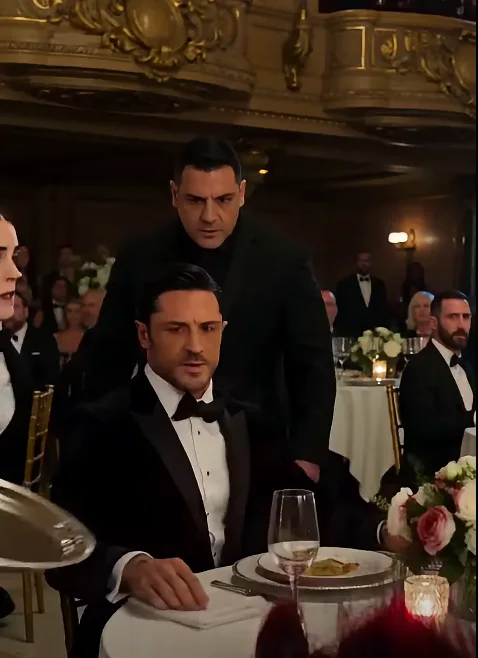
For eleven years, Elias Falcone had lived as though grief were a locked room and he alone possessed the key. Then, on the worst night of a coastal storm, he found his terrified young maid in labor behind the one greenhouse he had forbidden anyone to enter—the greenhouse where his wife Rosalind had once grown white roses before her death. The woman begged him to keep the police, doctors, and everyone else away because someone was hunting her unborn child, but her first whispered confession was even more impossible: Anna Reed was not her real name. And when her newborn daughter cried beneath the shattered glass roof, she spoke a name Elias had buried with Rosalind eleven years ago.
For eleven years, men lowered their voices when Elias Falcone entered a room.
They did it in restaurants.
In courtrooms.
In private clubs where senators and businessmen pretended not to recognize him.
They did it even in his own house.
Fear had become a kind of architecture around Elias. It followed him through doorways, settled at the edges of conversations, and made people measure every word before they spoke.
He had never asked for it.
That was the lie he sometimes told himself.
The truth was that he had built much of his life with his own hands, one hard decision at a time.
Grayport, Massachusetts, had learned to live with the Falcone name. The family owned shipping interests, warehouses, restaurants, construction companies, and enough quiet influence to make certain problems disappear before they reached the police.
Elias rarely raised his voice.
He didn't need to.
But there was one room in his mansion where fear meant nothing.
The greenhouse.
No one had entered it in three years.
Not since Rosalind died.
Rosalind had loved that place. She had filled it with white roses, climbing vines, citrus trees, herbs, and tiny pots she labeled in her elegant handwriting. She used to sit beneath the glass roof every morning with coffee and a book while sunlight moved across her face.
Once, she had told Elias, "Plants are proof that something can look dead for an entire season and still be waiting for warmth."
He had kissed her forehead and called it sentimental nonsense.
He would have given anything now to hear her say it again.
Instead, the greenhouse had become a mausoleum.
After her funeral, Elias had locked the brass door himself.
He had never opened it.
Until the storm.
The rain began before sunset and turned vicious by midnight.
Wind screamed down from the Atlantic, bending the old trees along the eastern drive. Three pines came down within an hour. Water swallowed the narrow bridge connecting Ashgrove Estate to the county road.
The mansion's lights flickered.
Then went out.
Elias was already awake.
He had been awake most nights for eleven years.
He pulled on a dark coat and went outside to inspect the backup generator. The wind tore at his clothes as he crossed the grounds.
Lightning flashed.
For an instant, the greenhouse appeared through the sheets of rain.
The brass lock hung loose.
Elias stopped.
His heart gave one slow, heavy beat.
Nobody touched that door.
Nobody.
He walked toward it.
A low sound came from inside.
Not the wind.
A moan.
Elias pushed the door open.
Rain hammered the glass dome overhead. One pane had shattered, allowing water to pour onto the brick floor. Dead vines hung from the walls. Clay pots lay overturned. The old rose beds had become tangled with weeds.
His flashlight swept across the room.
Then stopped.
A woman lay curled beside the rose beds.
Elias recognized her after several seconds.
The new maid.
Anna Reed.
She had arrived four months earlier and seemed determined to leave no impression behind. Quiet. Polite. Always moving before anyone could ask her to.
Elias had passed her in hallways countless times without knowing anything about her.
Now she was soaked through.
Her dark hair clung to her face.
Her gray uniform was stretched over a belly that could no longer be hidden.
Elias stared.
Pregnant.
He had not known.
The woman opened her eyes.
"I'm sorry, sir."
Elias crouched beside her.
"What?"
Her lips trembled.
"I made a mess on your floor."
For several seconds, he couldn't speak.
She was alone in a locked greenhouse during a hurricane, about to give birth, and she was worried about his floor.
Something inside him twisted.
He removed his coat and spread it beneath her.
When he touched her shoulder, she recoiled so violently her head nearly struck the brick.
Elias froze.
"No one is going to hurt you."
Her eyes told him she had heard those words before.
And learned not to believe them.
He pulled the radio from his belt.
"Mrs. Quinn. Greenhouse. Now. Bring towels, blankets, hot water."
Static answered.
Then Bernadette Quinn's voice.
"On my way."
The woman grabbed Elias's wrist.
"No hospital."
He looked at her.
"The bridge is underwater."
"No police."
"I didn't call them."
"Promise me."
Elias studied her face.
He was a man who had made promises to presidents, enemies, partners, and dying men.
He knew what promises cost.
"I don't make promises I can't keep."
Her breathing became ragged as another contraction began.
"Then promise what you can."
Elias leaned closer.
"I promise nobody takes you from this property tonight."
Her fingers loosened.
She nodded.
Five minutes later, Bernadette Quinn entered the greenhouse beneath a raincoat, carrying towels and a medical bag she kept for emergencies.
At sixty-eight, Bernadette had the permanent expression of a woman who had spent half a century discovering that everyone around her was incompetent.
She took one look at the woman on the floor.
Then looked at Elias.
"How close?"
"I don't know."
"I wasn't asking you."
Elias almost smiled.
Almost.
Bernadette knelt beside the maid.
"What is your name, sweetheart?"
The woman hesitated.
"Anna."
Bernadette's eyes narrowed.
But she didn't challenge her.
"All right, Anna. Look at me."
Elias moved aside.
Bernadette caught his sleeve.
"Where are you going?"
"To give you room."
"You're her room. Sit down."
"I don't know anything about childbirth."
"You know how to hold a hand."
The woman reached for him before he could argue.
So Elias Falcone, a man who had once negotiated a harbor dispute while armed men waited outside the room, sat on a flooded greenhouse floor and allowed a terrified woman to crush his fingers.
The storm raged around them.
Rain struck the glass like thrown gravel.
Thunder rolled over the estate.
And slowly, the world became very small.
Bernadette's voice.
The woman's breathing.
Elias's numb hand.
The smell of wet earth.
The faint sweetness of roses that somehow still lingered beneath years of neglect.
At one point, the woman bit down on her own wrist.
Elias caught her hand.
"Stop."
She looked at him.
"I'm sorry."
"No."
"I didn't mean—"
"Stop apologizing."
Her eyes filled.
"I don't know how."
The words struck him harder than they should have.
I don't know how.
Elias looked away.
For eleven years, he had been telling himself he knew how to live with loss.
He didn't.
He had simply learned how to make the pain look respectable.
The woman cried out again.