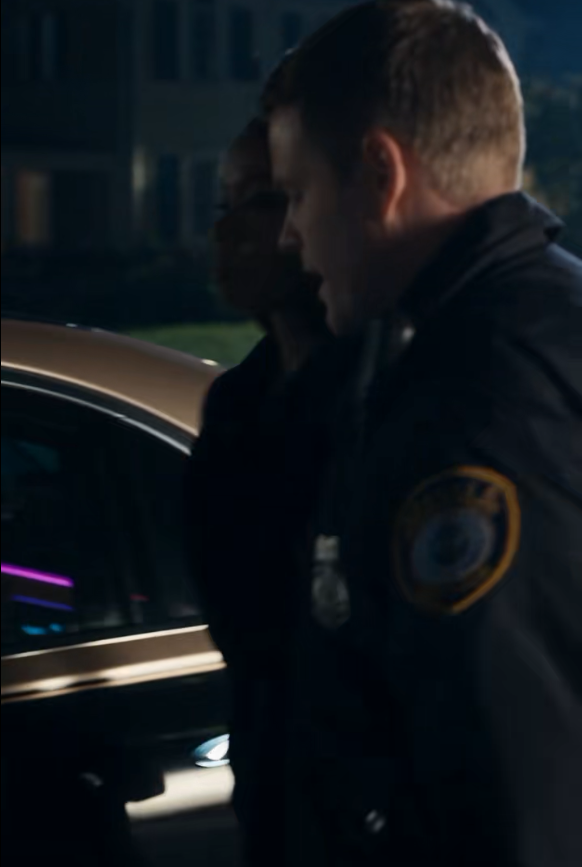
Her father’s Bible rested on the passenger seat.
She laid one swollen wrist on top of it.
For a moment, she did nothing.
Then she drove home.
At 12:06 a.m., Faith stood at her kitchen sink holding a bag of frozen peas against her wrist.
Her mother sat at the table wearing the navy-blue dress she had worn to the investiture ceremony. She had refused to change after Faith called.
Evelyn Sullivan was seventy-two, elegant even when furious, and had spent thirty-five years teaching fifth grade.
She looked at Faith’s wrists.
Then at the untouched cup of tea.
“You’re going to report him.”
Faith kept the peas pressed to the swelling.
“Yes.”
“To his department?”
“Yes.”
“To the Department of Justice?”
Faith looked out the kitchen window.
Her Mercedes sat in the driveway beneath the porch light.
“I don’t know yet.”
Evelyn’s eyebrows rose.
“Faith.”
“I don’t know everything yet.”
“I know enough.”
“So do I. That’s the problem.”
Evelyn sat back.
Faith crossed the kitchen and lowered herself into the chair opposite her.
“I can’t turn what happened to me into a verdict before there’s an investigation.”
“That man didn’t have any trouble reaching a verdict.”
“No.”
“Then don’t protect him.”
“I’m not.”
“It sounds like it.”
Faith rubbed the edge of the frozen bag with her thumb.
“I’m protecting the process.”
Her mother looked toward the Bible on the counter.
“Your father used to say things like that.”
“I know.”
“He also used to come home angry when people treated him like he didn’t belong in neighborhoods where he was fixing their pipes.”
Faith looked up.
Evelyn continued more quietly.
“He would park that old truck in somebody’s driveway, and twice a year somebody would call the police because they saw a Black man going into a house. He never told you most of it.”
Faith’s hand stopped moving.
“What?”
“He didn’t want you growing up afraid.”
Faith stared at her mother.
Evelyn folded her hands on the table.
“He wanted you to believe the law could be better before you learned how often it wasn’t.”
Faith looked toward the Bible again.
All those dinner-table definitions.
Probable cause.
Equal protection.
Reasonable suspicion.
Words her father had turned into homework because he wanted his daughter to know the structure of the world that might one day fail her.
“I thought he was just interested in law because of me.”
“He was interested because of himself too.”
Evelyn stood and kissed Faith’s forehead.
“Get some sleep.”
“I have arraignments at eight-thirty.”
“You’re going to court?”
Faith looked at her.
“Where else would I go?”
Part II — The Morning After
At 8:27 the next morning, Officer Derek Holloway stood at the defense table in Courtroom Four of the Ridgefield Federal Courthouse wearing yesterday’s certainty like a suit that no longer fit.
He had been awake most of the night.
At 1:14 a.m., Sergeant Price had called him.
By 2:00, Internal Affairs had requested preservation of the body-camera footage.
At 5:40, the department’s deputy chief had ordered Holloway to report for administrative reassignment after his federal court appearance.
And at 7:55, Holloway’s attorney had explained the part that had made his stomach turn.
The woman from the Mercedes was presiding over his case.
Holloway was not a defendant.
Not yet.
He was in federal court as the complaining officer in a narcotics prosecution built partly on a traffic stop he had conducted three months earlier.
United States v. Marcus Bell.
The prosecutor had expected a routine suppression hearing.
Holloway had testified twice before about the stop.
He had said Bell’s vehicle crossed the center line.
He had said Bell appeared nervous.
He had said he smelled marijuana.
He had said Bell consented to the search.
The search produced pills and an unregistered firearm.
The case had seemed clean.
Until that morning.
The courtroom deputy stood.
“All rise.”
The side door opened.
Faith entered in her robe.
Holloway stopped breathing for a second.
She did not look at him.
She took her seat.
“Please be seated.”
The room settled.
Faith reviewed the file in front of her.
The black robe felt different than it had the day before.
Heavier.
She could still feel the marks beneath the sleeves.
“Before we begin,” she said, “the court needs to address a matter of potential recusal.”
Holloway’s attorney looked at the prosecutor.
Faith continued.
“I had an encounter last night involving Officer Derek Holloway, who is a witness in this matter. I will not discuss facts outside the record except to say that the encounter creates an appearance issue the court must address before any substantive proceeding.”
Holloway finally looked up.
Faith’s expression gave him nothing.
“The parties are entitled to a neutral tribunal. Accordingly, I am transferring this suppression hearing to Judge Moreno.”
The prosecutor stood.
“Your Honor, may I ask whether the court is making any credibility determination regarding Officer Holloway?”
“No.”
“Any finding related to this case?”
“No.”
“Any recommendation?”
“No.”
Faith looked toward Holloway.
Only then.
“For the record, my recusal is not a sanction against anyone. It is exactly what judicial ethics require.”
Holloway swallowed.
Faith turned back to the clerk.
“Reassign the matter.”
There was a rustle behind him.
Reporters.
Someone had learned.
Faith saw them too.
By nine o’clock, the courthouse steps would be crowded.
By noon, the arrest footage would be the biggest story in Ridgefield.
But for that moment, inside Courtroom Four, she kept the proceeding ordinary.
That mattered to her.
When the case concluded, she rose and disappeared through the side door.
Holloway remained seated.
His attorney leaned toward him.
“You need to understand something.”
“What?”
“She just helped you.”
Holloway looked at him.
“She could have created an appellate nightmare if she’d touched your credibility. She didn’t.”
Holloway stared at the closed door.
He did not feel helped.
He felt exposed.
By lunchtime, thirty-two seconds of video had been posted online.
The clip began with Faith already against the hood.
“This car belongs to me.”
“Sure it does.”
Then:
“I am a federal judge.”
“A federal judge.”
The laugh.
The clip ended there.
The department released a statement before Faith had even seen the footage.
The incident was under administrative review.
Officer Holloway had been reassigned.
No conclusions should be drawn until all facts were known.
Faith read the statement from chambers.
Her law clerk, Maya Chen, stood near the desk holding a stack of emergency motions.
“You don’t have to watch any of it.”
“I know.”
“You also have seventy-three interview requests.”
“Decline them.”
“All?”
“All.”
Maya hesitated.
“The chief judge wants to know if you’d like security.”
Faith looked up.
“For what?”
“Threats started coming in.”
Faith’s face tightened.
Against whom?
Maya knew the question without being asked.
“Both directions.”
Faith leaned back.
The country had already split the encounter into teams.
Some people called Holloway a racist before an investigation had begun.
Others called Faith a liar, an activist, a quota judge, a criminal who had somehow manipulated police.
Strangers had found the address of the house where her mother still lived.