Chapter 8 — The Screen in the Courtroom
Noah ran across the parking lot with his backpack bouncing against his shoulders, and Mark met him halfway.
The boy wrapped both arms around Mark’s waist as if the distance from the school doors had been dangerous.
“Did you have a good day?”
Mark asked.
Noah nodded against his jacket, then shook his head.
Mark did not make him explain.
He took Noah’s hand and guided him to the car, feeling the unopened voicemail like a weight in his pocket.
At home, Noah went straight upstairs with a snack and a cartoon playing low behind his closed bedroom door.
Only then did Mark press play.
The caseworker’s voice was calm.
A formal home investigation had been opened after the counselor’s report.
Mark was asked to preserve all relevant material and make Noah available to be spoken with through appropriate channels.
Sarah arrived before he finished listening.
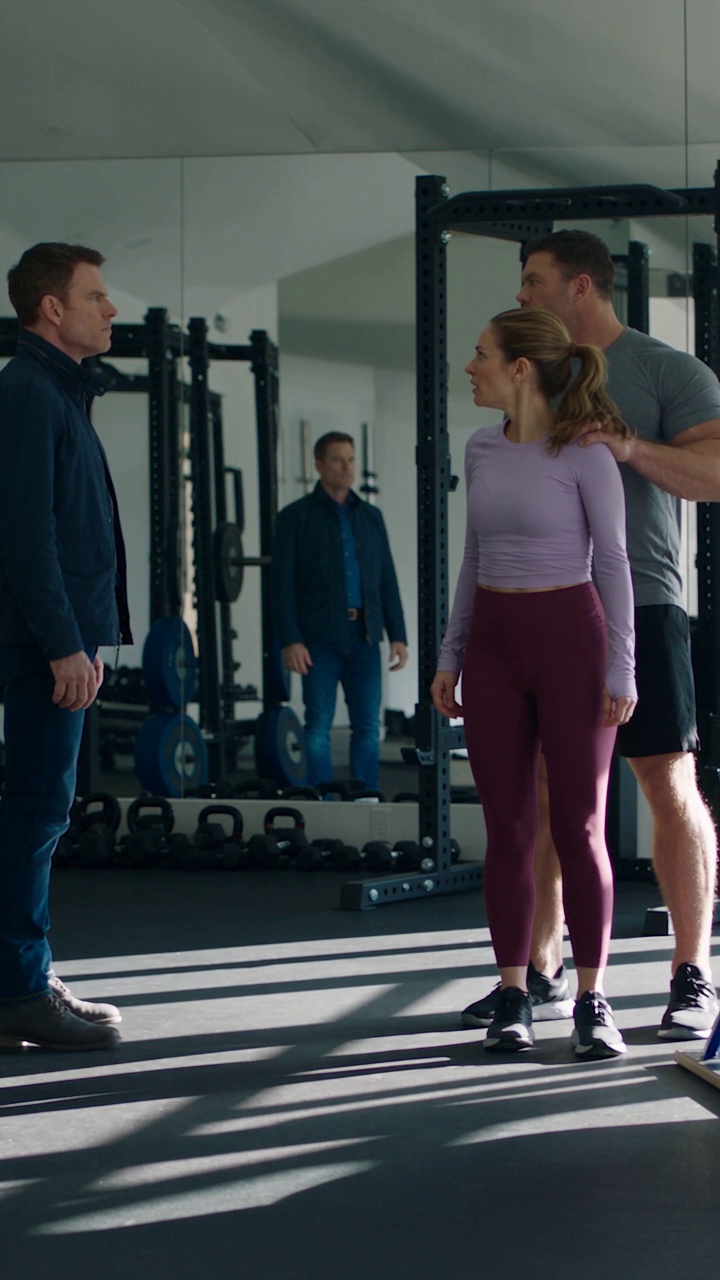
She stood just inside the kitchen, still in the purple workout top she seemed unable to stop wearing, her ponytail loosened around her face.
“You played it?” she asked.
“Yes.”
Her eyes moved toward the stairs.
“They can’t talk to him alone.”
“They can talk to him safely.”
“You don’t get to decide what safe is.”
The words landed hard, but Mark kept his hands flat on the kitchen counter.
“Noah already told someone what he saw because he couldn’t carry it by himself.”
Sarah’s face tightened.
“You’re turning one terrible moment into a weapon.”
“No.
I’m trying to stop every adult in this house from making him carry another one.”
For an instant, shame flickered through her expression.
Then it disappeared behind calculation.
“You have been recording things.
Watching me.
Going through my tablet.
Do you really think that makes you look stable?”
Mark looked at the dark screen of his laptop, locked beside the phone that held the gym footage.
“I think the truth looks like whatever it is.”
The investigation did not resolve anything quickly.
It made every room in the house feel borrowed.
Mark answered questions without embellishment.
Sarah answered them with a controlled fragility that made him understand how carefully she had built her version of him.
She called his silence cold.
She called his anger frightening.
She described his preservation of the footage as obsession.
But the footage had no anger until after the betrayal.
The financial records did not tremble when Sarah spoke.
The screenshots from her tablet did not change because she wished they would.
By the time the custody and divorce hearing began, Mark had learned to sit still through lies.
He sat at one end of the courtroom table in a plain suit, his phone and laptop no longer in his hands but cataloged with the records produced from them.
Across the aisle, Sarah sat rigidly beside her attorney.
The trainer sat farther back, grey shirt exchanged for a dark jacket, his broad shoulders drawn inward as if he could shrink beneath the courtroom’s fluorescent lights.
Noah was not there.
Mark had insisted on that much, and this time no one had argued.
When the screen came alive, the room seemed to lose air.
It showed the home gym from its fixed corner near the mirrored wall.
Sarah and the trainer stood in the open space between the squat rack and dumbbell rack.
Then they kissed.
Mark did not look at Sarah.
He watched the image of Noah appear at the edge of the doorway, small in his burgundy cardigan, frozen before he understood what he was seeing.
The courtroom speakers carried Mark’s own voice: “Noah.
Stay there.”
Then the trainer’s: “Calm down.”
Then Noah’s frightened cry.
“Mom!”
The recording ended, but the word remained inside Mark’s chest.
Sarah’s attorney rose quickly, arguing that a few seconds of video could not capture the history of a marriage or establish what kind of father Mark was.
The point was fair, in a way.
A marriage was larger than a recording.
But so was betrayal.
When Sarah took the stand, she began with the careful voice Mark had come to dread.
She said the footage was humiliating.
She said Mark had frightened her in the gym.
She said his conduct after the incident had become increasingly controlling.
Then Mark’s attorney placed the financial records in front of her.
“Are these household accounts?”
Sarah folded her hands.
“Some are.”
“Do the transfers shown here come from those accounts?”
“I handled bills.”
“That was not my question.”
Her gaze slid toward the trainer.
The attorney continued, one transfer at a time.
Months of payments.
Amounts labeled as household expenses, then traced through the account information attached to the records.
The trainer’s account.
Sarah answered more slowly.
“He was helping with training.”
“Was he being paid through undisclosed transfers from the household account?”
“I don’t know how they were categorized.”
The forensic examiner’s report was entered next: records extracted from Sarah’s tablet, transaction histories matched to the accounts, and the messages Mark had photographed before the device could be cleared.
The screen displayed the conversation in stark lines.
The planned sale of Mark’s family asset.
The money they expected to take.
The references to custody pressure as part of their way out.
Sarah stared at the words as though they belonged to someone else.
“Did you write these messages?”
Mark’s attorney asked.
Her mouth opened.
Nothing came out.
“Mrs. — did you write them?”
“They were private,” she whispered.
“That is not an answer.”
Her composure broke so quietly that at first Mark only noticed her shoulders moving.
She covered her face with both hands.
A sound escaped her, raw and unguarded.
The woman who had described him as dangerous could no longer look at the video, the accounts, or the messages that had turned her story inside out.
Mark felt no victory.
Only a dull grief for the life that had brought Noah into this room without ever letting him enter it.
Across the courtroom, the trainer leaned toward his attorney.
His eyes fixed on Sarah, then shifted to the records on the screen.
Whatever protection had passed between them in the gym was gone.
He lifted one hand.
“I need to testify,” he said.