Adrian was formally charged on a Thursday.
Patricia called me while I was in a meeting.
I stepped into the hallway.
"Domestic @sNextlt, one count.
The DA also added intimidation based on the phone call recording and the text." A pause.
"He entered a not guilty plea.
His attorney is already pushing for a continuance."
"And Charles?"
"Arraigned this morning.
Unlawful imprisonment of Daniel — that's the primary charge.
Financial fraud is being processed separately because of the scope.
His business partners have retained their own counsel and are cooperating with investigators." Another pause.
"Eleanor has not been charged with anything.
But she has been named in the civil suit Daniel's attorney filed this morning."
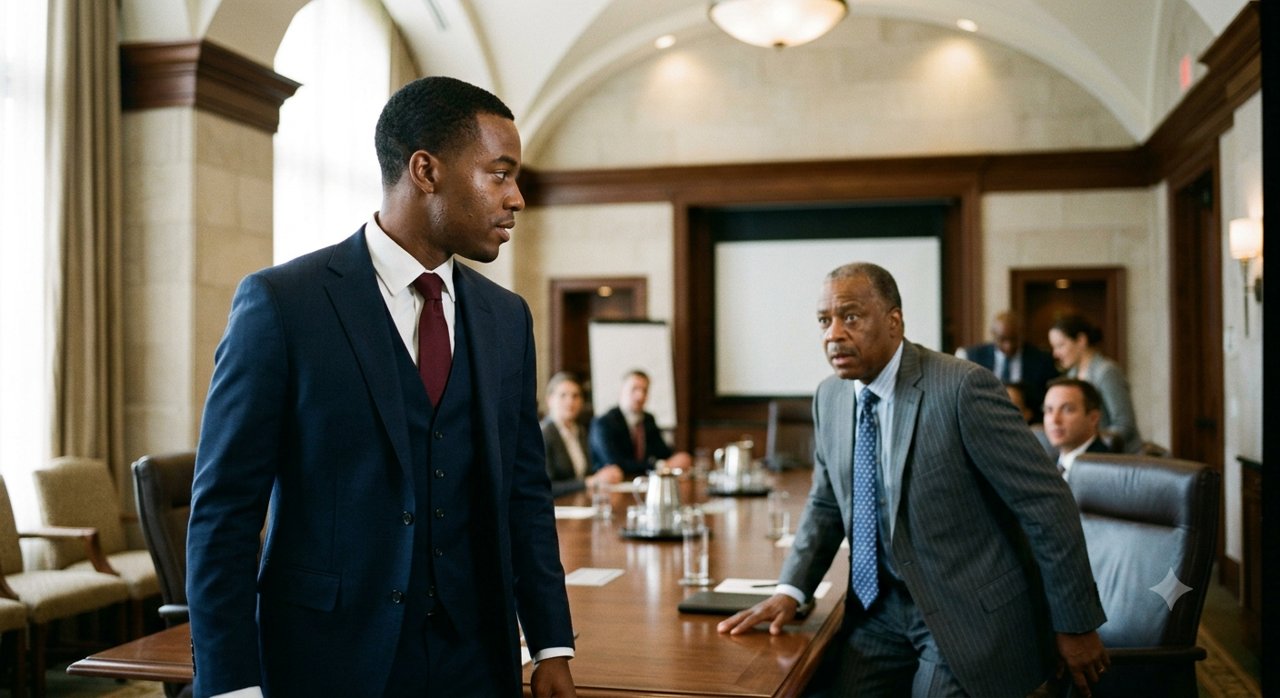
I looked through the glass at my colleagues waiting inside the conference room.
"Patricia," I said.
"The civil suit — is that separate from my case?"
"Entirely.
Daniel is pursuing that independently.
But the evidence overlaps significantly, which helps both of you." She paused.
"How are you holding up?"
"Fine," I said.
Then: "I don't know.
I thought I would feel more when it happened."
"You've been braced for a fight for weeks," she said.
"The feeling comes later, when you stop bracing."
She was right.
It came on a Saturday, six weeks after the dinner.
I was at the farmers market two blocks from my condo — something I had done every Saturday before I married Adrian and had somehow stopped doing in the years since.
I was standing at a stall looking at tomatoes, and the woman running the stall said something ordinary — asked if I was cooking for a crowd or just for myself — and I said just for myself, and she smiled and said that was the best kind of cooking, and I paid for the tomatoes and walked three steps away and stood on the sidewalk and cried.
Not from sadness.
From the simple, physical relief of being exactly where I was.
Alone.
Unbothered.
In possession of my own Saturday morning.
I stood there for probably two minutes.
Then I wiped my face and went to the next stall.
Maya texted me that afternoon.
*Daniel's hearing is next month.
His attorney says it's looking good.
I wanted you to know.*
I texted back: *I'm glad.
How are the kids?*
*Loud*, she wrote.
*Perfect.*
I smiled at my phone.
Then: *Claire — I've been wanting to ask you something.
Would you want to have coffee sometime?
Just us.
No lawyers, no cases, no family drama.*
I looked at the tomatoes on my counter.
*Yes*, I wrote back.
*Absolutely yes.*
The trial — Adrian's — was set for four months out.
Charles's case was on a separate, longer timeline given the complexity of the fraud charges.
Patricia kept me informed at every step.
I did not attend every hearing.
I did not need to be present for every procedural motion.
I had a life to return to, and Patricia was clear that returning to it was not avoidance — it was the correct response to a situation that was now, largely, out of my hands and in the hands of people whose job it was to handle it.
I went back to the farmers market the following Saturday.
And the one after that.
On a Tuesday in October, four months after the dinner, I sat in a courtroom and watched Adrian's attorney deliver an opening statement that described my husband as a man pushed to a breaking point by a wife who had become hostile and financially controlling.
I sat beside Patricia and I did not react.
The attorney for the prosecution stood up next.
She was young — younger than I expected — with a quiet, methodical manner that reminded me a little of Vasquez.
She said: "The defense will tell you this was a moment of passion.
The evidence will show you it was a pattern."
Then she put the photographs on the screen.
The dining room.
The tablecloth.
The broken porcelain.
The paramedic's report.
The text message sent two hours later.
The phone call recording.
The bank records.
The basement room.
The cot.
The single water bottle.
Forty-three transfers.
Two hundred and thirty-eight thousand dollars.
Four days.
The courtroom was very quiet.
I looked at Adrian across the room.
He was looking at the screen.
He did not look at me.