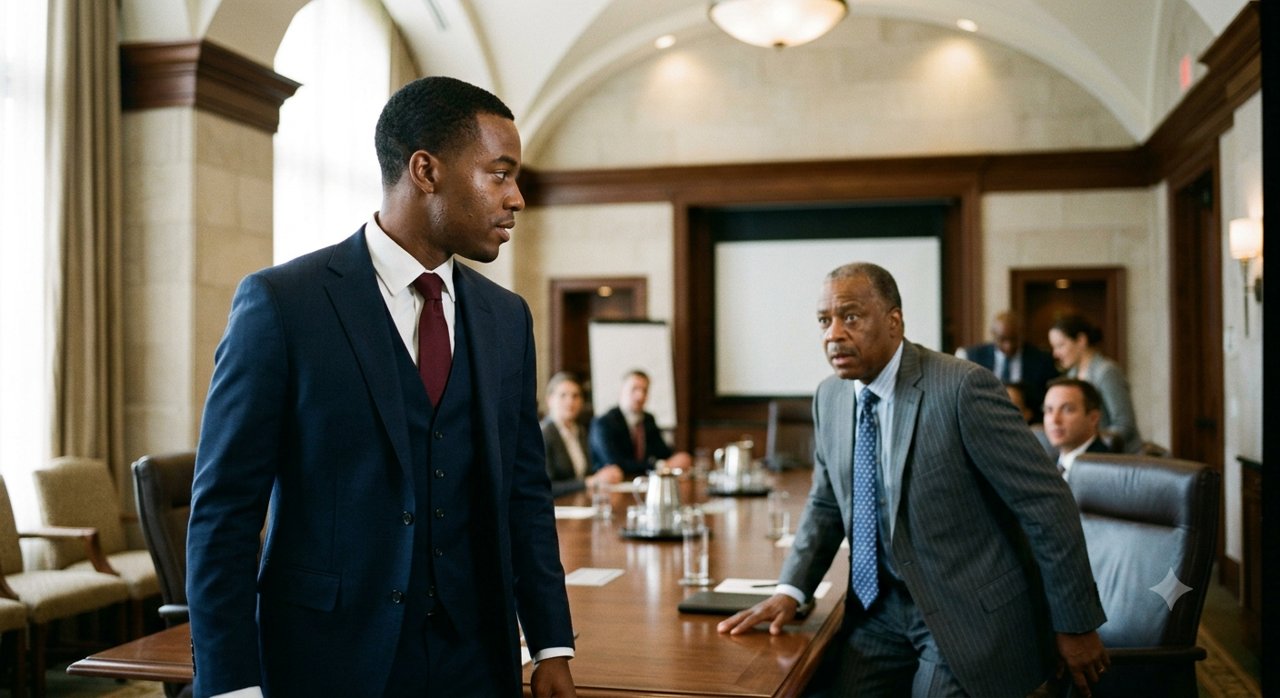
Torres heard it too.
His hand stopped on his radio.
His head turned toward the hallway.
"What was that?" he said.
Nobody answered.
Reyes was already moving.
Charles stepped directly into his path.
"You do not have permission to go down there."
"Sir, I heard a sound from inside this residence that may indicate someone needs assistance." Reyes did not slow down.
"Step aside."
"I will have your badge—"
"Step aside, sir."
Charles did not move.
Torres crossed the room in four steps and placed himself beside Reyes.
"Mr.
Charles," Torres said, "if you obstruct us from investigating a possible welfare concern, I will place you in handcuffs right now.
Do you understand me?"
Something shifted in Charles's face.
The certainty cracked — just enough.
He stepped aside.
The two officers moved into the hallway.
I followed.
The paramedic said something behind me about sitting down, but I was already at the top of the basement stairs.
The door at the bottom was heavy — solid wood, with a deadbolt that had been installed recently.
The lock was new.
The door frame around it was old.
Someone had added that lock within the last year or two.
Torres knocked firmly.
"This is the police.
If anyone is inside, please respond."
Silence.
Then: three slow knocks from the other side.
Deliberate.
Measured.
Torres looked at Reyes.
"We need that key," Torres said, turning back toward the hallway.
Charles stood at the end of it, arms crossed.
"I told you.
Private financial records—"
"The key," Torres said.
"Now.
Or I call for backup and we take the door off its hinges."
A long pause.
Then Charles reached into his jacket pocket and placed a single key on the hallway table without looking at either officer.
Torres picked it up.
The lock turned.
The door opened.
The room was small — perhaps ten feet by twelve.
Filing cabinets along one wall.
A folding table.
A laptop, closed.
A cot against the far wall with a thin blanket folded at the foot of it.
And sitting on the edge of that cot, blinking against the sudden light, was a man I had never seen before.
He was in his mid-thirties.
Dark circles under his eyes.
Three days of stubble.
He was wearing a dress shirt that had been slept in too many times.
Maya made a sound I had never heard from a person before — something between a cry and a gasp — and pushed past both officers.
"Daniel."
He stood up.
His legs were unsteady.
"Maya." His voice was rough, like someone who had not used it in days.
"How did you—"
"She called the police," Maya said.
She grabbed his face in both hands.
"She actually called the police."
He looked past her, toward me, toward Torres, toward the open door.
Then he looked toward the hallway where Charles was standing.
The expression on Daniel's face was not anger.
It was the expression of a man who had stopped being surprised by anything this family did — and had simply been waiting to find out whether anyone would ever come.
"How long?" Torres asked.
Daniel sat back down on the edge of the cot.
His hands were on his knees.
"Four days," he said.
The room went very quiet.
"He locked you in here four days ago," Torres said.
"I told him I was going to the police.
About the accounts.
About what he'd been doing." Daniel looked at his hands.
"He said if I did, he would make sure Maya lost the children.
He said he had documentation showing she was an unfit mother.
He said it would take one phone call." A pause.
"Then he said I could stay down here until I changed my mind."
Torres was already on his radio.
Reyes was taking photographs of the room — the lock, the cot, the door, the single bottle of water on the floor beside it.
I stood in the doorway and looked at this man I had never met — my husband's brother — sitting in a basement room his own father had locked him inside.
Maya was still holding his hand.
She hadn't let go since the moment she reached him.
"What accounts?" I asked.
Daniel looked up at me.
"You're Claire," he said.
"Yes."
He was quiet for a moment.
Then: "He's been moving money through your joint account for two years.
Small amounts.
Irregular intervals.
Enough that it wouldn't trigger an automatic flag." He paused.
"I found out because I do the books for one of his subsidiary companies.
I saw the routing.
I traced it back." Another pause.
"When I told Adrian I knew, he told Charles.
And Charles told me that if I went to anyone — anyone at all — he would destroy my family."
I thought about the joint account.
The one Adrian had insisted we open six months into our marriage.
The one I had stopped monitoring closely because Adrian handled the finances and I trusted him.
The one I had never questioned.
"How much?" I said.
Daniel looked at me steadily.
"Over the last two years?" He exhaled slowly.
"Approximately two hundred and forty thousand dollars."
The hallway behind me had gone completely silent.
I turned around.
Adrian was standing at the top of the basement stairs.
He was looking at his brother.
And the smile from earlier — the cold, certain smile — was completely gone.