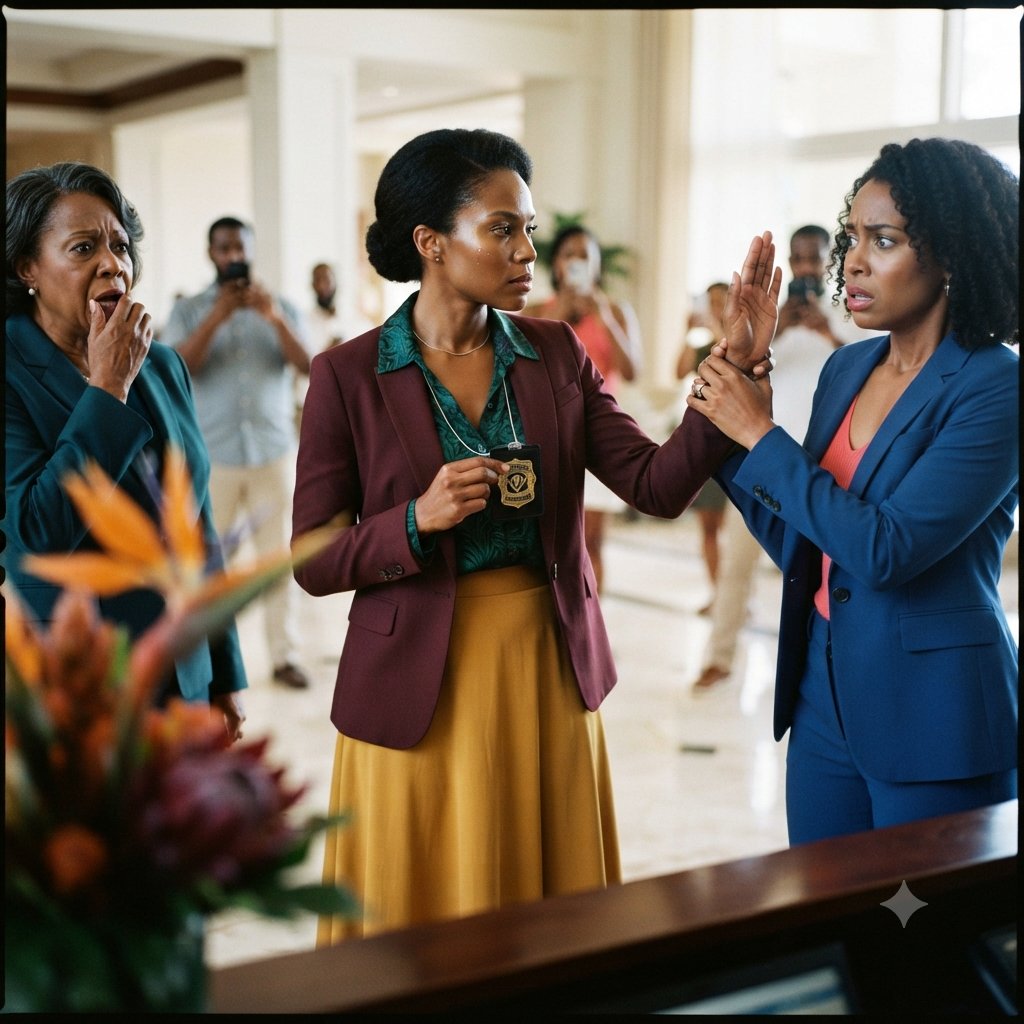
The band had started playing again — something soft and inappropriate — and the contrast made Amanda's words feel even sharper.
"Sit down, Amanda," Chloe's mother said from across the room.
She had reappeared from wherever she had retreated to during the footage.
Her voice carried the particular authority of a woman who had spent decades managing other people's mistakes.
"No." Amanda didn't look away from my father.
"I'm tired of sitting down."
My father regarded her with the same unhurried patience he had shown since he walked through the door.
"Say what you want to say," he told her.
Amanda's chin came up.
"Seventeen years ago, there was a land dispute.
A development project on the east side of the city.
Three families lost their properties.
One of them was my grandmother's."
The room had gone quiet again.
The band trailed off mid-phrase.
"The developer had connections," Amanda continued.
"The kind that made city permits move faster than they should.
The kind that made appeals disappear." She paused.
"The company was called Ashworth Development."
Martin Graves started to speak.
My father raised one hand slightly, and Martin stopped.
"I know the case," my father said.
"Then you know what happened to my grandmother."
"I know what happened," he said.
"And I know what was done about it afterward."
Amanda's expression flickered.
"Nothing was done."
"The settlement was handled privately," my father said.
"At your grandmother's request.
She didn't want litigation.
She wanted the matter closed.
Martin handled it personally."
Martin nodded once.
"I did."
"That's not—" Amanda stopped.
"She never told me about a settlement."
"She was eighty-one years old and she wanted peace," my father said.
"She got it.
The amount was fair.
More than fair.
The documentation is in our files if you want to see it."
Amanda's jaw tightened.
"You think money fixes everything."
"No," my father said.
"I think your grandmother made a choice that was hers to make.
And I think you've been carrying a story for a long time that isn't entirely the one she lived."
Something moved across Amanda's face.
Not defeat.
Something more complicated than that.
"Even if that's true," she said, and her voice had dropped, "it doesn't change what this family did to Vivienne.
What Chloe did tonight."
"No," my father agreed.
"It doesn't."
He looked at her for a moment longer.
"If you want to see the settlement records, call Martin's office on Monday.
He'll pull the file."
Amanda said nothing.
The woman in the grey blazer appeared at my father's elbow.
She leaned in and said something quietly.
My father listened, then turned to me.
"There's a private room upstairs," he said.
"You should sit down.
You've been standing for a long time."
He was right.
My lower back had been aching for the last forty minutes and I had been refusing to acknowledge it.
"I'm fine," I said.
"Vivienne."
"I know." I pressed one hand briefly to my side.
"All right."
He gestured to the woman in the grey blazer, who moved toward the side staircase.
I followed her, and my father fell into step beside me.
We were almost to the door when Dominic's voice came from behind us.
"Can I come?"
I stopped.
I didn't turn around immediately.
I stood there for a moment with my hand on the door frame, feeling the weight of the question and everything underneath it.
Then I looked back.
Dominic stood in the middle of the ballroom floor, surrounded by two hundred people who were all very carefully not watching him.
His jacket was slightly rumpled.
His bow tie had come loose at some point in the last hour.
He looked like a man who had just watched the ground shift under his feet and was still deciding whether to move.
"That's up to Vivienne," my father said, without looking at him.
I studied my husband's face.
Three years of promises.
Three years of afterward.
Three years of they'll come around and give them time and they don't mean it the way it sounds.
And tonight, in the moment that mattered most, he had sighed and looked away.
"Not tonight," I said.
Dominic's shoulders dropped slightly.
He nodded once, slowly, the way a man nods when he knows he has no right to argue.
I went through the door.
The private room upstairs was quiet and simply furnished — a sofa, a low table, a window overlooking the city.
The woman in the grey blazer brought water and a plate of food from somewhere without being asked.
My father sat across from me and said nothing for a while, which was one of the things I had always loved about him.
Then he said, "How long has it been this bad?"
"It got worse after I got pregnant," I said.
"Before that it was just — comments.
The way they talked around me.
The way Dominic never pushed back."
"Did he know how bad it was?"
I thought about it honestly.
"He knew enough.
He chose not to know the rest."
My father was quiet for a moment.
"What do you want to do?" he said.
I looked out the window at the city below.
Somewhere down there, Chloe and Garrett were having a conversation that was going to change the shape of their new marriage.
Eleanor was on the phone with an attorney.
Amanda was sitting with whatever she had just learned about her grandmother.
And Dominic was standing in the middle of a ballroom, alone, understanding for the first time what his silence had cost him.
"I don't know yet," I said honestly.
My father nodded.
He reached across and set his hand briefly over mine.
Then he sat back.
"Take your time," he said.
"You're not going anywhere tonight."
My phone lit up on the table between us.
A message from Dominic.
*I know I don't deserve to ask.
But can we talk?
Not tonight.
Whenever you're ready.
I need to say some things I should have said a long time ago.*
I read it twice.
Then I turned the phone face-down on the table.
My father didn't ask what it said.
Downstairs, I heard the sound of voices rising again — sharp, urgent, overlapping.
Not the wedding guests.
Something else.
My father's phone rang.
He looked at the screen, then stood up.
"That's Martin," he said.
His expression had shifted into something careful and controlled.
"Stay here."
"What is it?"
He was already moving toward the door.
"Stay here, Vivienne," he said again, and this time there was something in his voice that made me set down my glass.
He stepped out and pulled the door closed behind him.
Through the floor, I could feel the vibration of raised voices.
Then, clearly, even through the ceiling:
Eleanor's voice.
And one sentence that carried up through the building like a crack through glass.
"Tell them about the child."