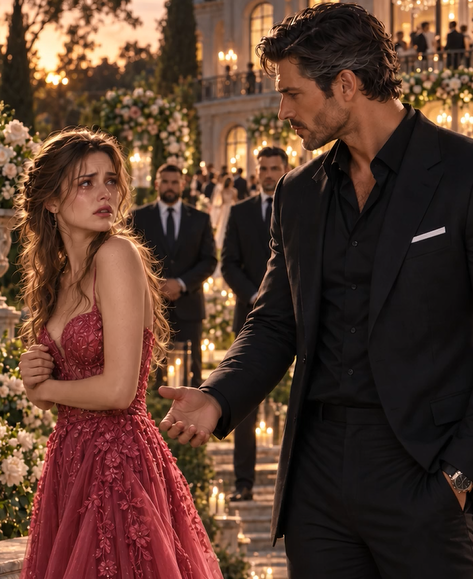
PART 1 — THE WEDDING CAKE
Four days of my life had gone into baking the wedding cake for the man who once told me I wasn’t the kind of woman a successful man could build a future with.
Now I stood twenty feet away beneath crystal chandeliers, watching Daniel Whitmore marry someone else while pretending the knife in my hand wasn’t shaking.
The six-tier cake stood beneath a spray of ivory roses at the edge of the ballroom, nearly six feet tall and covered in hundreds of sugar petals I had shaped one by one.
I had slept eleven hours since Wednesday.
Total.
There was flour beneath one fingernail, buttercream dried against the inside of my wrist, and the navy dress I wore had cost forty-two dollars at a consignment store on Charlotte Avenue.
Across the room, Daniel looked radiant.
That was the cruelest part.
He didn’t look haunted.
He didn’t look uncertain.
He looked exactly like a man whose life had turned out according to plan.
Sophia Harrington stood beside him in a silk gown that probably cost more than Monroe Street Bakery made in three months. She was beautiful in a soft, expensive way, the kind that looked effortless because dozens of people had been paid to make sure it did.
Daniel bent to whisper something near her ear.
Sophia laughed.
I looked away.
“Don’t.”
Patrice Monroe stood beside me.
At sixty-one, my aunt could silence a room with one eyebrow and had once chased a drunk customer out of our bakery with a wooden rolling pin.
Tonight she wore a plum-colored dress, sensible shoes, and the expression of a woman deciding whether prison time was worth it.
“Don’t what?” I asked.
“Pretend you don’t care.”
“I’m not pretending.”
“Baby, you’ve been holding that cake knife for five minutes.”
I looked down.
She was right.
“I’m working.”
“You finished twenty minutes ago.”
“The final payment hasn’t cleared.”
“It will.”
“The third tier shifted.”
“You fixed it.”
“The flowers—”
“Grace.”
Her voice softened.
“You survived him leaving.”
I swallowed.
“That doesn’t mean I have to enjoy watching this.”
Eighteen months earlier, Daniel had ended our relationship in the apartment we practically shared.
There had been no cheating.
No screaming.
No plate thrown against a wall.
Sometimes I wished there had been.
Anger was easier to survive than calm disappointment.
Daniel had sat across from me with a coffee mug between his hands and said, “I need someone more established.”
Then came the numbers.
Investment accounts.
Networking dinners.
Property.
Career trajectory.
Five-year plans.
Back then, I was twenty-eight years old, making $16.50 an hour plus overtime, driving a twelve-year-old Honda Civic, and sending my mother four hundred dollars every month because her arthritis had gotten too bad for full-time work.
“You’re wonderful,” Daniel had told me.
I remembered every syllable.
“But love isn’t always enough.”
Six months later, he met Sophia.
Twelve months after that, his wedding order arrived at Monroe Street Bakery.
I had stared at his name for almost a full minute before putting on my apron.
Because heartbreak did not pay utility bills.
Pride did not repair industrial ovens.
And rent did not care who had once promised to love you.
“I’m going outside,” I told Patrice.
“Good.”
“I’ll be back before they cut the cake.”
“If they cut anything before you return, I’ll cut Daniel.”
Despite everything, I laughed.
Then I slipped through a side door.
I kept walking until the music faded behind me.
Callaway Estate stretched over acres of rolling Tennessee land, all white stone, clipped hedges, fountains, and old money pretending it hadn’t been built by somebody else’s tired hands.
Behind the mansion, I found an old maple tree beside a stone bench.
I sat.
And for the first time all evening, nobody needed anything from me.
That was when Daniel’s old question came back.
Not the words he’d actually said.
The ones underneath them.
What if he had been right?
What if working hard wasn’t the same thing as becoming someone worth choosing?
I hated myself for still wondering.
Footsteps crunched over gravel.
I wiped quickly beneath one eye.
A man appeared around the hedge carrying two glasses of water.
Tall.
Broad-shouldered.
Late thirties, maybe.
His dark hair was beginning to gray at the temples. His suit was black and perfectly cut, but there was something about him that made the expensive fabric irrelevant.
He didn’t look polished.
He looked contained.
Like whatever lived underneath his calm had learned years ago that it didn’t need to raise its voice.
He stopped when he noticed me.
“Sorry,” he said. “Thought this part of the garden was empty.”
“So did I.”
He glanced at the two glasses.
Then offered one.
“I apparently stole more water than I need.”
I took it.
“You steal aggressively.”
Something faint moved at the corner of his mouth.
“I’ve been accused of worse.”
He sat at the far end of the bench.
Not close enough to make me uncomfortable.
Not far enough to pretend we weren’t sitting together.
For a while, neither of us spoke.
The silence was strangely easy.
Finally, he nodded toward the glowing mansion.
“Escaping the wedding?”
“Temporarily.”
“Family?”
“Ex-boyfriend.”
His eyes shifted toward me.
“He’s the groom?”
I nodded.
For the first time, his composure cracked slightly.
Not pity.
Something sharper.
“You baked the cake.”
I looked at him.
“How did you know?”
He glanced at my hand.
“Sugar burn on your thumb. Flour beneath your nail.”
I hid my hand automatically.
He said, “Occupational hazard?”
“Occupational lifestyle.”
That almost-smile again.
Then two men in dark suits appeared at the edge of the garden.
One lowered his head.
“Mr. Moretti. We found the car.”
Everything inside me stopped.
Moretti.
Everyone in Nashville knew the name.
Adrian Moretti wasn’t the kind of man who appeared in newspaper profiles smiling beside giant checks.
He was the man whispered about after the journalists went home.
Restaurants opened because he wanted them open.
Businesses closed because he wanted them closed.
Men who normally bragged about knowing everybody tended to lower their voices before saying they knew someone who knew Adrian Moretti.
He looked at me.
Saw the recognition.
And, to his credit, didn’t pretend not to.
Then he stood.
He held out his hand.
“Come with me.”
I stared at it.
“No.”
One of the men behind him blinked.
Adrian didn’t.
“No?”
“I don’t know you.”
“You know my name.”
“That’s exactly why I’m saying no.”
His mouth almost moved.
Then the garden door opened.
Daniel stepped outside.
His smile disappeared the second he saw us.
Not because I was talking to another man.
Because of who the man was.
“Grace.”
I hated how quickly my body remembered his voice.
Adrian lowered his hand.
Daniel approached slowly.
“Mr. Moretti.”
“Whitmore.”
Daniel looked between us.
“What are you doing out here?”
Adrian answered first.
“Drinking water.”
“That wasn’t what I meant.”
“No. I know.”
There was history between them.
I could feel it.
Daniel looked at me.
“You should go back inside.”