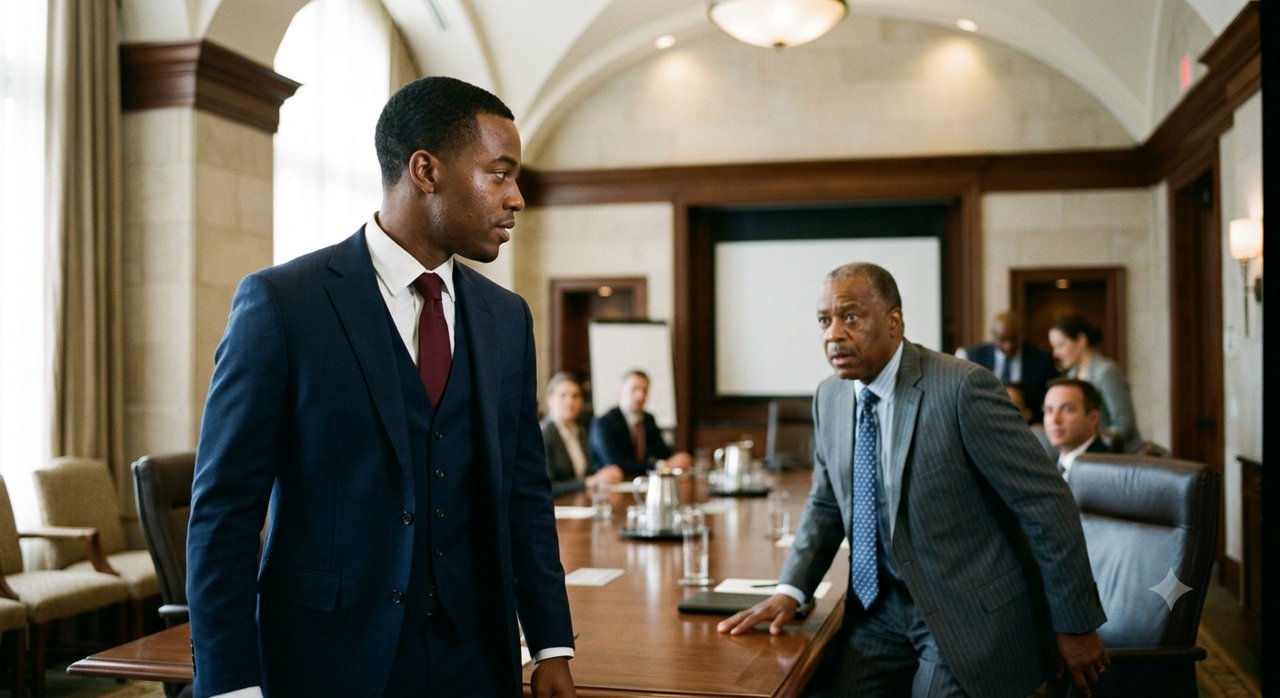
They took Miriam and Vanessa out separately.
Vanessa went quietly — too quietly, the kind of quiet that comes from someone who has already decided their next move and doesn't want to show it yet.
She didn't look at Ethan as she passed the kitchen doorway.
She looked at the floor, her jaw set, her handbag held against her side like a shield.
Grant was still in the ballroom when Calloway's partner went back for him.
Ethan heard him ask if he could speak to Ethan first.
He left Mrs.
Parrish with the girls and walked back to the ballroom.
Most of the guests had been asked to wait — names taken, contact details recorded — and were seated in small clusters along the walls, speaking in low voices.
Douglas stood near the window.
He gave Ethan a short nod as he came in.
Grant was seated at the head table.
He looked like a man who had put something down after carrying it for a very long time and wasn't sure yet if he felt better or worse for having let go.
Ethan sat across from him.
"I didn't know about the recording," Grant said.
"The November one.
I didn't know she'd spoken to Claire directly."
"What did you know?"
Grant looked at the tablecloth.
"I knew Miriam wanted control of the trust.
I knew she was angry that your father had structured it the way he did — with Claire as a secondary holder while you were overseas.
I knew she thought Claire was an obstacle."
"An obstacle," Ethan repeated.
"That's the word she used.
I didn't think she meant—" He stopped.
"I told myself I didn't think she meant anything beyond legal maneuvering.
Contesting the structure.
Finding a clause."
"But you looked toward this room when I asked who else was involved."
Grant didn't answer that directly.
"When Claire went into the hospital, Miriam moved fast.
She had documents drawn up within two weeks.
She brought Vanessa in — Vanessa is her niece, did you know that?
Not a professional hire.
Her niece.
She put her in charge of the girls and told me the arrangement was temporary, just until you came home."
"Seven months isn't temporary."
"No." Grant's voice was flat.
"It isn't."
"And the girls?
What they were being fed?
What they were being told about their mother?"
Grant's hands pressed together on the table.
"I came to the house twice.
Both times Vanessa told me the girls were fine.
That they were adjusting.
That children that age don't retain much." He paused.
"I didn't go into the breakfast room.
I stayed in the front rooms where everything looked normal."
"You chose not to look."
It wasn't a question.
Grant didn't treat it like one.
"Yes," he said.
"I chose not to look."
Ethan sat with that for a moment.
Outside the ballroom windows, the Christmas Eve sky was dark and clear.
He could see the driveway from where he sat — the police vehicles, the cold light, the shapes of people moving.
"Miriam told me Claire was already terminal," Grant said.
"That the doctors had given her very little time.
That the trust restructuring was just practical planning." He looked up.
"I wanted to believe that.
It was easier to believe that."
"My daughters were three years old," Ethan said.
"They were barefoot in December.
They were eating mold."
Grant flinched.
It was the first time his composure had broken in a visible way — not the hollow blankness from earlier, but something sharper.
Something that looked like it actually hurt.
"I know," he said.
"Claire left a recording for them.
She hid it because she was afraid that if she d*ed, someone would take even that from them.
She was sick and frightened and she still thought to do that." Ethan leaned forward slightly.
"She thought to do that because she knew what kind of people she was dealing with.
She knew, Grant.
She told you on that recording.
And you were in this house twice and you chose not to look."
Grant said nothing.
"I need to know one more thing," Ethan said.
"The survivorship clause.
The one Miriam mentioned to Claire.
Was it real?
Was it actually in the contract?"
Grant was quiet for a long moment.
"No," he said finally.
"She invented it.
There is no such clause.
She told Claire that to frighten her.
To make her feel like she had no ground to stand on." He looked at Ethan.
"I found out two weeks after Claire went into the hospital.
I confronted Miriam about it."
"And?"
"She told me it didn't matter anymore."
The room went very still.
Ethan stood up slowly.
He looked at Grant — at the man who had chosen not to look, who had let himself be told what was convenient, who had stood in this house twice and stayed in the front rooms where everything looked normal.
"Tell the officer everything," Ethan said.
"All of it.
Every conversation.
Every document.
Every date."
"I intend to."
Ethan walked back toward the kitchen.
Behind him, he heard Grant's chair scrape back — the sound of a man finally standing up, too late, to do the right thing.