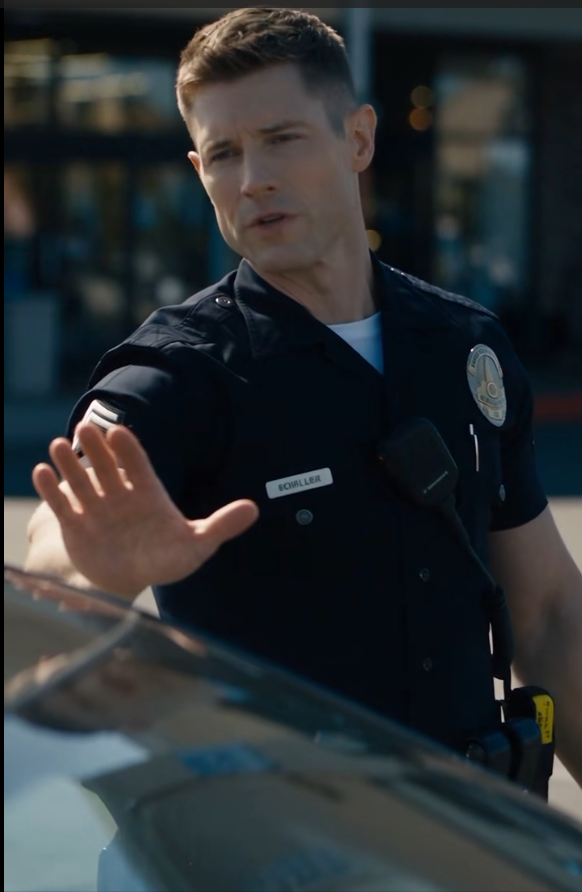
The first thing I noticed was not the officer’s hand hovering near his duty belt.
It was the way people started turning their phones toward me.
One by one, shoppers stopped between parked cars, grocery bags hanging from their wrists, coffee cups halfway to their mouths. A teenager beside a row of carts lifted his phone. A woman loading boxes into an SUV froze with her trunk open. Two men near the pharmacy entrance exchanged looks and started recording.
Only then did I fully understand how quickly an ordinary Saturday morning had become something else.
“Step out of the vehicle.”
Officer Derek Mitchell’s voice carried across the parking lot with such force that several people in the next row turned around.
I was sitting inside my black Mercedes, moving a shopping bag from the center console to the passenger seat.
I lowered the window.
“Officer,” I said, “is there a problem?”
Mitchell stared at me as if the question itself annoyed him.
“Step out.”
There was no explanation.
No greeting.
No indication that he had checked the license plate.
No request for my name.
Just the command.
I opened the door slowly and stepped onto the pavement.
I was fifty-three years old that spring. I had spent more than two decades practicing law, hearing testimony, studying procedure, watching nervous people stand beneath fluorescent courthouse lights while their entire futures depended on what happened next.
I had learned long ago that the most dangerous moment in any confrontation is often the moment when pride begins making decisions faster than reason.
So I kept my voice level.
My hands visible.
My breathing slow.
“May I ask why you’ve stopped me?”
Mitchell looked at the Mercedes.
Then at me.
Then back at the Mercedes.
“Whose car is this?”
“Mine.”
He gave a small laugh.
Not amused.
Disbelieving.
“Of course it is.”
That sentence changed everything.
It was not the question.
It was the assumption behind it.
I studied him carefully.
His nameplate read MITCHELL.
His posture was rigid. His right shoulder sat slightly higher than his left. His eyes kept flicking toward the people recording us.
He knew he had an audience.
And instead of making him cautious, it seemed to make him bolder.
“Why are you questioning whether I own my own vehicle?” I asked.
“Registration and identification.”
“They’re in my handbag.”
“Then get them.”
I reached toward the passenger seat.
“Don’t start reaching around!”
I stopped immediately.
A murmur traveled through the growing crowd.
“You just asked me for my documents,” I said.
Mitchell stepped closer.
“I said don’t move unless I tell you to move.”
I looked directly at him.
“All right.”
The morning sun reflected off the Mercedes behind me.
It had been a peaceful morning before this.
Almost offensively peaceful.
I had awakened later than usual, poured coffee, and stood barefoot in my kitchen while sunlight moved through the windows. For once there were no emergency motions to review before breakfast. No attorneys emailing chambers before sunrise. No reporters calling the courthouse clerk. No stack of sentencing memoranda waiting beside my robe.
My house was quiet.
On the small table near the front door sat a wooden key holder my father had given me thirty years earlier when I became an attorney.
It carried a brass plate engraved with eight words:
For my daughter, who will change the world.
My father had never lived to see me become a judge.
He died six months before my appointment to Superior Court.
But every difficult morning, I still touched those words before leaving home.
That Saturday, I had smiled at them.
I remember that very clearly.
Because I thought I was leaving for nothing more serious than errands.
I stopped at the neighborhood market first, where I found Mrs. Patterson, my eighty-two-year-old neighbor, struggling with grocery bags.
“Absolutely not,” I told her. “Give me those.”
She laughed.
“You’re a judge, Valerie. You’re not supposed to carry my canned tomatoes.”
“I don’t remember that part of the judicial code.”
She handed me the bags.
“You were on television again.”
“That is rarely good news.”
“They said you embarrassed three lawyers in twenty minutes.”
“They embarrassed themselves. I was simply present.”
Mrs. Patterson laughed so loudly that two shoppers turned around.
I loaded her groceries into her trunk.
“Have a quiet weekend,” she told me.
“That is exactly the plan.”
Less than an hour later, I was standing beside my Mercedes while Officer Derek Mitchell told a crowd of strangers that people who stole luxury vehicles always had explanations prepared.
“People try this all the time,” he said. “Nice car. Convenient story. Suddenly everything belongs to them.”
I felt something inside me become very still.
“Have you checked the license plate?”
His jaw tightened.
“Have you run the registration?”
“I know suspicious behavior when I see it.”
“What suspicious behavior?”
He said nothing.
The silence was worse than any answer.
A woman near the curb whispered, “He hasn’t even checked the plate.”
Mitchell heard her.
His face hardened.
“Hands on the roof.”
I did not move.
“Officer, before you escalate this, I’m asking you again to verify the vehicle registration.”
“Hands. On. The roof.”
There are moments when the law stops being an abstraction.
It becomes posture.
Tone.
Distance.
A hand reaching toward someone who has nowhere to go.
I slowly placed my palms against the roof of my own car.
Someone behind me said, “This is crazy.”
Mitchell turned his head.
“Everyone stay back.”
Then another officer arrived.
He came quickly from the far row of the parking lot, walking with purpose but not panic.
His badge identified him as Officer Daniel Reeves.
The first thing Reeves did was look at my license plate.
That detail mattered.
Professionally.
Humanly.
It mattered.
“What have we got?” Reeves asked.
Mitchell answered immediately.
“Possible stolen vehicle.”
Reeves looked at me.
“She claims it’s hers.”
Reeves glanced at the Mercedes again.
“Did dispatch confirm it stolen?”
Mitchell hesitated.
“No.”
“Did you run the plate?”
Another pause.
“Not yet.”
Reeves stared at him.
“Then why are we treating it as stolen?”
Mitchell did not answer.
I removed my hands from the roof.
Mitchell moved toward me.
“I didn’t tell you to move.”
“You asked for identification,” I said. “May I retrieve it?”
“Stay where you are.”
Reeves looked between us.
“Derek.”
“What?”
“Let her get the ID.”
Mitchell’s expression tightened.
I reached toward my handbag.
Then he grabbed for my wrist.
I stepped back.
The crowd reacted immediately.
A few people shouted.
One phone came close enough that I could see my own face reflected in its screen.
“Do not touch me,” I said, “unless you can tell me what I am being detained for.”
Mitchell moved forward.
“You don’t dictate procedure to me.”
I held his gaze.
“No,” I said quietly. “But I know procedure extremely well.”
Reeves’s expression changed.
Not dramatically.
Just enough.
He looked at my face longer this time.
Then at my clothing.
Then back at my face.
I opened my handbag after he gave me a slight nod.
Inside was my driver’s license.
My courthouse security badge.