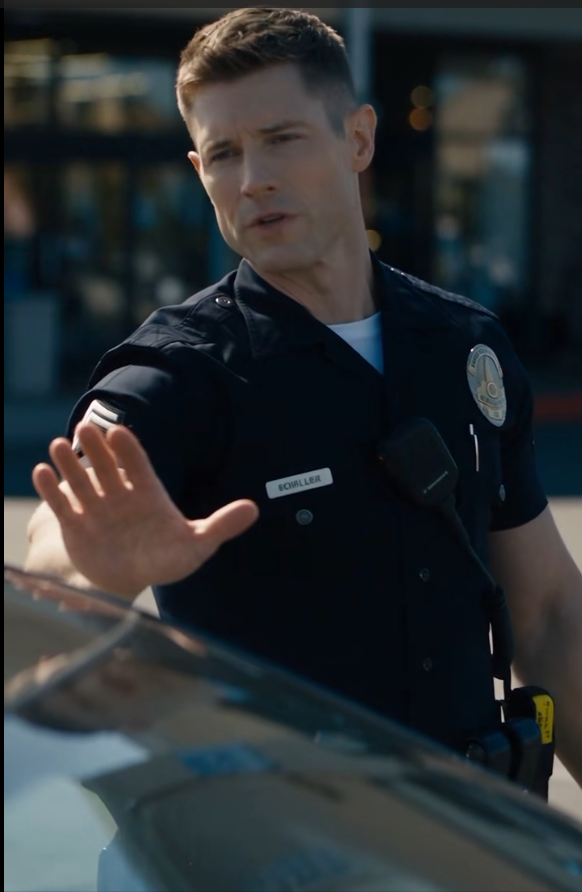
“Mitchell knew who you were.”
The hallway behind me suddenly felt too quiet.
“What?”
“He knew.”
“That doesn’t make sense.”
“I know.”
“If he knew, why would he—”
“He didn’t know when he first saw you.”
Reeves glanced behind him again.
“But he knew before you showed the card.”
I felt my grip tighten on the door.
“How?”
“Dispatch.”
“What about dispatch?”
“He ran your plate after you asked him the first time.”
“No. He told you he hadn’t.”
“He lied.”
The words landed with more weight than I expected.
Reeves continued.
“I checked the call log after shift. He ran it at 10:14. Dispatch returned the owner name thirty-one seconds later.”
“Valerie Henderson.”
“Yes.”
“He could have thought it was another Valerie Henderson.”
“Dispatch also flagged the judicial protection notation.”
My throat tightened.
That notation existed for one reason.
Threats.
Years earlier, after a defendant’s family began following me home, the state added an advisory to certain records associated with judges.
A law enforcement officer checking my plate would see that the owner was a judicial official.
“When did Mitchell receive that information?”
“Before he ordered your hands onto the roof.”
I stared at Reeves.
“Why?”
“I don’t know.”
“Then why are you here?”
“Because that isn’t the worst part.”
He reached into his jacket.
I stiffened.
He froze immediately.
“Sorry.”
Slowly, he removed his phone.
“I took screenshots of the internal call history.”
“You brought confidential departmental records to my home?”
“Yes.”
“Officer Reeves, do you understand what position you are putting yourself in?”
“Yes.”
“I’m not sure you do.”
“Judge Henderson, please.”
His voice cracked for the first time.
“Look at the timestamp.”
He held out the phone.
I did not take it.
I read the screen from where I stood.
10:13:41 — Mitchell request plate query.
10:14:12 — registration return.
10:14:13 — judicial notification flag.
10:14:29 — supplemental message sent to Officer Mitchell.
I read the final line twice.
“Supplemental message?”
Reeves nodded.
“What did it say?”
“That’s what scared me.”
He tapped the screen.
The message appeared.
Five words.
SUBJECT PRESIDING MONDAY. USE CAUTION.
I stared at it.
Reeves whispered, “He knew.”
My mind began moving through possibilities.
Threat.
Intimidation.
Coincidence.
Retaliation.
A stupid impulse that had turned criminal.
“What happened before 10:13?” I asked.
“I don’t know.”
“Was there a call for service?”
“No.”
“Report of a stolen Mercedes?”
“No.”
“Complaint about me?”
“No.”
“Then why did he approach?”
“That’s what I couldn’t answer.”
I looked at him.
“And tomorrow?”
He swallowed.
“Tomorrow, they’re going to say you need to recuse because you’re biased against him.”
“That may be correct.”
“No.”
His answer came too quickly.
“Officer Reeves.”
“No, Your Honor. I don’t think the parking-lot incident was about the car.”
“What do you think it was about?”
He looked terrified.
“I think somebody wanted you off the Monday case.”
I did not invite him inside.
I did not look at the screenshots again.
I told him to preserve everything and contact the state inspector general.
Then I closed the door.
And stood in my entryway with my father’s words behind me.
For my daughter, who will change the world.
At eight the next morning, Courtroom 4B was already packed.
Reporters filled the rear benches.
Attorneys clustered near counsel tables.
Uniformed officers stood along the wall.
The viral video had transformed what was supposed to be a narrow evidentiary hearing into something approaching a public referendum.
I entered through the side door.
“All rise.”
Everyone stood.
I took the bench.
I could feel Mitchell before I saw him.
He sat behind the department’s attorneys, wearing a dark suit instead of a uniform.
Our eyes met for half a second.
He looked away.
I placed my hands on the bench.
“Please be seated.”
The room settled.
The department’s lead attorney, Martin Keller, rose almost immediately.
“Your Honor, before we proceed—”
“I am aware of the issue.”
Keller stopped.
I continued.
“Yesterday evening, I informed the presiding administrative judge of the Saturday encounter involving Officer Mitchell. I also requested an emergency ethics consultation.”
Keller nodded.
“Then we would move for recusal.”
“I assumed you would.”
Isaiah Cole’s attorney, Lena Brooks, stood.
“We oppose.”
Keller turned.
“Of course you do.”
I looked at him.
“Mr. Keller.”
He faced me.
“This is not a conversation between counsel.”
“Yes, Your Honor.”
I opened the memorandum in front of me.
“The ethics office advised that the parking-lot encounter creates, at minimum, an appearance issue regarding any personal credibility findings involving Officer Mitchell. Under ordinary circumstances, recusal would be appropriate.”
Keller relaxed.
Only slightly.
Then I continued.
“However, an additional matter arose last night.”
His expression changed.
“What additional matter?”
“I am not going to litigate it from the bench.”
I looked toward the clerk.
“Mark as Court Exhibit One the sealed notification received from the Inspector General’s Office at 7:12 this morning.”
The room erupted in whispers.
Mitchell looked at Keller.
Keller looked at his co-counsel.
Lena Brooks did not move.
I continued.
“The Inspector General has opened an inquiry concerning possible interference with this proceeding.”
Now Keller stood fully upright.
“Your Honor, we have received no such notice.”
“You will.”
“On what basis?”
“That question is beyond today’s scope.”
He opened his mouth.
I raised a hand.
“There is more.”
The courtroom became silent.
“The administrative judge has reassigned all credibility determinations concerning Officer Mitchell personally.”
Keller exhaled.
“But.”
Again, the room shifted.
“I remain assigned to the underlying evidentiary matter involving the department’s preservation obligations because those obligations concern institutional conduct, not Officer Mitchell alone.”
Lena Brooks sat back slowly.
Keller looked furious.
“So we have half a recusal?”
“You have a carefully tailored order designed to prevent a party from creating grounds for disqualification through its own conduct.”
That sentence changed the temperature in the room.
Mitchell stared at the table.
Keller said, “Are you suggesting the department manufactured Saturday’s incident?”
“I am suggesting nothing.”
“Because that would be an extraordinary accusation.”
“Yes.”
I held his gaze.
“It would.”
For the next three hours, the hearing became far worse for the department than anyone anticipated.
The first witness was the records custodian.
She testified that body-camera footage from Isaiah Cole’s arrest had been automatically uploaded to a secure server.
Lena Brooks asked, “Was the entire recording uploaded?”
“Yes.”
“Did the system show any malfunction?”
“No.”
Keller objected.
“Foundation.”
“Overruled.”
Brooks continued.
“Was forty-seven seconds later missing?”
“Yes.”
“Can footage be deleted?”
“Not by patrol officers.”
“Who can delete it?”
The witness hesitated.
“Supervisory administrators.”
“Which supervisory administrators?”
Another pause.
“Users with evidence-management privileges.”
Brooks handed her a list.
“Do you recognize these names?”
“Yes.”
“Was Officer Mitchell one of those users?”
Keller stood.
“Objection.”
“Overruled.”
“Yes,” the witness said.
A murmur moved through the room.
Mitchell’s attorney leaned toward him.
Brooks continued.
“Did Officer Mitchell access the file?”
“Yes.”
“When?”
“Forty-three minutes after the arrest.”
“Did he modify it?”
The witness looked uncomfortable.
“The system records an administrative action.”
“What action?”
“It says segment exclusion.”
I looked up.
“Explain that phrase.”
“It means part of the recording was marked for removal from the accessible evidence file.”