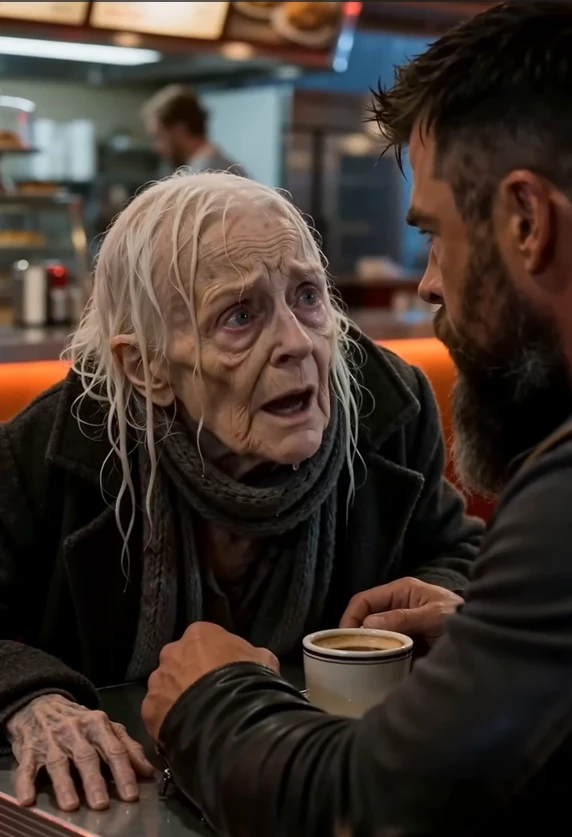
He Came in With the Rain. She Came in With a Lie That Could Get Them Both Killed.
Rain hammered Route 50 so hard that night it turned the highway into a ribbon of black glass, reflecting the red neon of the Silver Ridge Diner in broken, bleeding streaks. Thunder rolled across the Nevada flats, low and heavy, like something ancient dragging itself closer. To anyone passing through, the diner looked like a lonely refuge at the edge of nowhere.
To Gideon Rourke, it was just a place to sit down before the next stretch of road.
He had been riding since sunrise, the cold gnawing through leather and denim, his shoulders locked with exhaustion. **A memorial ride** waited for him in Idaho by morning, one he had already delayed too long. He wanted nothing except hot coffee, a quiet booth, and ten minutes where nobody looked at him like they had already decided what kind of man he was.
He took the back booth automatically, **his back to the wall, eyes on the room**. Old habits. Hard-earned habits.
The Silver Ridge Diner held the usual midnight ghosts: **a trucker fighting sleep over eggs gone cold, two college kids whispering over fries, and a waitress named Marla who moved like she had given up being surprised by anything years ago**. Gideon wrapped both hands around his mug and stared at the rain streaking the windows.
Then the front door chimed.
The old woman who stepped inside looked as if the storm had tried to erase her and failed.
She was tiny, drowning in a soaked gray coat, her white hair plastered to her cheeks. Her shoes left trembling little prints on the floor. But her face wasn’t confused. It wasn’t lost.
It was terrified.
**Her eyes scanned the room too fast, too carefully.** Door. Windows. Faces. Door again.
Marla started to call out, but the woman walked right past every empty booth and headed straight toward the back.
Toward Gideon.
He felt the whole room notice it.
She stopped at his table and grabbed the edge with both hands, as though she might collapse if she let go. Her fingers shook violently. Up close, he saw bruising on one wrist, half-hidden by her sleeve.
Then she whispered, “**Please… pretend you’re my grandson.**”
Gideon blinked once. “What?”
“Please,” she said again, leaning closer. **“Just for a few minutes. Don’t ask me anything. Please.”**
He should have told her no.
He should have stood up, walked away, let the cops sort it out if there was trouble. He had spent years promising himself he would stop stepping into other people’s fires.
But before he could answer, the diner door chimed again.
A man stepped in wearing a charcoal suit so immaculate it looked unnatural in a place like that. He was in his fifties, silver at the temples, composed in a way that made the room feel suddenly smaller. Rain glistened on his shoulders, but nothing about him seemed unsettled by the storm.
He took off his gloves with quiet precision, then smiled when he saw the woman.
Not kindly.
**Possessively.**
“There you are, Mother,” he said. “I’ve been looking everywhere for you.”
The woman’s hand shot to Gideon’s wrist. **Her nails dug into him so hard he felt the tremor in her bones.**
“That’s not my son,” she whispered.
The suited man approached the booth slowly, as if there were no reason for anyone to panic. “I’m sorry,” he said to Gideon. “My mother suffers from episodes. Dementia. She wanders. Tells stories. We’ve been worried sick.”
The trucker looked uncertain. One of the college kids muttered, “Oh my God.”
Gideon looked at the old woman. She stared back at him with such raw pleading it made his chest tighten.
“Your name?” he asked her quietly.
She hesitated.
The man in the suit answered first. “Eleanor Voss.”
A flicker crossed the woman’s face. Fear. Fury. Something deeper.
Then she said, clearly, “**My name is Margaret Weller. And if you let him take me, I will be dead before sunrise.**”
Silence dropped over the diner.
The suited man exhaled like a patient father. “You see? Delusions.”
Gideon studied both of them. He had spent enough time around liars, drunks, fugitives, and men who wore friendliness like a disguise. **The old woman looked terrified. The man looked careful. And careful was often worse.**
Marla set the coffee pot down. “Should I call the sheriff?”
The suited man turned to her with a polished smile. “That won’t be necessary.”
Margaret clutched Gideon’s sleeve. “Call them,” she whispered. “Now.”
The man reached into his coat.
Every muscle in Gideon’s body tightened.
But instead of a weapon, the man produced a leather wallet and flipped it open. “Daniel Voss,” he said. “Family attorney. Medical power of attorney included. My mother has been under my care for three years.”
He placed papers on the table.
They looked official. Stamped. Signed.
The trucker nodded uncertainly. “Seems legit.”
Margaret made a broken sound in her throat. “He forged them.”
Daniel smiled without warmth. “You don’t know what you’re saying, Mother.”
Gideon did not touch the papers. “Why’d she run from you in the rain?”
Daniel’s expression stayed calm. “Because paranoia does that. We were on our way to a private care facility outside Reno. She became agitated at a gas station and disappeared.”
Margaret’s grip turned desperate. “No facility. **He’s taking me to a house in the desert.**”
Daniel’s smile faded a fraction. “That is enough.”
Gideon looked at the bruise on her wrist again. Fresh. Finger-shaped.
He rose slowly from the booth.
At six-foot-three, broad across the shoulders, leather jacket creaking as he stood, **he turned the diner air heavy**. Daniel noticed. His polished calm shifted into measured caution.
“She stays,” Gideon said.
Daniel folded the wallet shut. “This is a private family matter.”
“Not anymore.”
The storm cracked outside with a flash of white light, and for an instant every face in the diner looked carved from bone.
Daniel’s jaw tightened. “You have no idea what you’re interfering in.”
Margaret whispered, “He killed my daughter.”
That hit the room like a gunshot.
One of the college kids gasped. Marla took a step back. The trucker straightened fully for the first time all night.
Daniel’s face remained composed, but only just. “That is a vile accusation.”
“It’s true,” Margaret said, louder now, trembling but fierce. **“My daughter Helen found something. Money. Names. Accounts. She told me if anything happened to her, I was to go to someone with this.”**
With shaking hands, she reached inside the lining of her soaked coat and pulled out **a tiny plastic-wrapped flash drive**.
Daniel moved instantly.
Gideon moved faster.
Daniel lunged across the booth, but Gideon caught him by the forearm and slammed him against the table hard enough to rattle dishes. The trucker jumped to his feet. One of the students screamed.
“Marla,” Gideon barked, “call the sheriff.”
She grabbed the phone.
Daniel didn’t struggle wildly. That was the unnerving part. He went still beneath Gideon’s grip, then said in a low voice, “You really should let go.”