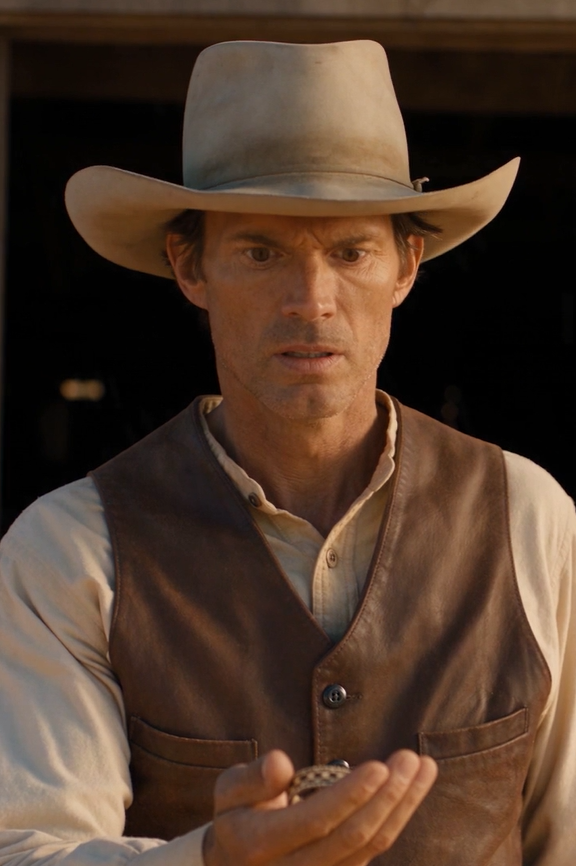
He Gave Three Apache Women Water and Woke to Twenty-Five at His Gate. By Sundown, Eli Caldwell Would Learn Why They Had Chosen Him—and What His Dead Wife Had Hidden.
The first thing Eli Caldwell noticed was that the woman walking toward him had no fear in her eyes.
That frightened him more than if she had been carrying a rifle.
Twenty-five Apache women stood in a long, silent line beneath the blood-colored dawn, their dresses and blankets gray with desert dust, their faces hollow from exhaustion. Behind Eli, the barn doors creaked in the morning wind. To his right, the old stone well waited beneath its crooked beam, dark water thirty feet below.
Yesterday, three of these women had appeared half dead from thirst.
He had given them water.
They had disappeared.
During the night, fires had crawled across the horizon.
Now there were twenty-five.
Eli stood with his boots planted in the dust, his old rifle leaning against the fence several yards behind him.
Close enough to reach.
Far enough away to make one thing clear.
He was not threatening them.
The woman at the front stopped ten paces away.
She was perhaps twenty-eight, though hardship made age difficult to read. Her long black hair had been tied with a strip of faded red cloth. Dust clung to the hem of her buckskin skirt. A shallow cut crossed one cheek.
Eli recognized her immediately.
She had been the first woman at his well.
The one who had given him the bracelet.
Her gaze dropped to his left hand.
The bracelet was wrapped around his wrist.
Something changed in her expression.
Not relief.
Something heavier.
Confirmation.
Eli swallowed.
“What is this?”
The woman looked beyond him toward the well.
“Water.”
“You already had water.”
“For us.”
Eli looked slowly along the line.
Twenty-five women.
No horses.
No wagons.
No children.
No men.
And yet each woman carried something. A rolled blanket. A leather pouch. A bundle tied with rawhide. One carried a clay jar against her ribs. Another had dried blood at her sleeve.
They looked less like travelers than survivors.
Eli’s mouth tightened.
“How far have you walked?”
The woman considered him before answering.
“Three days.”
“From where?”
“Black Mesa.”
Eli knew the name.
Everybody in Dry Hollow did.
Black Mesa lay north beyond the lava ridges, country most white ranchers avoided because the ground turned cruel there and the water disappeared without warning.
“What happened?”
Her eyes hardened.
“Fire.”
That one word went through Eli like a blade.
For three years, fire had lived in the back rooms of his mind.
A burned wagon.
Blackened wheels.
A wife he had loved since he was twenty-five.
A four-year-old boy who used to climb onto his shoulders and pull his hair while laughing into the Arizona wind.
He had buried them both.
Or what Sheriff Harlan Rusk had told him was left of them.
Eli looked away.
The woman noticed.
“What burned?” he asked.
“Everything.”
“Who did it?”
She did not answer.
Instead she pointed to the barn.
“You slept there.”
Eli frowned.
“You were watching me?”
“You sleep in barn. House empty.”
His stomach tightened.
The women had been on his land longer than he realized.
“You cleaned my barn.”
“Yes.”
“Why?”
“For water.”
“Cleaning an entire barn for three buckets is a poor bargain.”
The smallest hint of amusement touched her face.
Then it vanished.
“Water is not small.”
Eli couldn’t argue with that.
He looked again toward the others.
One woman was trembling.
Another leaned slightly to the side, favoring an injured leg.
A third had lips so cracked that blood showed when she breathed.
Whatever danger they represented, thirst represented more.
Eli pointed toward the well.
“Drink.”
No one moved.
The lead woman studied him.
“All?”
“All.”
Her eyes narrowed.
“No price?”
Eli felt something twist inside his chest.
“I already told you yesterday. Water’s water.”
“That is not answer.”
He understood.
“No price.”
The woman turned.
She spoke several quick words in Apache.
The line finally broke.
But even exhausted, the women did not rush.
They approached the well in groups of three and four, waiting while others drank, never crowding the bucket, never wasting a mouthful.
Eli watched one woman pour a little water into her hand and dab it carefully across the lips of the injured woman before drinking herself.
People who believed savagery lived only on one side of a frontier had never watched thirsty people share the last mouthful.
Eli lowered another bucket.
Then another.
Then another.
By the sixth, his shoulders burned.
The lead woman took the rope from him.
“I pull.”
“I’ve got it.”
“You are tired.”
“I’m forty-one, not ninety.”
For the first time, she smiled.
Barely.
But it changed her entire face.
“My name is Tazha,” she said.
“Eli.”
“I know.”
His hand froze on the rope.
“How?”
Tazha looked directly at him.
“Your wife told us.”
The bucket slipped.
The rope burned across Eli’s palm.
It dropped ten feet before he caught it again.
For a moment, the desert vanished.
There was only the woman’s voice.
Your wife told us.
Eli stared at her.
“What did you say?”
Tazha did not look away.
“Your wife told us your name.”
“My wife has been dead three years.”
“Yes.”
The word was quiet.
Certain.
He stepped closer.
“You knew Rebecca?”
At the name, several women stopped drinking.
One turned sharply.
Another made a sound beneath her breath.
Tazha’s face changed again.
Recognition.
Grief.
Eli saw it.
And suddenly he was no longer a man standing beside a well.
He was kneeling beside a burned wagon in the rain three years earlier while Sheriff Harlan Rusk held his shoulder and told him there was nothing left worth seeing.
He smelled ash.
Wet leather.
Burned wood.
He heard himself screaming Rebecca’s name.
Then Daniel’s.
His boy had been four.
Only four.
Eli’s hand closed around Tazha’s wrist.
“Tell me how you knew my wife.”
Every woman around the well went still.
Tazha looked at his hand.
Eli released her immediately.
“Please.”
She glanced toward the ranch house.
“Inside.”
“No.”
“Inside.”
“You tell me here.”
“Not safe.”
Eli laughed once, without humor.
“There’s nobody for fifteen miles.”
Tazha’s eyes moved toward the eastern hills.
“That is why it is not safe.”
By eight o’clock, twenty-five Apache women were sitting inside and around Eli Caldwell’s barn.
He had never seen it so full.
Some rested in the shade. Others ate strips of dried beef he pulled from winter storage. The injured woman sat on an overturned crate while Eli cleaned the gash on her calf with boiled water.
Her name was Mesa.
She never flinched.
“You need stitches,” Eli said.
She looked at Tazha.
Tazha translated.
Mesa answered.
“She says do it.”
Eli threaded a needle.
“Tell her I’m better with horses.”
Tazha spoke.
Mesa actually laughed.
That made Eli feel worse.
He stitched the wound anyway.
When he finished, Tazha took the bracelet from Eli’s wrist.
He almost objected.
Instead, he watched her turn it over.
“What?”
She pointed to a row of beads.