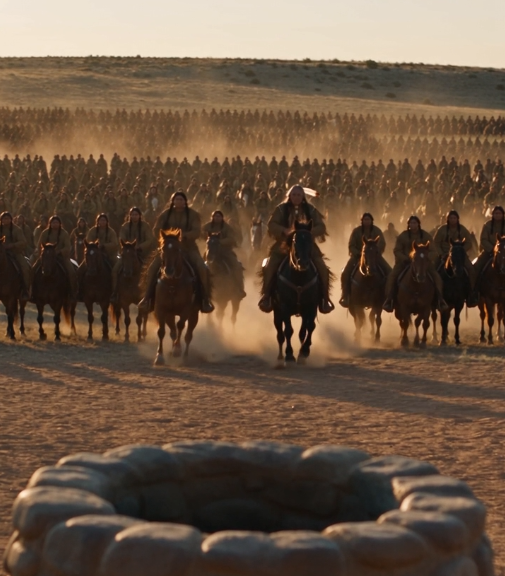
PART 2 — THE THREE HUNDRED WARRIORS HAD NOT COME FOR CORVIN. THEY HAD COME FOR HIS WELL.
The old warrior looked at Corvin.
Then pointed toward the towering woman approaching through the opened ranks.
His voice was low.
“She says you gave water.”
Corvin glanced at the woman.
Then back at him.
“One ladle.”
The old man’s face did not change.
“To her.”
“Yes.”
“While she bled.”
“Yes.”
“Without asking payment.”
“Yes.”
The warrior studied him for several seconds.
Then said:
“That is why you are still standing.”
Corvin’s stomach tightened.
Not exactly comforting.
The woman reached the yard.
Up close, she looked worse than she had the day before.
A fresh bandage crossed her left shoulder.
Dust darkened the hem of her deerskin dress.
But she stood straight.
Strong.
Her eyes fixed on Corvin with the same unsettling calm.
The old warrior spoke.
“This is Naya.”
Corvin nodded.
“Naya.”
She understood the name.
Maybe more.
Her gaze moved toward the well.
Then toward the dry creek beyond the ranch.
She said something to the older man.
He translated.
“She says men followed her yesterday.”
Corvin’s eyes narrowed.
“What men?”
“White men.”
That description was useless.
Half the territory fit it.
Then Naya reached beneath her belt.
She removed a folded piece of paper.
Dirty.
Torn.
Blood on one corner.
She handed it to Corvin.
He opened it.
Survey markings.
Property lines.
Water symbols.
A stamp from the county land office.
And one name repeated across several parcels:
BELLROSE CATTLE & LAND COMPANY
Corvin knew Bellrose.
Everyone within a hundred miles did.
They bought distressed ranches.
Water rights.
Grazing permits.
Sometimes honestly.
Sometimes too quickly.
Corvin pointed toward one mark.
“That’s my north boundary.”
The old warrior nodded.
“Not only yours.”
Corvin looked again.
The survey showed an underground spring line running beneath his well and continuing north toward Apache-used land.
Then south into Bellrose-controlled acreage.
Naya spoke again.
The old warrior translated:
“Men say all water belongs to Bellrose now.”
Corvin almost laughed.
“That’s nonsense.”
The old man’s eyes hardened.
“Men with papers say many things.”
Good point.
Corvin looked toward the ridges.
Three hundred warriors.
Still waiting.
“If you came to ask about water, you could have sent five men.”
The old warrior answered:
“We did.”
Corvin went still.
“When?”
“Four days ago.”
“What happened?”
“Two returned.”
There.
The valley changed.
Not peaceful anymore.
“What happened to the others?”
The warrior looked east.
“Found dead near Bellrose fence.”
Corvin’s jaw tightened.
“Who killed them?”
“We do not know.”
Good.
Not accusation yet.
Then:
“But Bellrose men say Apache killed Bellrose riders.”
Of course.
Two deaths on one side.
Two on another.
Enough to start a war if someone wanted one.
Corvin looked at Naya.
“What were you doing yesterday?”
She answered before the old warrior translated.
“Watching.”
Her English was rough but clear.
Corvin blinked.
“You speak English.”
“Some.”
The old warrior almost smiled.
Apparently he had enjoyed translating unnecessarily.
Naya pointed toward the paper.
“I took this.”
“From where?”
“Bellrose camp.”
There.
That explained injury.
Corvin folded the survey slowly.
“You stole it?”
Naya’s mouth tightened.
“They stole water first.”
Fair.
The old warrior introduced himself at last.
Taza.
Naya’s maternal uncle.
Not a “chief” in the simple way outsiders used the word, but an older leader whose authority came partly from age, partly from family, partly from people choosing to follow him.
Corvin appreciated that explanation later.
At the time, he mostly appreciated that nobody had shot him.
Taza pointed toward the well.
“We need water today.”
Corvin looked at three hundred riders.
Then at his small windlass.
“If all of them drink here, my well drops.”
Taza nodded.
“We know.”
Corvin expected demand.
Instead Taza asked:
“How much can you give?”
There.
A question.
Corvin calculated.
Horses first?
People?
Storage barrels?
He had two cisterns.
Some water in cattle troughs.
“If I stop watering my east pasture today, maybe forty barrels before sundown without risking the well.”
Taza looked toward Naya.
They spoke.
Then:
“Twenty.”
Corvin frowned.
“You asked for less.”
“We do not need your death tomorrow for our thirst today.”
That sentence stayed with him.
The warriors came down in groups.
Not three hundred at once.
Ten.
Twenty.
Filled skins.
Watered horses carefully.
No one entered the cabin.
No one touched cattle.
One boy offered Corvin dried meat.
Corvin accepted.
Exchange.
Not debt.
Good.
By midday, the valley looked less like siege and more like an enormous temporary camp.
Still terrifying.
But ordered.
Then Naya found Corvin’s ledger.
It sat open near the cabin door.
Her eyes moved to yesterday’s entry.
7:42 PM — Apache woman at the well. Hurt. Gave water. Left north.
She pointed.
“You write time?”
“Yes.”
“Every day?”
“Most.”
“Why?”
“Because memory lies when frightened.”
Naya stared at him.
Then smiled.
First time.
Small.
“You may be useful.”
Corvin laughed.
“Wonderful.”
That afternoon, usefulness became important.
A rider appeared from the south.
White flag tied to rifle.
Bellrose man.
Young.
Nervous.
He stopped far from the ranch when he saw the Apache camp.
Taza sent two men.
Corvin joined.
The rider introduced himself as Owen Pike.
Foreman.
He carried a written notice.
Corvin read it.
Illegal armed occupation of Bellrose-recognized water property.
Interesting.
“My well is on my deed.”
Pike answered:
“Bellrose purchased senior spring rights.”
“From whom?”
“County registration.”
“Show me.”
“I don’t carry it.”
Convenient.
Then:
“You’re harboring raiders.”
Corvin looked toward Taza.
“No.”
“They’re watering horses.”
Pike laughed nervously.
“Three hundred?”
“Yes.”
“Looks like an army.”
“Then you should be relieved they’re only thirsty.”
Pike did not laugh.
He delivered second message.
Any interference with Bellrose water operations would result in:
Eviction.
Livestock seizure.
Criminal charges.
Corvin read it twice.
Then:
“Eviction from my own deeded ranch?”
“Water default can affect property claim.”
That sounded wrong.
Not impossible in territory with overlapping filings.
But wrong enough to verify.
Corvin asked:
“When did Bellrose file?”
Pike hesitated.
“Last month.”
Corvin’s eyebrows rose.
“I’ve owned this place eleven years.”
“Senior water claim.”
“From before your purchase.”
“Whose?”
Pike had no answer.
There.
Naya watched him.
Then pointed toward Corvin’s ledger again.
“What time men came yesterday?”
“No men came.”
She frowned.
“Bellrose says you met scouts.”
“I didn’t.”
“When?”
“Yesterday afternoon.”
“No.”
Naya’s expression sharpened.
She explained.
Bellrose had told county riders that three Apache scouts threatened Corvin’s ranch around sunset.
That incident supposedly justified armed patrols.
But Corvin’s ledger recorded ordinary work.
Fence repairs.
Horse feed.
Naya at well.
No attack.
More importantly:
At 7:42, Naya left north.
If Bellrose’s statement placed her group attacking Corvin at 7:30?
Impossible.
She had arrived alone and injured earlier.
Corvin had seen nobody else.
His ledger was mundane.
That made it useful.
Not created for court.
No reason to lie.
Taza asked:
“You will say this?”
“To whom?”
“Marshal.”
“Judge.”
“Anyone who listens.”
Corvin looked toward Pike.
Then the hundreds of people who had become pawns inside someone else’s paperwork.
“Yes.”
Pike went pale.
There.
He knew something.
Corvin saw.
“What?”
“Nothing.”
“No.”
“You recognized something.”
Pike swallowed.
Then:
“I’m just foreman.”
“Good.”
“Then you may still have time to decide what kind.”
Pike looked toward riders.
Then whispered:
“Bellrose has men coming tomorrow.”
“How many?”
“Sixty.”
“Army?”
“Private guards.”
“Purpose?”
He looked at Taza.
“Clear the valley.”
There.
Clear.
Not negotiate.
Not verify.
Clear.
Three hundred Apache warriors had arrived...