CHAPTER 2: THE ROAD THAT SHOULD HAVE KILLED US
The bridge wasn't merely damaged.
It was gone.
At 1:36 a.m., a reconnaissance drone transmitted the first overhead images onto the command vehicle's screens.
The center span of Mill Creek Bridge had collapsed into the ravine.
Fire burned along both embankments.
A delivery truck abandoned near the eastern approach had been reduced to twisted metal.
The blast pattern told me immediately this had not been an accident.
Ortiz stood beside me inside the command vehicle.
"Directional charges."
"Military grade?"
"Close enough."
"Remote?"
"Probably."
I watched the drone footage again.
Our original timing had placed the convoy on that bridge at 1:24 a.m.
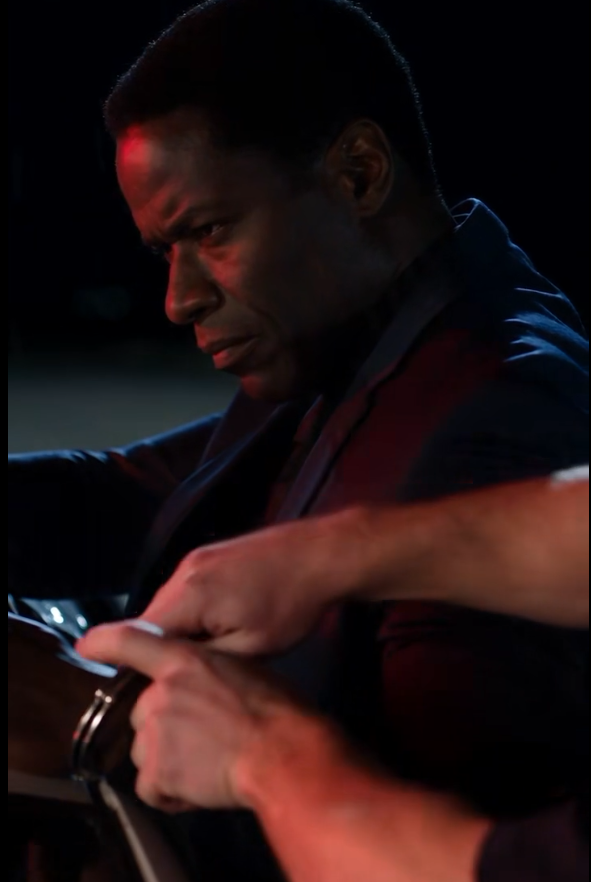
Seven minutes after Mitchell cuffed me.
We would have entered the blast zone almost perfectly.
I looked toward the rear monitor.
Mitchell was sitting on the shoulder beside his cruiser, supervised by two federal agents.
Nobody had arrested him.
Yet.
Ortiz noticed me watching.
"You want him transported?"
"Not yet."
She frowned.
"Marcus, he asNextlted you."
"I know."
"He ignored federal credentials."
"I was there."
"He compromised a classified movement."
"And accidentally prevented that classified movement from driving onto a bridge wired to explode."
Ortiz folded her arms.
"You think he's involved?"
"I think somebody wanted him to stop me."
"And you think he was manipulated."
"I think we need facts before we decide."
Outside, Mitchell sat with his elbows on his knees.
His hands were shaking.
I understood Ortiz's anger.
I felt plenty of my own.
The bruising around my wrists had already darkened.
My left shoulder throbbed where Mitchell had slammed me against the roof.
His words still echoed in my head.
You people always have a story.
There were moments in life when anger offered the easiest road.
This was one of them.
But I'd spent twenty years learning that anger and evidence rarely arrived at the same speed.
Evidence needed patience.
So I walked toward him.
Mitchell stood immediately.
"Sir—"
"Don't call me sir."
He stopped.
I held his gaze.
"Tell me exactly what you saw on your terminal."
He took a breath.
"About one-oh-six I got an automated priority flag."
"Radio dispatch?"
"No."
"Voice confirmation?"
"No."
"Why not?"
"It was listed as restricted interagency information."
I glanced at Ortiz, who had followed us.
Mitchell continued.
"Vehicle description matched yours. Black sedan. Government-style plates. Alert said driver might display counterfeit federal credentials."
That explained why he'd refused to open the case.
It didn't excuse it.
But it explained part of it.
"What else?"
"It said the driver should be considered dangerous."
"You never mentioned that."
"I didn't want to escalate."
I almost laughed.
"You kicked my ankle apart and shoved my face onto a car."
Mitchell looked down.
"Yeah."
"That's your version of avoiding escalation?"
"No."
He swallowed.
"No, it isn't."
A long silence followed.
Then I asked, "Echo Seventeen."
His face tightened.
"My father was Deputy Thomas Mitchell."
Ortiz and I exchanged a glance.
Mitchell continued.
"He worked this county before I was born. Started patrol, later investigations."
"What happened to him?"
"There was a warehouse fire."
"When?"
"October 9, sixteen years ago."
"Body recovered?"
Mitchell hesitated.
"Not exactly."
That interested me.
"What does that mean?"
"They found bone fragments."
"Identified?"
"Sheriff said DNA was too damaged."
"Which sheriff?"
Mitchell looked toward the tree line.
"Wade Danner."
That name registered.
Every county had certain figures whose names appeared repeatedly in operational reports.
Sheriff Wade Danner had controlled law enforcement in the county for twenty-two years.
Decorated.
Popular.
Photographed with governors.
The sort of man who spoke at high-school graduations and charity breakfasts.
He had personally coordinated road closure support for tonight's federal movement.
I felt something cold settle in my stomach.
"Your father worked for Danner?"
Mitchell nodded.
"Danner was his partner before becoming sheriff."
"And after your father died?"
"He helped my mother. Helped me."
"How?"
"He paid for part of college. Got me into the academy. Gave me my first recommendation."
Ortiz's expression hardened.
"Where's Danner tonight?"
"County command center."
Ortiz immediately keyed her radio.
"Control, verify Sheriff's location."
Static.
Then:
"Stand by."
Ten seconds passed.
"Command, county center reports Sheriff Danner departed approximately twenty minutes ago."
"Destination?"
"Unknown."
Mitchell looked up.
My phone vibrated.
It was not my normal device.
This one only received operational communications.
A single encrypted message appeared.
PACKAGE ALDER REQUESTS DIRECT CONTACT WITH ADVANCE LEAD.
I looked toward the third armored carrier.
I'd been given almost no information about Package Alder.
Only that the individual carried the highest protective classification assigned to a civilian witness.
Identity compartmentalized.
Destination sealed.
The convoy had one job:
Deliver Alder before dawn.
I turned to Ortiz.
"He wants me."
"Or she."
"You know?"
"No."
We walked toward the carrier.
Two agents unlocked the rear door.
I climbed inside.
The interior was dim.
A man sat alone behind a reinforced partition.
Gray hair.
Thin face.
Hands folded calmly.
He appeared to be somewhere in his late fifties.
Something about the way he looked at me made me stop.
Not fear.
Recognition.
"Agent Hale," he said.
"You know me?"
"By reputation."
His voice was rough.
He glanced toward the open door.
"Is the patrol officer still outside?"
"Yes."
"His name?"
I already knew the answer he was waiting for.
"Ryan Mitchell."
The man's eyes closed.
His hands began trembling.
Not slightly.
Violently.
I stared at him.
"Who are you?"
He opened his eyes.
For several seconds, neither of us spoke.
Then he said four words.
"I'm Ryan Mitchell's father."