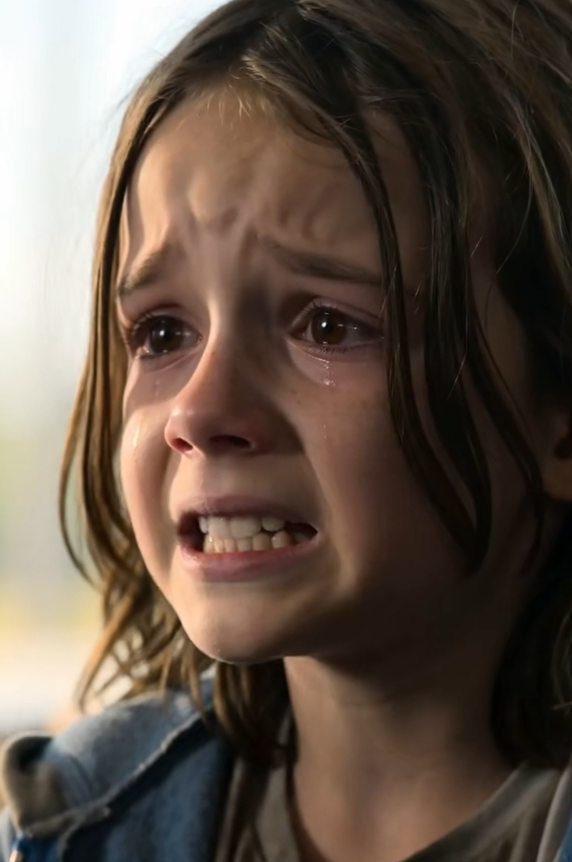
HE HURT ME!” A LITTLE GIRL BEGGED A HELL’S ANGEL FOR HELP – MINUTES LATER, 100 BIKERS STOOD OUTSIDE HER HOUSE
The little girl did not scream when she entered the diner.
That was what made everyone stop.
She came through the door shaking so badly the bell above it rattled twice, her oversized jacket hanging off one shoulder, her sneakers untied, her face streaked with tears that looked like they had dried and started again.
Every fork paused over every plate.
Every conversation died in the space of one breath.
Forty motorcycles sat outside the Blue Plate Diner, chrome pipes flashing in the morning sun, and inside, nearly every booth was filled with men and women wearing leather vests, heavy boots, and road dust.
To most strangers, it would have looked like the wrong place for a frightened child to run.
To Lily Carter, seven years old and running out of choices, it looked like the only room in town where someone might not be afraid of the man waiting back at the blue house.
Her eyes searched the diner in wild panic.
Then they landed on Jack Morgan.
Jack was sitting by the window with a coffee cup in one hand and his helmet on the seat beside him.
He was forty-five, broad shouldered, gray in the beard, with old tattoos faded into his arms and a leather vest marked by years of roads, losses, loyalty, and hard-earned brotherhood.
He looked like trouble to people who only knew how to read a man from the outside.
But Lily ran straight to him.
She ignored the stunned faces.
She ignored the scrape of chairs.
She reached Jack’s booth, grabbed his arm with both hands, and held on like the floor might vanish beneath her.
For a moment, Jack did not move.
He looked down at the child’s fingers locked around his sleeve, then at her tear-wet face, then at the bruised circles around her small wrists.
Something inside him went cold.
The marks were not the careless marks of childhood.
They were too dark, too even, too familiar in a way no child should ever have to explain.
Lily tried to speak.
Only a broken breath came out.
Jack set his coffee down very slowly.
He did not stand over her.
He did not bark questions.
He lowered himself to one knee in front of her, making his big body smaller, making his voice soft enough that only she needed to hear it.
“You’re safe here,” he said.
Her lips trembled.
“He hurt me,” she whispered.
The diner seemed to lose every sound it had.
Behind Jack, Big Tom stopped chewing.
Rosie, the owner, stood frozen behind the counter with a coffee pot in her hand.
The bikers who had been laughing minutes before sat like stone.
Jack kept his eyes on Lily.
“What is your name, sweetheart?”
“Lily,” she said, barely breathing the word.
“That’s a beautiful name,” Jack said.
“My name is Jack.”
Her grip tightened.
“He said nobody would believe me.”
Jack’s jaw worked once, but his voice stayed calm.
“I believe you.”
The words hit Lily harder than any question could have.
Her face crumpled, not from fear this time, but from the shock of being heard.
Jack glanced at Rosie without turning away from the child.
“Call 911.”
Rosie was already reaching for the phone.
Jack looked back at Lily.
“Who hurt you?”
Lily swallowed and looked toward the window, toward Route 9, toward a tired blue house sitting near the gas station with a sagging porch and a broken fence.
“Darren,” she whispered.
“My mom’s boyfriend.”
Every man in the diner heard the name.
Nobody moved.
That was the first mercy.
The town had heard plenty about Darren Wilson, though not enough to understand him.
He was the sort of man who smiled at cashiers and looked neighbors straight in the eye.
He offered to carry groceries.
He waved at church events.
He spoke smoothly, dressed neatly when he had to, and knew exactly how to make himself seem reasonable.
People like that could hide a whole house full of fear behind curtains and a polite voice.
Jack had seen enough of the world to know that monsters did not always announce themselves.
Sometimes they smiled and told everyone else the child had an imagination.
Lily told him what she could.
Not all of it.
Not neatly.
Children in terror do not give polished statements.
They give fragments.
A hard grab.
A slammed door.
A threat whispered low.
A mother crying in the kitchen.
A warning that if Lily told anyone, everything would get worse.
Jack listened to every word like it mattered, because it did.
He did not rush her.
He did not fill in the silence.
He simply stayed on one knee in front of her while the diner watched a man everyone feared become the gentlest thing in the room.
Sirens came within ten minutes.
Deputy Ramirez entered first, his hand resting near his belt but his face softening when he saw Lily.
Jack waved him over.
“This is Lily Carter,” Jack said.
“She came in alone.”
He nodded toward her wrists.
“Look there.”
Ramirez looked.
His expression tightened.
Then he crouched in front of her the same way Jack had, careful not to crowd her.
“Lily, I am Deputy Ramirez,” he said.
“I am here to help you.”
Lily looked at Jack first.
Jack nodded once.
“You can tell him.”
So she did.
Enough for the deputy to understand the urgency.
Enough for his pen to move quickly across his notepad.
Enough for the room to know that whatever was waiting at the blue house could not be handled by whispers anymore.
Ramirez stood and looked at Jack.
“We need to go to the house.”
Jack nodded.
“You do your job.”
Ramirez hesitated as his eyes moved around the diner.
“I know your club helps this town, Jack.”
“But this cannot turn into a scene.”
Jack’s face stayed still.
“It won’t.”
Ramirez studied him.
Jack spoke again.
“But that little girl needs to see something today.”
“She needs to see that when she asks for help, people show up.”
“Not one person.”
“Not one badge.”
“People.”
Ramirez understood before Jack finished.
“Peaceful.”
“Outside the property line.”
“No threats.”
“No interference.”
Jack held his gaze.
“You have my word.”
Then Jack took out his phone.
He stepped a few feet away from Lily, though not far enough that she could feel abandoned.
The call went to the club line, the number reserved for emergencies, charity rides, hospital visits, lost brothers, and the kind of trouble that needed witnesses more than fists.
Jack’s voice was steady.
“This is Jack.”
“I need every rider who can make it to Route 9.”
“Blue house by the gas station.”
“A little girl needs to know people believe her.”
“This is not about violence.”
“This is not about revenge.”
“This is about standing where she can see us.”
“Spread the word.”
Word moved faster than weather.
It reached men at gas pumps, women in garages, riders halfway through breakfast, old members who had not made a charity run in months, young prospects who dropped tools and reached for helmets without asking why twice.