People who had built lives here long before some clerk in Tucson stamped a document.
He turned back.
“Why me?”
For the first time, Lobo Negro’s stern face softened.
“You helped a boy two days east of here.”
Maverick’s eyebrows rose.
“A boy?”
“Near Red Stone Wash.”
Memory returned.
A child thrown from a frightened pony.
Maverick had found him limping beside the trail and spent nearly an hour repairing the pony’s broken reins before sending him toward a distant camp.
“That was your boy?”
“My grandson.”
Maverick stared.
“You were watching me?”
“Others were.”
The chief stepped closer.
“You could have taken his horse. His knife. His silver bracelet. Instead you gave him water.”
Maverick shrugged.
“He was a child.”
“Many men need more reason than that.”
Maverick looked away.
He did not enjoy being measured.
Especially when he suspected he was being measured accurately.
Lobo Negro continued.
“You entered our camp without hatred. You did not reach for your gun. You admitted you wanted the land rather than pretending otherwise.”
“That qualifies me for marriage?”
“No.”
“Then what does?”
The old chief’s gaze hardened again.
“Nothing. Ayasha decides.”
The name caught Maverick.
“Ayasha?”
“My daughter.”
Somehow hearing her name changed something.
She was no longer an invisible condition attached to acreage.
Ayasha.
Maverick repeated it silently.
“What if she refuses me?”
“You leave.”
“And if I refuse her?”
“You leave.”
“So the valley belongs to her decision.”
A strange expression moved across Lobo Negro’s face.
“Yes.”
Maverick looked toward the glittering river.
Five years of wandering rose before him.
Snow in Colorado.
Rain in Kansas.
A bunkhouse in New Mexico where six men snored and one stole his boots.
The grave of his mother in Texas.
His father disappearing when Maverick was twelve, leaving nothing except unanswered questions and a battered brass compass Maverick still carried.
Maverick had spent twenty years leaving.
Perhaps every road eventually demanded that a man choose somewhere to stop.
“When is the ceremony?” he asked.
A murmur moved through the camp.
Lobo Negro’s eyes narrowed.
“You have not seen her.”
“I know.”
“You may regret your answer.”
“I’ve regretted half the things I’ve done.”
The chief almost smiled.
“Three days.”
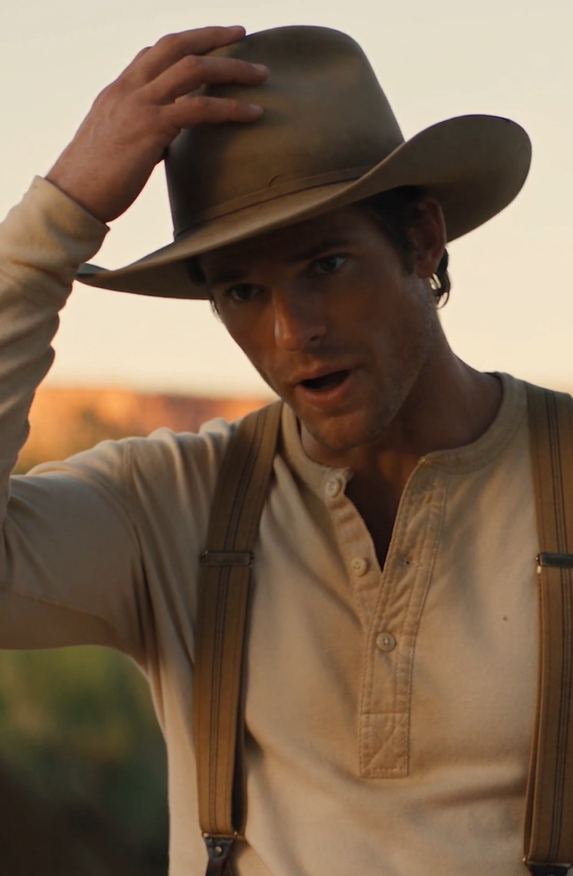
Maverick replaced his hat.
“Then I accept.”
Three evenings later, the river turned gold.
Maverick stood along the bank wearing the cleanest shirt he owned and feeling more terrified than he had during gunfights.
The entire camp gathered around him.
He had spent three days helping repair irrigation trenches, carrying timber, eating with Lobo Negro’s family, and attempting to learn anything about the woman he had agreed to marry.
No one told him much.
Ayasha was twenty-five.
She spoke English, Spanish, and Apache.
She knew horses.
She could read.
She had once broken a man’s nose.
That last fact came from a twelve-year-old girl who immediately fled laughing.
Maverick had still never seen her face.
He had glimpsed a veiled woman twice.
Once carrying medicine into an elderly man’s shelter.
Once standing beneath cottonwoods at dusk.
Both times she disappeared before he could speak.
Now drums sounded softly beside the river.
The gathered people separated.
A woman walked toward him.
Maverick forgot the drums.
Ayasha wore a pale dress trimmed with blue beadwork. A long white veil fell over her face, tiny blue beads catching the sunlight.
Her hands were clasped tightly.
Maverick saw one thumb pressing nervously against the other.
She stopped before him.
Lobo Negro stepped between them.
“Once the veil rises,” he said, “there is no turning back.”
Maverick almost answered that he had crossed three days of desert, agreed to marry a stranger, and slept beside a river guarded by warriors who still considered him suspicious.
Turning back seemed unlikely.
Instead he looked at Ayasha.
“Are you ready?”
Several seconds passed.
She nodded.
Her hands lifted.
The camp became completely silent.
Wind moved through the cottonwoods.
The veil rose slowly.
Maverick saw her chin.
Her lips.
Her cheeks.
A faint pale scar crossed from beneath her left ear toward the edge of her jaw.
Then the fabric lifted completely.
Maverick froze.
Ayasha was not ugly.
Not remotely.
Her face was striking—strong rather than delicate, with high cheekbones, dark eyes, and the faint scar along one side that disappeared into her hair.
But beauty was not what stopped Maverick’s breath.
It was her eyes.
One was dark brown.
The other carried a narrow ring of gray-blue around the iris.
Maverick had seen eyes like that only once.
In a small painted portrait his father had kept hidden inside a wooden box.
A portrait Maverick had found after the man disappeared.
The woman in that picture had possessed the same unusual eyes.
The same high cheekbones.
And beneath the portrait, written in his father’s hand, had been one name.
Elena.
Maverick took one involuntary step backward.
Ayasha saw it.
Pain flashed across her face.
She mistook his shock.
“Now you understand,” she whispered.
Maverick barely heard her.
“Where did you get those eyes?”
Her expression changed.
“What?”
Lobo Negro went completely still.
Maverick looked between them.
“My father owned a portrait.”
No one moved.
“A woman named Elena.”
Ayasha’s face drained of color.
Lobo Negro’s hand tightened around the staff he carried.
Maverick’s heartbeat thundered.
“Who was she?”
The old chief said nothing.
Ayasha turned toward him.
“Father?”
For the first time since Maverick had arrived, Lobo Negro looked afraid.
The wedding continued.
But the silence around it had changed.
Maverick and Ayasha exchanged vows in both Apache and English. Lobo Negro tied their hands together with woven cord. The camp shared food afterward.
People laughed.
Children raced along the water.
Maverick barely tasted anything.
Ayasha sat beside him.
Neither spoke for nearly an hour.
Finally she leaned toward him.
“You looked disappointed when my veil lifted.”
Maverick turned.
“No.”
“You stepped away.”
“Because you reminded me of someone.”
“A dead woman?”
“I don’t know whether she was dead.”
Ayasha’s eyes sharpened.
“What does that mean?”
“My father disappeared twenty years ago. His things were sent to my mother two years later. No body. No explanation.”
“And the portrait?”
“Inside his belongings.”
“Who was your father?”
“Nathan Cole.”
Ayasha dropped the cup in her hand.
It struck the ground.
Water spilled across the dust.
Conversation around them stopped.
Lobo Negro rose from across the fire.
Ayasha stared at Maverick.
“Nathan Cole?”
“Yes.”
She stood abruptly.
“Come.”
Maverick followed her away from the celebration, beneath cottonwood trees, toward a small shelter near the river.
Inside waited a wooden chest.
Ayasha opened it.
From beneath folded cloth she removed a brass compass.
Maverick stopped breathing.
It was nearly identical to his own.
He pulled his compass from his pocket.
They placed them side by side.
The same maker.
The same scratched star on the lid.
The same dent near the hinge.
Only the engraved initials differed.
Maverick’s read N.C.
Ayasha’s read E.A.
“Elena Alvarez,” Ayasha whispered.
Maverick looked at her.
“Who was she?”
Ayasha swallowed.
“My mother.”
The world seemed to tilt.
Maverick sat heavily.
“You’re saying my father knew your mother.”