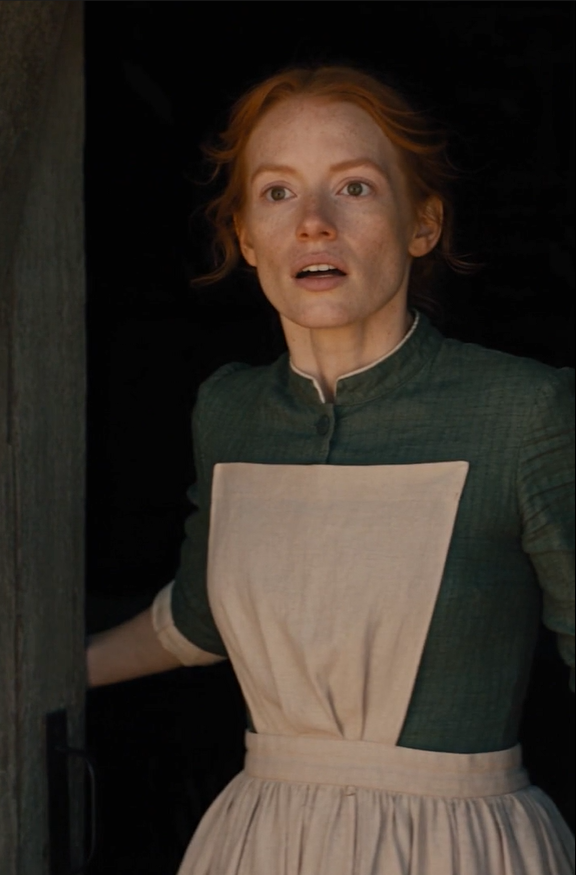
By twenty-one, he had built a bakery beside the station.
Travelers crossed Nebraska talking about Turner bread.
The recipe never changed.
Honey.
Fresh wheat.
Patience.
Years passed.
Caleb and Emily had three children.
Two daughters.
One son.
The dugout remained.
Emily refused to destroy it.
“It reminds me.”
“Of poverty?”
“No.”
“Fear?”
“No.”
Caleb looked at her.
“Then what?”
“That I survived long enough to meet you.”
They visited every autumn.
One evening, nearly twenty years after the harvest gathering, Caleb sat on the old bench.
His hair had gone mostly gray.
Emily emerged carrying a loaf.
Dark golden.
Three cuts across the top.
She sat beside him.
“Still obsessed?”
“Yes.”
She tore off a piece.
Handed it over.
Caleb tasted it.
Chewed solemnly.
Emily waited.
“Well?”
He frowned.
“Not bad.”
She hit him with the cloth.
He laughed.
Then grew quiet.
“What?”
she asked.
“I’ve wondered something for twenty years.”
“What?”
“Why did you send that loaf?”
Emily looked toward the creek.
“Thomas.”
“He said that.”
“He wanted to attend the harvest gathering.”
“You wouldn’t go.”
“No.”
“So you sent bread.”
“Yes.”
“Why that loaf?”
Emily smiled faintly.
“Because I thought we were leaving Nebraska.”
Caleb turned.
“What?”
“I had saved enough for train tickets.”
“To where?”
“Oregon.”
He stared.
“When?”
“Two weeks after harvest.”
Caleb’s heart twisted even after all those years.
“You never told me.”
“You never asked.”
“I asked everything.”
“Not that.”
“Why leave?”
“I was tired.”
Her eyes drifted toward the dugout.
“Tired of notes under the door. Tired of winter. Tired of Thomas pretending he wasn’t hungry so I would eat.”
Caleb’s throat tightened.
“I thought Nebraska had forgotten us.”
She looked at the loaf.
“So I baked one last good thing.”
“One last?”
“Yes.”
“For people who forgot you?”
“I suppose.”
“Why?”
Emily smiled.
“Because bitterness should not be the last thing you make.”
Caleb looked at her.
That sentence hit him almost as hard as the first bite.
Emily continued.
“I told Thomas he could take it to the gathering. I thought no one would notice.”
Caleb laughed.
“I noticed.”
“Yes.”
“Rather aggressively.”
“You became unbearable.”
“I crossed thirty miles repeatedly.”
“Exactly.”
He took her hand.
“If that boy hadn’t taken the bread—”
“We would have left.”
“I never would have found you.”
“No.”
The thought settled between them.
So much life.
Children.
Land.
Truth.
Justice.
All balanced once on a ten-year-old boy carrying a loaf into a church hall.
Caleb whispered:
“God.”
Emily rested her head on his shoulder.
“What?”
“I nearly missed my whole life.”
She smiled.
“Because of bread?”
“No.”
He kissed her hand.
“Because I almost didn’t ask who made it.”
The annual harvest gathering continued for decades.
One year, after Caleb turned seventy, Thomas placed a loaf on the same old table where the first had once appeared.
Caleb’s grandson took a bite.
His eyes widened.
“Who made this?”
The old men laughed.
Caleb, sitting nearby, looked toward Emily.
Her hair was white now.
Her hands slower.
But her smile was the same one that had appeared outside the dugout all those years ago.
She lifted an eyebrow.
Caleb said:
“Careful, boy.”
His grandson frowned.
“Why?”
Caleb looked around the hall.
At Thomas.
At his daughters.
At the grandchildren.
At Emily.
At everything that existed because of one anonymous loaf.
Then he smiled.
“Sometimes a question costs you your old life.”
His grandson stared.
Caleb reached for Emily’s hand.
“And gives you a better one.”
Outside, autumn wind moved across Dry Creek.
Across wheat fields.
Across the railway.
Across land Henry Turner once believed had been taken forever.
The dugout still stood in the hill.
Not as a monument to poverty.
As proof.
That forgotten people were not always gone.
That silence was not surrender.
That truth could survive fire.
That love could arrive absurdly.
On horseback.
Thirty miles from home.
Chasing the name of a woman who baked bread.
And sometimes the smallest thing—a loaf set anonymously on a crowded table—could open the door to everything.
Caleb leaned toward Emily.
“Do you remember what you said when I came to the dugout?”
She smiled.
“That you were ridiculous?”
“Yes.”
“You were.”
“I still am.”
“Very.”
He squeezed her hand.
“And you?”
“What about me?”
“Still glad I came?”
Emily looked at him for a long moment.
Then at the family around them.
Her eyes filled with the kind of tears that belonged not to grief, but to survival remembered from a safe distance.
She whispered:
“Every single day.”
Caleb kissed her forehead.
The church hall filled with laughter.
And on the long table before them sat a dark golden loaf of bread, warm enough that steam still rose from its center.
Exactly as it had that first autumn.
Exactly as it always would in Caleb’s memory.
Because the bread had never been the miracle.
Emily was.