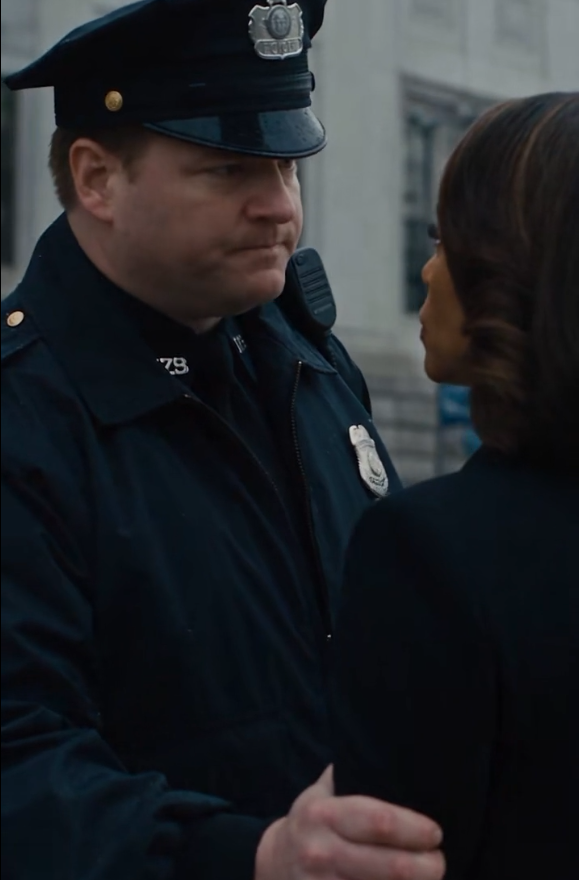
Daniels swallowed.
“No.”
“No what?”
“No, the wording isn’t accurate.”
“Did the bag fall?”
“Yes.”
“Did Judge Monroe cause it to fall?”
“No.”
“Did you?”
Daniels looked at the tabletop.
“Yes.”
They showed the wallet.
His shoe.
The small push.
Daniels almost laughed.
Not because it was funny.
Because the gesture looked so petty that he could not connect it to the person he believed himself to be.
The administrator paused the screen.
“That is not in your report.”
“No.”
“Why?”
“I forgot.”
The security chief leaned forward for the first time.
“You forgot?”
“There was a lot happening.”
“You wrote the report less than two hours later.”
“I was under pressure.”
“From who?”
Daniels’s face tightened.
“The cameras. Everyone. I’d just found out she was a judge.”
The chief let the answer sit.
“Did Judge Monroe contact you?”
“No.”
“Did she threaten your employment?”
“No.”
“Did she direct anyone to remove you?”
“I don’t know.”
“We do. She did not.”
Daniels looked away.
The administrator changed the screen.
Now the clerk came through the doors.
Judge Monroe.
Daniels watched his own face.
That moment was worse than the purse.
His expression changed so completely that the truth became visible without words.
He had not suddenly realized his behavior was inappropriate.
He had realized who had been on the receiving end of it.
The administrator stopped the video there.
“Officer Daniels, why did your behavior change when you learned her title?”
He had no answer ready.
His first instinct was defensive.
Because judges have authority.
Because she could affect my career.
Because I knew then she belonged there.
He heard each answer before speaking it and understood how it sounded.
Finally he said, “Because I knew I’d made a mistake.”
The security chief asked, “What mistake?”
Daniels looked up.
“Not recognizing her.”
The room changed.
Very slightly.
The administrator stopped writing.
The chief leaned back.
Daniels felt the mistake before either of them said anything.
The chief’s voice was quiet.
“You think the mistake was failing to recognize a judge?”
Daniels opened his mouth.
Closed it.
“That’s not what I meant.”
“What did you mean?”
“I mean I should’ve handled it differently.”
“If she had not been a judge?”
Daniels looked at the frozen image.
Ava’s face was turned toward him.
His own hand was still halfway lifted, as though he might explain himself.
The question had nowhere to go.
He stared at the screen.
Finally he said, “I don’t know.”
For the first time since the incident, it was completely true.
Ava was called to give a statement that afternoon.
She entered the same conference room after Daniels had left.
The recording device sat in the same place.
The questions were simpler.
What did he say?
What did she say?
When did he touch her?
Why did she reach for the purse?
Did she pull away?
Did she refuse a search?
Did she threaten him?
Ava answered each question without embellishment.
When the administrator asked about the line You are going to remember doing that, Ava allowed herself a small breath.
“I can see why he asked if it was a threat.”
“Was it?”
“No.”
“What did you mean?”
Ava looked toward the blank wall.
“I meant he had done something in front of too many witnesses to pretend later that it had not happened.”
The administrator glanced at the security chief.
Neither mentioned the report.
They did not need to.
The chief asked, “Were you aware cameras were recording?”
“Yes.”
“Did that influence your behavior?”
“Of course.”
He seemed surprised.
Ava continued.
“Anyone who says cameras do not affect behavior is probably not being entirely honest.”
“Did you stay calm because you knew he was being recorded?”
“Partly.”
“What was the other part?”
Ava folded her hands.
“He had a uniform, authority, and control of the entrance.”
She looked directly at him.
“I had no interest in giving him a reason to increase the level of force.”
The chief nodded once.
“Did you believe he might?”
Ava considered.
“I didn’t know.”
That answer was enough.
At the end of the interview, the administrator turned off the recorder.
“Judge Monroe.”
Ava remained seated.
“This is off the record.”
“Then perhaps you should not ask it.”
The administrator almost smiled.
“I want to know whether you would be willing to meet with him.”
Ava’s expression changed.
“Why?”
“He requested it.”
“When?”
“After his interview.”
“What does he want?”
“He says he wants to apologize directly.”
Ava looked toward the dark recording device.
“No.”
The administrator seemed surprised.
“No?”
“Not privately.”
“He specifically asked for a private conversation.”
“That is why the answer is no.”
The security chief watched her.
Ava explained.
“If he wants to correct something he did publicly and described inaccurately in writing, I will not participate in making the correction private.”
“Are you asking for a public apology?”
“No.”
“Then what are you asking for?”
“Nothing.”
Ava stood.
“If he has something relevant to the investigation, he should say it where it becomes part of the record.”
She pushed her chair in.
“If what he wants is forgiveness, that is a different conversation.”
The administrator asked, “Would you have that conversation?”
Ava paused at the door.
“Not while he still believes the worst thing he did was fail to recognize me.”
She left.
Part V — The Record
The formal review took place four days later.
It was not a trial.
That distinction mattered.
No jury sat in judgment. No television cameras were permitted inside. The process was administrative, governed by employment rules, security procedures, and the courthouse’s obligations to the public.
Yet by then, enough of the incident had become public that everyone in the building understood what was at stake.
Not simply Daniels’s job.
The courthouse’s credibility.
If a building dedicated to law could not accurately account for what happened on its own front steps, the marble, flags, and carved words above the entrance meant very little.
Ava had no role in deciding the outcome.
She insisted on that in writing.
She would appear as a witness.
Nothing more.
Daniels would be allowed to respond.
The second officer would testify.
The clerk would confirm when she came outside and what she said.
Video would be reviewed.
The incident report would be compared to the recordings.
Ava arrived without her robe.
She was not there as a judge.
She wore the same black suit.
Not deliberately.
She did not realize it until Amanda pointed it out that morning.
“You know that’s the suit.”
Ava looked down.
“It’s a black suit.”
“It’s the black suit.”
“I own several.”
“That one has the tiny stitch on the sleeve.”
Ava examined it.
Amanda was right.
“Do you want to change?”
Ava thought about it.
“No.”
She reached for the purse.
Amanda watched.
“You really are stubborn.”
“You keep saying that as if you have discovered something.”
Daniels was already seated when Ava entered.
He stood automatically.
She stopped.
For one brief second, they faced each other without rain, cameras, uniforms, or a crowd.
Daniels wore another suit.
He looked older than he had four days earlier.