Part I — Disruption
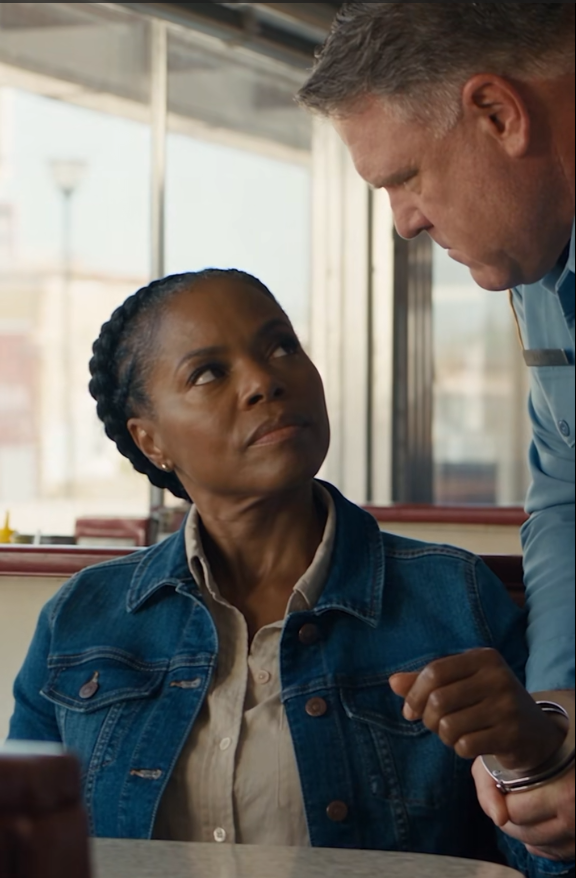
The heavy steel handcuffs snapped around my left wrist before I could even put down my fork.
"Put your hands behind your back! Now!" Sheriff Dalton Voss barked, his booming voice rolling through the little town diner like an unexpected thunderclap.
The entire restaurant fell completely silent. Silverware dropped against ceramic plates. Local customers froze halfway through their meals, staring in stunned disbelief as the broad-shouldered, thick-necked sheriff forcefully pressed my shoulder against the vinyl booth. I didn't recoil. I didn't shout. I remained perfectly motionless, feeling the freezing metal dig into my wrist as I quietly finished chewing my food.
My name is Amara Whitlock. I'm forty-four years old, born and raised in Georgia, and for the last six years, I've served as an appointed United States District Judge in the federal court system. But today, dressed in an ordinary denim jacket with my hair neatly braided, I appeared to Sheriff Voss to be nothing more than a Black woman he assumed was helpless, alone, and entirely under his control. What he didn't realize was that I had intentionally hidden my judicial badge deep inside my purse, entering his county without revealing my identity after receiving dozens of anonymous reports alleging corruption within his department. I needed to see with my own eyes how Sheriff Voss treated everyday citizens when he believed no one important was paying attention.
"You're making a terrible mistake, Sheriff," I said quietly, my voice remaining calm, composed, and carefully controlled.
"I don't make mistakes in my county, lady," Voss scoffed, bending so close that the bitter smell of old coffee and cigar smoke washed over me. He wrenched my right arm behind my back and snapped the other cuff into place with a harsh metallic click. "You fit the description of someone involved in an armed robbery, and as far as I'm concerned, you're resisting arrest right now."
I hadn't moved a single inch. I hadn't even lifted my voice. Still, he dragged me from the booth with such force that the table rattled and my glass of water tipped over, spilling across the surface. People gasped around us, but not one person dared challenge the sheriff who had controlled this town through intimidation and fear for more than ten years.
Voss lowered his face beside my ear, his words thick with malicious satisfaction. "You think you're smart? In my town, no one hears you screaming, and nobody's coming to rescue you."
As he roughly pushed me through the diner's glass entrance toward his waiting patrol car, my purse dangled from his deputy's shoulder. The young man—whose uniform nameplate read Miller—looked no older than twenty-five, his posture rigid and uncomfortable. Hidden inside that purse, my encrypted phone suddenly started vibrating repeatedly with an urgent, high-priority notification sent directly by the Chief Judge of the Federal District Court.
Sheriff Voss believed he'd simply disgraced another defenseless outsider in his little county. He had absolutely no idea that the woman he was taking into custody was the very federal judge who could determine his entire future—and the nightmare waiting at the precinct had barely begun.
The midday Georgia heat pressed against my face as Voss shoved me into the back of his cruiser. The molded plastic seat offered no traction, and with my hands bound tightly behind me, I had to brace my boots against the floorboard to stay upright. The heavy door slammed shut, sealing me inside a cage of reinforced glass and stale air.
Voss climbed into the driver’s seat. Deputy Miller slipped into the passenger side, placing my leather purse in his lap. He kept his eyes locked straight ahead, his knuckles white where they gripped the edge of his tactical vest.
"Call dispatch," Voss instructed, shifting the cruiser into drive. "Tell them we apprehended the suspect from the Miller Road break-in."
Miller swallowed hard. "Sheriff, the description on the wire said a male suspect. White, early twenties."
"Descriptions get garbled in a panic," Voss replied smoothly, his eyes catching mine in the rearview mirror. "I say she's a match. We'll let her sit in holding until she remembers where she stashed the stolen property."
He was constructing the narrative in real time. This was exactly what the anonymous civil rights complaints had detailed: arbitrary arrests, manufactured probable cause, and the systemic intimidation of anyone who dared pass through Oakhaven County without the protection of local influence.
I leaned my head against the plexiglass divider, studying the passing pines. Every bump in the road dug the cold steel further into my radial bone. I registered the pain, cataloging it alongside the civil rights violations piling up by the minute.
"You have the right to remain silent, by the way," Voss mocked over his shoulder. "Though I highly suggest you start talking the minute we get to the station."
I remained entirely silent.
Part II — Pressure
The Oakhaven County Sheriff's Department was a brutalist brick building set off the main highway, surrounded by an expanse of cracked asphalt. Inside, the air conditioning rattled loudly, failing to mask the distinct smell of floor wax and old sweat.
Voss hauled me out of the cruiser by my bicep. He didn't bother escorting me to the booking desk. Instead, he bypassed the front room entirely, marching me down a narrow, windowless corridor lit by flickering fluorescent tubes. Other deputies stepped aside, their expressions a mix of dull compliance and practiced indifference. Nobody asked questions.
He shoved me into a stark interrogation room and forced me into a bolted metal chair.
"Take the cuffs off, Miller," Voss ordered.
The young deputy approached cautiously. His hands trembled slightly as he fumbled with the key. The moment the metal jaws released, I brought my arms forward, carefully massaging the deep red indentations on my wrists.
"Empty the purse, Toby. Inventory it," Voss said, pulling out a chair and sitting directly across from me. He leaned forward, resting his heavy forearms on the scarred metal table. "Let's see what our armed robber is carrying."
Deputy Miller moved to a small steel table in the corner of the room. He unclasped my leather handbag.
"You haven't read me my Miranda rights properly," I stated, my voice steady, projecting effortlessly from the diaphragm the way I had trained to speak in a crowded courtroom. "You have failed to provide a warrant. You have failed to establish probable cause. And you are detaining me in an unsecured room without initiating a formal booking process."
Voss chuckled, a low, grating sound in his chest. "Listen to you. Sounding like a real television lawyer. You think throwing around a few big words scares me?"
"I am simply establishing the procedural timeline," I replied.
"The timeline is whatever I write on the report," Voss said. His demeanor shifted, the mocking amusement evaporating into something hard and dangerous. "Here’s how this goes. You’re going to sign a confession stating you acted as the lookout for the Miller Road robbery. You’re going to accept a plea. If you do that, maybe I recommend a light sentence."
"And if I decline?"
"Then I find drugs in your purse," Voss said flatly. "A lot of them. I find an unregistered firearm in the trunk of whatever car you drove into my town. And you spend the next ten years in a state penitentiary, wondering why you didn't just take the deal."
Across the room, my encrypted phone vibrated against the metal table. A harsh, sustained buzz.
"Turn that damn thing off," Voss snapped at his deputy.
"Sheriff..." Miller’s voice was barely a whisper.
I didn't turn to look at the young deputy. I kept my eyes locked on Voss, letting the silence stretch.
"I said turn it off, Toby!"
"Sheriff, you need to see this."
Part III — Reversal
Voss stood up, his chair scraping violently against the linoleum floor. He stormed over to the small table, prepared to berate the younger man.
Deputy Miller wasn't holding the phone. In his left hand, he held my simple black leather wallet. It lay open, revealing the thick, heavy gold shield pinned to the interior flap. Beside it sat my federal identification card, complete with my photograph, the seal of the United States, and my judicial title printed in bold, unyielding lettering.
Voss looked down. The color drained from his face with staggering speed. It was a physical transformation—the arrogant flush of his cheeks instantly replaced by a sallow, sickly gray.
He stared at the gold shield. Then he stared at the ID card.
The room grew profoundly still. Even the rattling air conditioner seemed to drop an octave.
"What is this?" Voss muttered, his voice stripped of its booming authority.
"She's a judge," Miller said, his breathing shallow. He took a step backward, distancing himself from both the wallet and his superior officer. "She's... she's a United States District Judge. Article III."
Voss slowly turned his head to look at me. I was still sitting in the bolted chair, my hands folded neatly on the table over the red welts he had left on my wrists.
"You're a fake," Voss said. It was a desperate, hollow accusation. "This is a prop."
"18 U.S.C. Section 242," I said, my voice cutting through the stale air like a scalpel. "Deprivation of Rights Under Color of Law. A federal offense, Sheriff Voss. Punishable by up to ten years in federal prison."
He swallowed. His thick neck corded with tension.
"You unlawfully restrained me. You threatened to fabricate evidence. You threatened to plant narcotics and a firearm to coerce a false confession." I stood up. I didn't rush. I simply rose to my feet, reclaiming my physical space in the room. "And you detailed your intent to falsify an official police report, which constitutes a violation of 18 U.S.C. Section 1519, destruction, alteration, or falsification of records in federal investigations."
"Sit down," Voss ordered, though his hand drifted nervously toward the heavy leather belt at his waist.
"I will not," I replied.
I took two steps forward. Voss instinctively took a step back.
"You have run Oakhaven County as your personal fiefdom for eleven years," I continued, closing the distance. "The Department of Justice Civil Rights Division has received forty-seven complaints regarding your conduct over the last eighteen months. Excessive force. False imprisonment. Extortion. When the Attorney General’s office brought the petition to my desk for a full federal inquiry, I wanted to understand exactly the kind of man I was dealing with."
"You came down here to bait me," Voss sneered, a defensive anger finally breaking through his panic.
"I came down here to eat a chicken salad sandwich," I corrected him. "You chose to arrest a woman eating her lunch because you believed you were untouchable."
My phone vibrated again.
"Answer it, Deputy," I instructed.
Miller jumped. He looked at Voss, then at the phone, paralyzed by conflicting authorities.
"Don't touch it," Voss growled.
"Deputy Miller," I said, locking eyes with the terrified young man. "Right now, you are an accessory to the kidnapping of a federal judge. The only way you walk out of this building with a career—and your freedom—is by handing me that phone."
Miller hesitated for a fraction of a second before snatching the phone from the table and practically throwing it into my hands.
Part IV — Reckoning
Voss’s hand dropped to his holster. He didn't draw the weapon, but he rested his palm heavily against the grip of his service pistol.
"Nobody is answering any calls," Voss said. The muscles in his jaw ticked. His eyes darted toward the closed door of the interrogation room. "This is a misunderstanding. You’re going to walk out the back door, Judge. You're going to get in your car, and you're going to drive back to Atlanta."
"Or what?" I asked softly.
He didn't answer. He didn't have to. The heavy silence in the room was a threat all on its own.
I looked down at the encrypted device in my hand. "Do you know how a federal sting operation works, Sheriff?"
Voss didn't move.
"Before I crossed your county line, my phone established a secure, continuous audio uplink with the FBI field office in Atlanta," I explained calmly. "They heard the arrest at the diner. They heard the threats in your cruiser. They heard you promise to plant narcotics in my purse just three minutes ago."
Voss stared at me, his chest heaving. The reality of his situation was finally crashing down, suffocating his ego.
"There is no version of this day where you remain a free man," I told him. "The only variable left is how many of your deputies go down with you."
I pressed the screen on my phone, accepting the persistent incoming call. I put it on speaker and set it on the metal table between us.
"Judge Whitlock," the crisp, urgent voice of Special Agent in Charge Marcus Vance filled the small room. "Status check. Do we need to breach?"
Voss flinched at the word breach.
"I am secure, Agent Vance," I replied, never taking my eyes off Voss. "Sheriff Voss and I were just concluding our conversation. What is your position?"
"We have the Oakhaven precinct surrounded. Tactical teams are securing the perimeter. Warrants have been executed on the sheriff's residence and his financial assets as of two minutes ago."
Voss sagged against the wall as if the bones had suddenly been removed from his legs.
"Understood," I said. "Hold your position. I will walk out the front door shortly."
I terminated the call.
"It's over, Dalton," I said.
Part V — Final Confrontation
For a long, agonizing moment, Sheriff Voss did not move. He stood trapped between the locked door and the reality of his ruined life. The desperate, animal panic in his eyes told me he was calculating the unthinkable. If he drew his weapon, if he eliminated the threat in front of him, he could try to escape through the rear maintenance tunnels. It was a suicide mission, but men who have spent a decade holding absolute power do not surrender it gracefully.
His thumb unclipped the retention strap on his holster. The heavy leather snapped.
Deputy Miller drew his own weapon instantly, leveling it directly at Voss's chest.
"Sheriff, don't do it!" Miller shouted, his voice cracking with pure terror. "Take your hand off the gun!"
Voss glared at the young deputy, betrayed. "Put it down, Toby. You’re throwing away your life for an outsider."
"She’s a federal judge!" Miller screamed, his hands shaking so violently the barrel of his Glock dipped and swayed. "The FBI is outside! I’m not going to federal prison for you, Dalton!"
I stood between them, the geometry of the room turning violently lethal. If Voss drew, Miller would fire. If Miller missed, Voss would kill us both before the tactical teams could breach the reinforced doors.
"Sheriff Voss," I said. My voice was low, commanding, stripping away the chaos. "Look at me."
His bloodshot eyes snapped to mine.
"If you draw that weapon, you will die on this linoleum floor. If you manage to shoot Deputy Miller, you will face capital murder of a law enforcement officer. But if you take your hand away from your belt, you walk out of here breathing."
"I lose everything," he whispered, a pathetic, childish grievance slipping out through his teeth.
"You lost everything the moment you put handcuffs on an innocent woman," I corrected him. "Now you are only deciding whether you keep your life."
I took a slow, deliberate step toward him. I did not break eye contact. I did not show him a fraction of the adrenaline coursing through my veins.
"Take your hand off the weapon."
He stared at me, searching my face for weakness, for hesitation. He found only the rigid, immovable weight of the law he had mocked for a decade.
Slowly, agonizingly, Voss pulled his hand away from his hip.
"Get on your knees," I commanded.
He sank to the floor. The fight drained out of him, leaving nothing but a hollow, broken man.
I looked at Deputy Miller. "Secure him."
Miller rushed forward, holstering his weapon. He grabbed his own set of handcuffs and violently wrenched Voss’s arms behind his back. The harsh metallic clicks echoed off the concrete walls—the exact same sound I had heard in the diner less than an hour ago.
Part VI — Aftermath
When I pushed open the front doors of the Oakhaven County precinct, the afternoon sun blinded me for a fraction of a second.
The asphalt parking lot was filled with dark, armored SUVs. Heavily armed FBI agents in tactical gear stood behind open doors, rifles lowered but ready. At the center of the formation stood Agent Vance, his suit immaculate despite the suffocating humidity.
Behind me, two agents escorted Dalton Voss out of the building. His head was bowed, his wrists shackled, the silver badge already stripped from his chest. The few local residents who had gathered at the police barricades watched in absolute silence as their untouchable tyrant was shoved into the back of a federal transport van.
Agent Vance approached me, his eyes dropping briefly to the angry red welts encircling my wrists.
"Paramedics are standing by, Your Honor," he said softly.
"That won't be necessary, Marcus. Just document the injuries for the indictment." I adjusted my denim jacket, feeling the familiar, reassuring weight of my leather purse over my shoulder.
Inside the precinct, a dozen federal agents were already boxing up files, seizing hard drives, and dismantling the corrupted infrastructure Voss had built. Deputy Miller was sitting on the bumper of a cruiser, speaking quietly to an FBI investigator. He would face his own consequences for his complicity, but his final choice to draw on Voss would likely save him from a cell.
"He really didn't know?" Vance asked, watching the transport van pull away.
"He saw what he wanted to see," I replied, looking out over the quiet town. "A target. A victim. Someone who couldn't fight back."
I walked toward the waiting federal sedan that would drive me back to Atlanta. The air felt lighter in Oakhaven than it had an hour ago. The silence was no longer heavy with fear, but open with possibility.
Justice isn't a concept we debate in pristine courtrooms. It is a line we hold in the dirt. And today, Sheriff Dalton Voss finally crossed it.