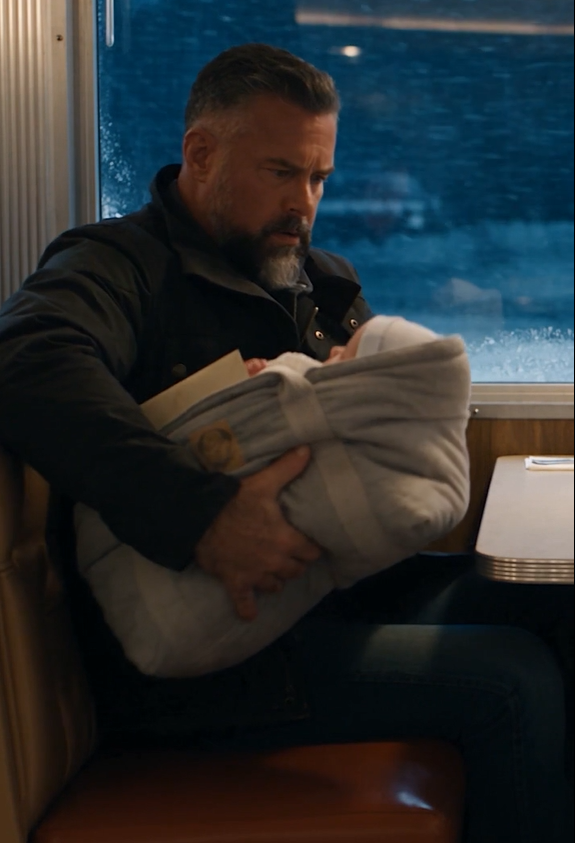
It said they had not been.
It did not say why a baby with his eyes had been left behind his motorcycle club.
It did not say why a seven year old girl had been turned into the messenger.
It did not say who had decided that Ronin Vale’s body belonged to them more than it belonged to him.
Elsie looked over the rim of her mug.
“Is something wrong?”
“I don’t know yet,” Ronin said.
It was not enough of the truth, but it was as much as he could give a child in that moment.
He pulled out his phone and dialed a number from memory.
The call rang three times.
“It’s late,” Dutch said.
His voice was low, calm, and annoyed in the exact measure of a man who expected the world to have a good reason for waking him.
“Wake up,” Ronin said.
“I need the chapter on the road.”
A silence.
Ronin heard the difference in it.
Dutch was already moving.
“Full mobilization?” Dutch asked.
“Full.”
“Why?”
Ronin looked at the baby.
He looked at Elsie.
He looked at the envelope.
“Because I found something behind the clubhouse.”
Another silence.
Dutch had three kinds of response.
Quiet.
Quieter.
And the silence that meant he had already accepted the worst possible version of the news and was preparing accordingly.
“ETA ninety minutes,” Dutch said.
“Roads are bad.”
“Yeah,” Dutch said.
“So call us sooner next time.”
The line went dead.
Elsie watched him.
“Are those your friends?”
“My brothers,” Ronin said.
“Are they dangerous?”
He considered lying.
Children deserved comfort.
They also deserved not to be insulted with foolishness.
“Sometimes.”
Elsie nodded as if that answer made sense.
“But not to us,” Ronin said.
“Not to you.”
Something in her shoulders loosened by the smallest degree.
Not trust.
Not yet.
But the beginning of a place where trust might someday stand.
Outside, the storm thickened.
The neon sign over Pearl’s window stuttered until the letters failed one by one.
By the time the first headlights appeared through the snow ninety three minutes later, Pearl’s Roadside looked less like a diner and more like a holding place between one life and another.
Twelve Harley engines rolled into the parking lot together.
Not as noise.
As presence.
The sound settled in Ronin’s chest before the men even stepped inside.
Pearl walked to the window.
She watched twelve bikers in Iron Shepherd cuts dismount in the blizzard.
She watched Dutch come first.
Fifty six years old.
Gray bearded.
Wide through the chest.
A scar along his left jaw.
A man who entered every doorway as if whatever waited inside had already been considered and would be handled.
Dutch stepped into the diner and stopped.
His eyes went to the infant.
Then to Elsie.
Then to Ronin.
His face did not perform surprise.
It simply arrived at a conclusion.
“Okay,” Dutch said.
“I’ll explain on the road,” Ronin said.
“I said okay.”
Dutch removed his gloves and approached the booth.
He looked down at Elsie with the careful gentleness large men learn only if they have paid attention to the world.
“What’s your name?”
“Elsie.”
“You hungry, Elsie?”
She looked at her empty mug.
“I could eat.”
Dutch turned toward Pearl.
“Whatever you’ve got.”
Pearl looked at the men filling her diner, snow melting on their shoulders, engines ticking outside like iron animals cooling in the cold.
Then she looked at the child in the yellow dress.
“Stay as long as you need,” she said.
“Coffee’s on the house.”
By three in the morning, Pearl’s had become something no one named because no name would have fit.
Eight brothers took positions around the outside without being asked.
Four remained inside.
Dutch sat at the counter with the envelope.
He read the document once.
He folded it back along its creases.
Then he set it down in front of him and let it exist.
That was Dutch’s way.
He did not waste words on shock.
He let shock become information.
Ronin stayed in the booth.
The baby slept against his chest.
Elsie had fallen asleep across the table, her head on her folded arms, her yellow dress bright and wrong in the gray diner light.
Ronin should have slept.
He did not.
The document had opened a door in his mind, and every thought led through it.
Project Continuence.
That was the partial name left visible beneath one redaction.
The date matched the week in 2014 when he had been hospitalized in Germany for shrapnel removal from his left shoulder.
The same shoulder had been aching since Ohio.
He had blamed weather.
Old wounds always knew when storms were coming.
Now it felt like his body had known before his mind did.
He remembered that hospital.
The fluorescent corridors.
The German winter.
The drugs.
The gaps.
He had signed forms he had not read because exhausted soldiers signed whatever men in clean coats placed in front of them.
He had thought the worst thing that happened to him there was the metal pulled from his shoulder.
He was starting to understand that something else had been taken.
Dutch slid into the booth across from him without waking Elsie.
“You read it,” Ronin said.
“Yeah.”
“Project Continuence.”
“You ever hear that name?”
“No.”
“Neither have I.”
Dutch looked at the baby.
“He’s got your jaw.”
“I noticed.”
“You need a name,” Elsie mumbled without lifting her head.
Ronin looked at her.
She had not been fully asleep after all.
“Everyone needs a name,” she said.
Then she went quiet again.
Dutch’s eyes moved from Elsie to the baby.
Something crossed his face so quickly Ronin almost missed it.
A tenderness.
A wound.
A memory.
Dutch had three grown sons and a long history of not saying their names unless necessary.
The baby made a small sound.
Ronin adjusted him.
“I need formula,” he said.
“Vasquez went to the twenty four hour pharmacy in Ridgeway,” Dutch said.
“Twenty minutes out.”
Ronin looked at him.
“You already sent him?”
“I sent him when you called.”
“You didn’t know there was an infant.”
“You said infant.”
Dutch picked up his coffee.
“Medics do not mention infants unless the infant is the situation.”
At 4:12, Vasquez came in with formula, bottles, two sizes of diapers, and no questions.
He was the newest patch, twenty three, former army medic, and young enough that his face still showed the effort it took not to react.
Ronin prepared the bottle by instinct.
The baby took it with the focused urgency of someone who had waited too long and did not intend to wait anymore.
At 4:30, Elsie woke.
She looked around the diner first.
Doors.
Windows.
Men.
Baby.
Ronin.
Only after confirming nothing had turned dangerous did she ask, “Is he eating?”
“Yeah.”
“Good.”
Then she put her head down again.
Dutch watched her.
“She has nobody,” he said quietly.
“Grandmother at Mercy General,” Ronin said.
“Critical.”
“Anybody else?”
“She did not say so directly.”
“But you heard it.”
“Yeah.”
Dutch sat with that.
Ronin looked down at the baby.
“I am not handing either of them to the system.”