Rener Street waited in pale winter light.
Twelve Harleys idled in the cold.
Dutch stood near the bikes.
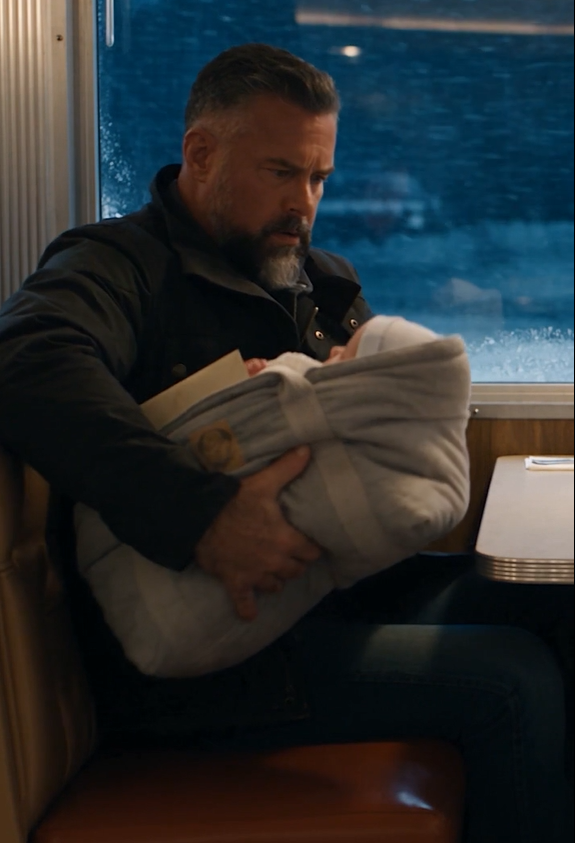
Vasquez held the baby.
Elsie saw Ronin first and ran.
Not the careful walk of a child who had been managing herself all night.
A run.
A real one.
She hit him at the waist and held on.
Ronin put his hand on the back of her head.
He did not say everything was fine.
He did not say it was over.
He said the only true thing.
“I’ve got you.”
She did not let go for a long time.
Dutch stepped beside him.
“Harwick?”
“Standing in an alley with a problem.”
“Sarah?”
“Crestwood Suites.”
“Farley Avenue.”
“We move.”
Elsie looked up.
“Are we going to get her?”
“The baby’s mom?”
“Yeah.”
“Is she going to be okay?”
Ronin thought of a twenty six year old woman who had given birth, run bleeding through fear, and left her child in the only place she had been told might stand between him and the men who wanted him.
“She made it this far,” he said.
Elsie considered that.
Then she nodded like the odds were acceptable.
Sarah Voss was sitting on the edge of the bed in room seven when they arrived.
She was already dressed.
Already packed.
Already holding a bag on her lap with both hands.
Her eyes had the look of someone who had been afraid for so long that calm felt suspicious.
She looked at Ronin in the doorway.
She looked at Elsie beside him.
Then she saw the baby in Vasquez’s arms.
Her face collapsed and rebuilt itself in the same breath.
She crossed the room in four steps and took her son.
She pressed her face to his head.
She made no sound at all.
That silence was louder than any crying would have been.
Ronin stood in the doorway because some moments did not require saving.
Only witnessing.
After a while, Sarah looked up.
“I did not know if you would come.”
“You put him in the alley,” Ronin said.
“You knew I might.”
“Margaret said you were stubborn enough to follow it all the way.”
“Margaret was right.”
Sarah looked down at the baby.
Then at Elsie.
Then back at Ronin.
“Harwick’s filing?”
“Will be answered.”
“We have the documents.”
“You are not going back to Drayden Cole.”
Sarah’s face changed.
Not surprise.
Need.
Sometimes a person already knows the door is open but still needs someone else to say it.
“No,” she said.
“I am not.”
“Then we leave.”
She picked up her bag.
She walked out of room seven without looking back once.
The legal process took four months.
It was not clean.
It was not fast.
It did not arrive with a single speech, a slammed door, or one perfect victory scene.
Real justice moved in filings, hearings, recorded statements, emergency motions, medical affidavits, and rooms where powerful men learned that paper could cut both ways.
Margaret Ola gave testimony from her hospital bed.
Gaines organized eleven years of hidden records into something a civil rights attorney named Kwame Asante called the most thorough private evidence file he had ever received from a non lawyer.
The court vacated Harwick’s medical guardianship filing in week six.
The ruling used the phrase egregious ethical violation four times.
Ronin read every page.
Then he read them again.
The paternity confirmation came in week nine.
The final number was 99.97 percent.
Ronin stood in the parking lot of the testing facility with the results in his hand and did not move for a long time.
He had known.
Knowing did not stop the paper from changing him.
He folded the results and placed them inside his jacket.
Then he rode for two hours on back roads outside Mil Haven.
He stopped at a gas station with the engine off and the winter wind moving around him.
He called Dutch.
Dutch answered on the second ring.
Ronin did not speak.
“Yeah,” Dutch said.
That was all.
Dutch had received his own results the week before.
A different child.
A different mother.
A different story tangled in the same stolen beginning.
Dutch was handling it the way Dutch handled everything.
Forward.
Quiet.
Not alone this time.
“Yeah,” Ronin said.
A pause.
“You good?” Dutch asked.
Ronin looked at the ordinary morning around him.
A woman filling her tank.
A kid on a bicycle.
The world continuing with the strange indifference of ordinary days after extraordinary damage.
“Getting there.”
“That is enough,” Dutch said.
And it was.
Margaret Ola died on a Tuesday in late February at 4:47 in the morning.
Elsie was with her.
The nurses had stopped enforcing visiting hours weeks before because some rules were not built for the situations life actually produced.
Ronin sat with Elsie in the corridor afterward.
For a long time, neither of them spoke.
Elsie kept her hands folded in her lap.
Her breathing was careful and steady.
At last, she said, “She wasn’t scared.”
“No.”
“She said she finished what she started.”
Elsie leaned against his arm.
“I think she meant you.”
Ronin looked down at the linoleum floor.
“She meant a lot of things.”
Elsie did not cry loudly.
She did not perform grief.
She leaned into the nearest solid thing and let herself be held there.
Spring came slowly to Wisconsin.
It arrived in stages, with false warmth, bitter mornings, and mud that clung to boot soles like it had unfinished business.
The Iron Shepherd compound on Kriger Road changed with it.
It had always been practical.
A converted warehouse.
A garage.
A common room.
A kitchen that functioned because hungry men eventually learned to cook or complain.
It had been a place to gather.
It had not quite been a home.
Then Elsie’s drawings appeared on the refrigerator.
A storage room became a nursery without anyone formally voting on it.
Diapers appeared beside motorcycle parts.
Formula sat near coffee tins.
Baby blankets ended up over the backs of chairs where men with scarred hands pretended not to notice how carefully they folded them.
Sarah moved into the apartment above the garage.
She fixed the broken window herself.
She learned the industrial stove.
She began paralegal certification with the quiet determination of a woman who intended never to be trapped by paperwork again.
She and Ronin moved around each other carefully at first.
Not because there was nothing between them.
Because there was too much.
A child.
A stolen beginning.
Fear.
Gratitude.
Anger.
Trust.
The possibility of something real growing out of circumstances neither of them would have chosen.
They did not rush it.
Some stories did not become honest by becoming fast.
Dutch came by on a Sunday in April.
Elsie poured him coffee with the solemn pride of a child who had appointed herself hospitality director of the compound.
The baby sat in a bouncer on the kitchen floor, fascinated by his own feet.
Dutch lowered one finger.
The baby wrapped a tiny hand around it.
Dutch’s face changed.
This time, the tenderness did not vanish.
Elsie watched from the counter.
“You need a name for this place,” she said.
Ronin looked at her.
“What kind of name?”
“A real one.”
“Not just the compound.”
She poured juice with careful concentration.
“It is a home now.”
“Homes have names.”
Dutch looked at the baby’s hand around his finger.
“She is not wrong.”
They named it Ola House.
Elsie’s suggestion took thirty seconds to become unanimous.
The sign above the gate held only the name.
No explanation.
No motto.
No claim.
Just the name of a woman who had spent eleven years learning how to do the right thing and had finally found a way.
On the last Sunday of April, Ronin stood in the yard with coffee going cold in his hand.
Spring birds called from the trees along Kriger Road.
The compound smelled of engine oil, wet grass, and new beginnings that did not pretend the past had disappeared.
Inside, Elsie talked to the baby in her serious one sided way, explaining whatever she believed he needed to know about the world.
Sarah’s voice answered from the kitchen.
Dutch’s bike came through the gate at 7:45.
Then Cass.
Then Vasquez.
Then Gaines.
Then the others in ones and twos, arriving not because they had been summoned, but because Sunday mornings had become something worth finding.
The Harleys settled along the wall.
Ronin looked at the men.
At the gate.
At the name above it.
At Elsie standing in the doorway with juice in her hand and satisfaction on her face.
He thought of the storm.
The diner.
The baby who did not cry.
The envelope.
The eyes.
The legal filings.
The hospital corridor.
The alley.
The woman in room seven.
The old woman in room 412.
Everything that had broken his life open.
He had expected wreckage to leave him with less.
Instead, it had left him standing in the middle of a place that held.
Not perfectly.
Not easily.
But honestly.
Ronin drank the cold coffee.
Then he went inside.
The baby was awake.
Elsie was laughing.
Sarah looked up when he entered.