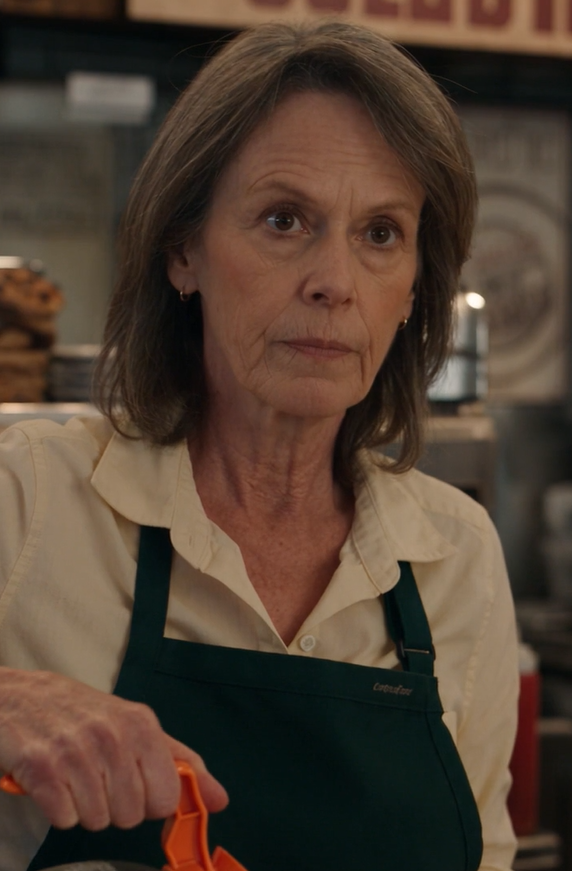
“I HAVEN’T EATEN IN THREE DAYS,” THE LITTLE GIRL WHISPERED – THEN EIGHT BIKERS STOOD UP
“I haven’t eaten in three days,” the little girl whispered.
She said it so softly that June Hartley almost missed it beneath the hiss of the coffee machine and the scrape of Carl’s spatula against the grill.
Five words landed on the worn counter of the Copper Mug like something too heavy for a child to carry.
The girl was small enough that her feet did not reach the floor.
Her wet sneakers dangled from the chair, dripping melted snow onto the old tile.
Her hands were wrapped around a glass of water as if the glass itself might keep her upright.
Across the room, eight men in black leather sat at two tables pushed together in the corner.
They had come in with the storm still clinging to their boots, their jackets, and their beards.
Every person in the cafe had noticed them when they arrived.
Every person had become a little quieter.
But when the child spoke those five words, the men in the corner went completely still.
Not because she had shouted.
Not because she had cried.
Because she had not done either.
There are some kinds of suffering that announce themselves.
There are other kinds that slip out by accident, in a child’s exhausted whisper, when the body has finally run out of strength to keep a secret.
June had owned the Copper Mug long enough to know the difference.
She had seen people come in hungry, broke, lonely, proud, angry, ashamed, and half frozen from the Vermont roads.
She had seen truckers who wanted coffee and silence.
She had seen old men who came every morning because home had grown too quiet.
She had seen young mothers count coins under the table, pretending they were searching for a napkin.
But she had never heard a child say she had not eaten in three days in that flat, careful voice.
No pleading.
No drama.
Just a fact.
June looked at the girl’s mother.
The woman had gone rigid.
Her name, though June did not know it yet, was Anna Reyes.
She was not careless.
She was not cruel.
She was not the sort of mother who forgot to feed her child.
That much June knew before any explanations came.
Anna’s face held the terror of someone who had been caught surviving.
Her hand moved once toward her daughter, then stopped.
“Mia,” Anna said.
One word.
A warning, an apology, and a heartbreak all at once.
The girl lowered her eyes.
“It’s fine,” Anna said quickly, looking at June.
Her voice was steady only because she was holding it there with both hands.
“She talks. She’s seven. Children say things.”
June had heard people lie before.
This was not the sound of a woman lying to hide neglect.
This was the sound of a woman trying to protect the last small piece of dignity she had left.
June did not ask a question.
She did not make a face.
She did not glance around to see who had heard.
She held Anna’s eyes for one quiet second.
Long enough to say without speaking, I heard what your child said, and I am not going to punish you for it.
Then June tucked her order pad into her apron and walked straight into the kitchen.
Carl Briggs was at the grill, shoulders squared, sleeves rolled, spatula moving with the calm authority of a man who had fed sailors through storms far worse than this one.
He had cooked for the Navy for twenty-two years before he ever cracked an egg at the Copper Mug.
Nothing about eight tables and six stools intimidated him.
Nothing about a rush order frightened him.
But he looked up when June pushed through the swinging door, because he knew her footsteps.
He knew the difference between regular busy and something wrong.
“I need the biggest breakfast you can make,” June said.
Carl did not ask who it was for.
He looked once at her face.
“Eggs, home fries, Nextsage, toast, fruit if we have it,” she said.
Carl turned back to the grill.
“Eight minutes.”
“Make it six.”
Carl nodded.
June stood there for one extra breath, hands flat on the stainless-steel counter, trying to steady something inside her chest.
Then she pushed back into the dining room.
The storm outside had thickened against the windows.
Snow dragged itself sideways across Route 9.
The plows had been running since morning, but the road was already disappearing again beneath white.
The Copper Mug sat at the base of the last long curve before County Road 4, a square little building with a green tin roof and a hand-painted sign that had survived three decades of winters.
Open.
Coffee’s hot.
Come as you are.
June had painted that sign herself when she and her husband Frank opened the cafe with thirty dollars in the register and more hope than business sense.
Frank had been gone nine years.
The sign had stayed.
So had June.
So had the promise.
Come as you are.
That morning, the promise had brought in a terrified mother, a starving child, and eight bikers nobody in the room quite knew how to read.
Their jackets said Iron Ridge.
Their bottom patches said Vermont Chapter.
The patch between them showed a mountain split by lightning.
The man at the head of their table was called Stone.
His real name was Thomas Reed, though almost no one used it anymore.
He owned Reed’s Garage outside town, a twelve-bay repair shop with two full-time mechanics and a reputation for doing work right the first time.
He was six foot three, broad and calm, with a dark gray beard and pale green eyes that missed very little.
When June came back from the kitchen, Stone was looking at her.
Not staring.
Not prying.
Reading.
His eyes moved from June’s face to the table in the back corner, where Anna sat with her daughter.
Then he gave one small nod.
It was not dramatic.
It was not a command.
It was the quiet signal of a man who had already understood more than anyone had said aloud.
June felt it like a hand placed against her back.
Not pushing.
Steadying.
She filled a fresh glass of water and carried it to Anna’s table.
Mia was drawing on the back of a paper placemat with a green crayon she had pulled from her canvas tote.
Her small face was bent close to the paper.
Her concentration was fierce.
June set the water down without comment.
Anna looked up with guarded eyes.
June smiled gently and moved away before Anna had to thank her.
When Carl slid the food into the pass-through, it was not just a breakfast.
It was a declaration.
There were scrambled eggs, soft and golden.
There were home fries crisped dark at the edges, flecked with rosemary from the pot Carl kept on the kitchen windowsill even in winter.
There were two thick Nextsage links.
There were four slices of sourdough toast, buttered while still hot.
There was a small bowl of orange slices and blueberries, the kind June rarely used in December because the price made no sense.