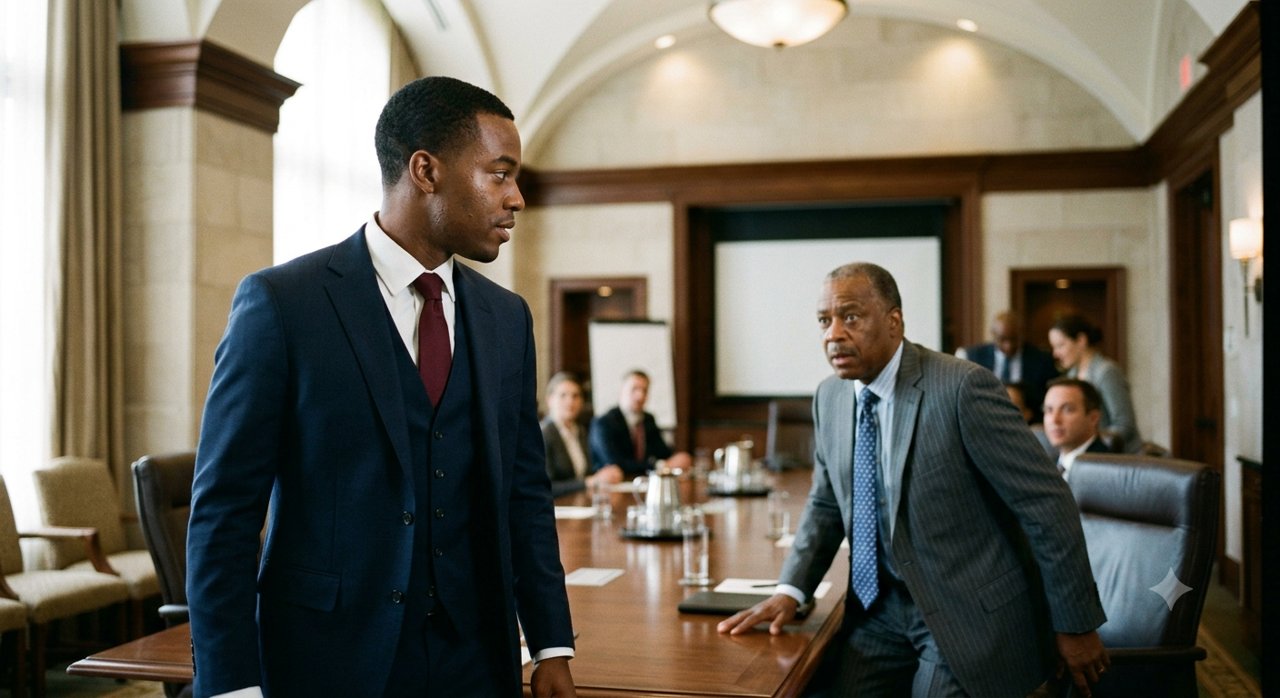
My attorney's name was Howard Brill.
He had handled Richard's affairs for twenty-two years and mine for the eleven since.
He was seventy-one, unhurried, and almost impossible to rattle.
When I called him Monday evening and told him everything — Carol, Patricia Voss, D.
Mercer, the temp named Kelsey Donahue, the ambush lunch — he listened without interrupting.
When I finished, he said, "Come in tomorrow morning.
It's time."
I arrived at his office at nine.
He had coffee waiting and a thick folder on the desk between us.
"I've been expecting this conversation for about a year," he said.
"I want you to understand something before we go through this.
Richard knew.
He knew Sarah would push back.
He knew it might get complicated.
That's precisely why he was so specific."
He opened the folder.
Richard's updated will divided the estate into three parts.
The first part — the primary house, the investment accounts, and the bulk of the liquid assets — came to me outright, with no conditions.
The second part — a trust fund — was set aside for any grandchildren, accessible when they turned twenty-five.
Sarah could not touch it.
Greg could not touch it.
It was sealed until the next generation.
The third part was the cottage.
Richard had not left the cottage to Sarah.
He had not left it to me either — not exactly.
He had left it with a specific instruction: that I could use it, rent it, renovate it, or sell it entirely at my own discretion.
But if I chose to gift it to anyone, that person was named.
Not Sarah.
Not Greg.
A woman named Miriam Cole.
I looked up from the document.
"Who is Miriam Cole?" I asked.
Howard set down his coffee.
"She was Richard's sister.
Estranged.
They had a falling out before you and Richard met — something to do with their mother's estate, years ago.
Richard spent the last two years of his life trying to find her.
He wanted to make things right."
"He never told me."
"He was ashamed of how long it had taken him.
He asked me not to say anything until he was ready." Howard paused.
"He passed before he was ready."
I sat with that for a moment.
Richard had a sister.
He had been quietly trying to repair something broken long before I ever knew it existed.
"Did he find her?" I asked.
"I found her," Howard said.
"Three months ago.
She's seventy-four.
Lives in Vermont.
She doesn't know about the will."
I looked at the cottage in my mind — the new cabinets, the painted porch, the locks I had replaced, the cameras I had installed to keep my own daughter out.
"Sarah can't contest this," I said.
It wasn't a question.
"She can try.
Mercer will tell her she has grounds because the update happened eight months before Richard passed.
But Richard was examined by two physicians who certified his capacity.
He signed in front of three witnesses.
And the language is ironclad." Howard folded his hands.
"She won't win.
But she may try anyway, and it will cost both of you time and money and pain."
"Then I need to talk to her before she files anything."
"That's your choice.
But Ellen—" He looked at me steadily.
"Whatever you decide to tell her, tell her the truth.
All of it.
She's going to find out eventually.
Better it comes from you."
I drove home slowly.
The cottage sat at the end of my mother's street, quiet in the afternoon light, the new paint still bright on the porch railing.
Richard had a sister.
And somewhere in Vermont, she didn't know that the man who had spent two years trying to find her had left her a home.
My phone buzzed.
A text from Sarah: *I know you were recording.
That was a betrayal.
We need to talk about what kind of mother does that to her own daughter.*
I set the phone face-down on the passenger seat.
There was a harder conversation coming.
But first, I needed to make one phone call I should have made months ago.