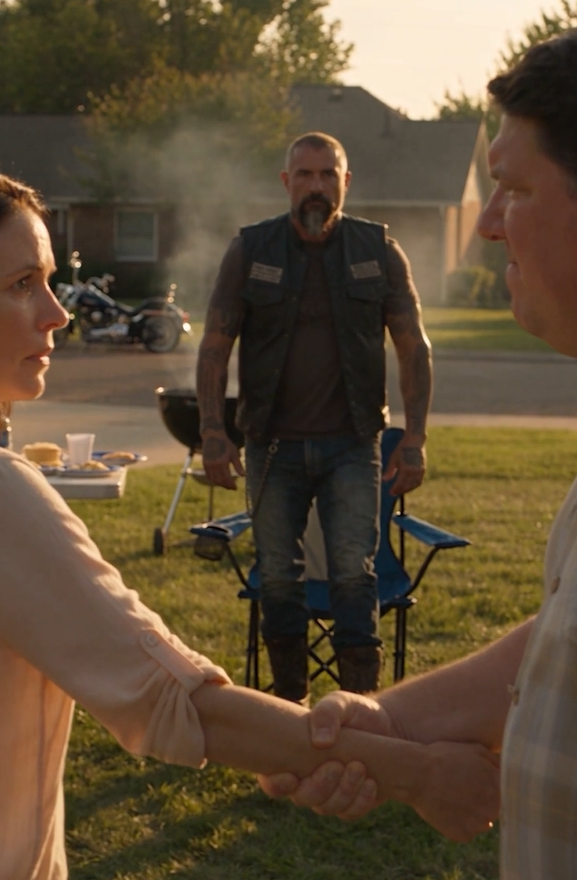
I was eleven years old. I didn’t understand. My dad was lying in the grass holding his face and screaming. My uncle was pulling out his phone to call 911. My cousins were crying. The whole party had gone silent.
And my mom was thanking the man who’d done it.
My dad was a big man. Loud voice. Louder temper. Everyone in our family knew to stay out of his way when he’d been drinking. And he’d been drinking since noon.
The biker was my uncle Ray’s friend. I’d never met him before that day. He showed up on a Harley around 3 PM. Tattoos everywhere. Leather vest. Quiet. He barely said ten words the whole afternoon. Just sat in a lawn chair drinking water and eating a hamburger.
I remember thinking he looked scary.
My dad thought so too. He spent the whole afternoon making comments. Loud enough for everyone to hear. About bikers. About criminals. About people who don’t belong at family events.
The biker ignored him. Every single time.
Then around 5 PM my dad had his eighth beer. And my mom said something. I don’t even remember what. Something small. Something that didn’t matter.
My dad grabbed her arm. Hard. The way he always did when he was angry. The way that left bruises she’d cover with long sleeves in July.
Nobody moved. Nobody ever moved. That was the rule in our family. You don’t get involved. You look away. You pretend it’s not happening.
But the biker didn’t know our family’s rules.
He stood up from his lawn chair. Walked over slow. Didn’t say a word.
My dad saw him coming. "Mind your own business."
"Let go of her arm," the biker said.
"Or what?"
One punch. Just one. My dad went down like someone cut his strings.
The yard went dead quiet. Thirty people frozen with paper plates and sparklers.
My mom looked at the biker. Looked at my dad on the ground. Looked at the red marks on her arm.
"Thank you."
Not whispered. She said it clearly. Like she’d been waiting years for someone to do what that man just did.
I didn’t understand that day. I was eleven. I thought the biker was the bad guy.
It took me years to realize that the monster wasn't the man in the leather vest; it was the man who sat at the head of our dinner table every night.
In the chaotic minutes that followed the punch, the "family" finally found their voices, but not to help my mother. They swarmed my father, offering ice packs and apologies for the "thug" who had ruined the barbecue. My Uncle Ray, looking pale and terrified, ushered his friend toward the driveway.
The biker didn't run. He didn't look proud. He looked at my mother one last time—a long, steady gaze that seemed to acknowledge the secret pain she’d been carrying in the shadows of our home. He nodded once, kicked his Harley into gear, and roared away, leaving a cloud of dust and a heavy, transformative silence behind him.
That night was the first time my father didn't come home. He spent it in the hospital getting his jaw wired shut, and for the first time in my life, the house was quiet. No shouting. No sound of breaking glass. No muffled sobs coming from the kitchen.
My mother sat me down at the kitchen table. She didn't hide the marks on her arm anymore. She didn't pull down her sleeves.
"Sometimes," she told me, her voice trembling but stronger than I'd ever heard it, "the people who are supposed to protect you are the ones you need protection from. And sometimes, a stranger sees what your own family chooses to ignore."
That barbecue was the end of our life as we knew it, and the beginning of our survival. My mother filed for divorce three days later, while my father was still slurping soup through a straw, unable to utter a single threat. The "family" stopped calling us. They blamed her for "letting a criminal strike a family member." They chose the comfort of their rules over the safety of a woman and her child.
Years later, I saw a man on a motorcycle at a red light. He had the same weathered vest, the same stoic presence. I found myself rolling down my window, wanting to say something, but the light turned green and he was gone.
I realize now that the biker didn't just break my father's jaw. He broke the cycle. He was the only person in a yard full of "good men" who had the courage to be "bad" enough to do what was right. My mother's "thank you" wasn't just for the punch; it was for the permission to finally leave the battlefield.
She never wore long sleeves in July again.
.
.
Please follow us if you like this story 💫🙏💕