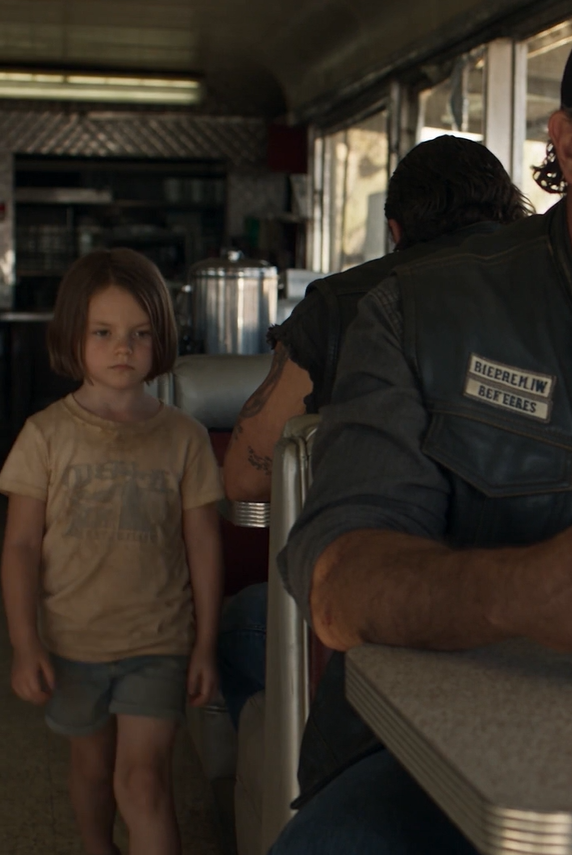
I’ve lived long enough to know what happens when two hundred motorcycles flood the parking lot of a small-town diner. It stops being a meal and becomes a spectacle—chrome glinting under the sun, engines roaring like a storm, boots hitting pavement like a marching line. People who claim they don’t stare always end up staring anyway, eyes flicking over patches and ink as if they’re reading warnings off our skin.
But what I didn’t know—what I couldn’t have known—was that on one brutal afternoon outside Barstow, California, inside a roadside joint called The Dusty Spur, a six-year-old girl would step out of the noise and into my life like a match tossed into gasoline.
She would tug the hem of my leather vest. And she would whisper five words that would change everything.
My name is Rylan “Torque” Mercer, and for almost eighteen years I’ve been Road Captain of the Iron Nomads. That means I ride point, I map the routes, I keep the line clean, and I keep tempers from spilling over into violence. I’m forty-eight now—broad shoulders, scarred knuckles, a beard more gray than black—and I’ve watched enough funerals to know life can end in a blink if you stop paying attention.
I thought I had seen every kind of trouble the road could deliver. I was wrong.
That Wednesday felt like the sun had decided to punish the earth. Heat shimmered over Route 66, warping the horizon into a wavering mirage. We rolled into The Dusty Spur because the owner, a widow named Marlene, didn’t mind our numbers. Inside, the diner smelled like burnt coffee, grilled onions, and grease. I sat where I always sat—back corner, clear view of the entrance. It wasn’t paranoia; it was habit.
Across from me was Colton Reyes, my Sergeant-at-Arms. He was scanning the room. So was I.
The bell above the front door chimed. A man stepped in who didn’t belong. He was too thin, too wired, his eyes darting everywhere with the sharpness of someone measuring danger. And he was gripping the wrist of a little girl.
She looked about six. One sneaker was pink, the other gray. Her hair was unevenly hacked. But it was her face that made my stomach tighten. No tears. No tantrum. Just a blankness that didn’t belong in a child. They sat near the window, the man tapping the table nervously while the girl sat perfectly still.
Ten minutes passed. Then the man stood to pay at the register, turning his back for maybe five seconds. That was all she needed. She slipped off the seat and walked straight toward me. She stopped at my side and tugged my vest.
“Hey,” I said gently. “You lost, sweetheart?”
She shook her head once. Then she whispered the five words that stopped my heart: “That’s not my dad.”
The words hit me like a physical blow. I kept my face a mask of stone, but internally, the "Road Captain" in me—the protector—shifted into something much darker.
“Okay,” I said, my voice dropping to a low, soothing rumble. “Then who is he?”
She didn't look back at him. She kept her eyes locked on mine, as if I were the only solid thing in a world made of smoke. “He took me from the park. He said my mommy was in the hospital, but he wouldn't let me see her. He told me if I made a sound, he’d hurt my dog.”
A cold, murderous heat flooded my veins. I looked at Colton. I didn't have to say a word; he’d heard enough. He stood up slowly, his massive frame blocking the man’s view of the girl.
“Colton,” I said. “Take her to the kitchen. Give her to Marlene.”
Colton reached down. His hands were covered in tattoos of barbed wire and skulls, but when he took that little girl’s hand, he was as gentle as a breeze. She didn't hesitate. She trusted the giant in leather more than the man she’d arrived with.
As they disappeared into the kitchen, the man at the register finished his transaction. He turned around, his eyes immediately snapping to the empty booth. His face went from pale to a sickly, mottled grey.
“Lily?” he called out, his voice cracking. “Lily, let’s go!”
He scanned the room, his eyes landing on me. I was standing now. Behind me, forty other Iron Nomads had stopped eating. The diner, once filled with the clatter of forks and low talk, was now deathly silent. A wall of black leather and heavy boots stood between him and the exit.
The man bolted. He didn't head for the kitchen; he headed for the front door.
I didn't run. I stepped. With two long strides, I intercepted him, my hand catching him by the throat and pinning him against the wood-paneled wall. The glass in the door rattled.
“She’s not your daughter,” I growled, my face inches from his.
“You’re crazy! Let me go!” he screamed, his legs kicking uselessly. “I’m calling the police!”
“Actually,” Marlene said, stepping out of the kitchen with a cordless phone in her hand and a look of pure steel in her eyes, “I already did. They’re two minutes out.”
The man’s bravado collapsed. He started to sob—not the sob of a man who was sorry, but the pathetic whine of a predator who had finally been cornered. We held him there. We didn't hit him, though every man in that room wanted to. We simply stood in a circle, a cage of scarred knuckles and silent judgment, until the sirens began to wail in the distance.
When the sheriff arrived and led the man away in irons, the atmosphere finally broke. The girl, whose name was Sarah, stayed in the kitchen until the "official" people arrived. But before she was taken to the station to be reunited with her frantic mother, she asked to see the "big man" one more time.
I knelt down on the dusty gravel of the parking lot. She walked up to me, looking tiny against the backdrop of two hundred idling motorcycles. She didn't say thank you. Instead, she reached into her pocket and pulled out a small, crumpled sticker—a gold star she must have found somewhere. She reached out and pressed it firmly onto the center of my "Road Captain" patch.
“You’re the good guys,” she whispered.
I watched the patrol car drive away until the dust settled. I looked down at the gold sticker on my chest, then back at my brothers. We weren't saints. We were rough men who lived hard lives on the edge of the law. But that day, the road had given us a different map to follow.
I swung my leg over my bike and fired the engine. The roar felt different this time—not like a threat, but like a promise.
“Line up!” I shouted over the thunder. “We’ve got miles to go.”
As we pulled onto Route 66, the wind catching my beard, I kept one hand over that gold star. For the first time in eighteen years, I wasn't just leading a pack. I was riding for a reason.
.
.
Please follow us if you like this story 💫🙏💕