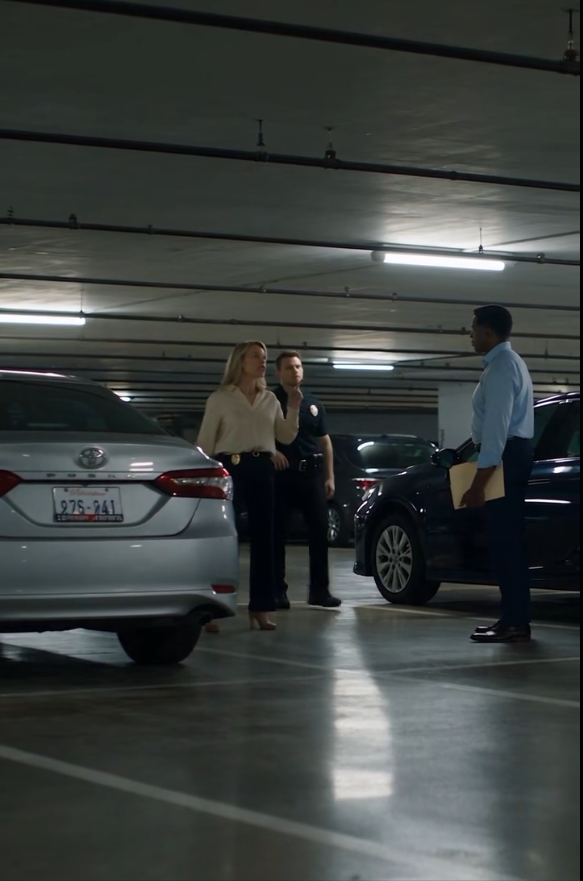
Department guidance on property-access disputes would instruct officers, where practical and safe, to seek available independent verification before escalation.
The reforms were narrow.
Marcus liked that.
Narrow reforms tended to survive.
The city released a statement citing the incident as the reason for the changes.
Marcus requested one edit before publication.
The draft said:
“Following the detention of United States District Judge Marcus Reed…”
He asked that it read:
“Following review of an investigative detention captured on body-worn camera…”
The city agreed.
The headlines used his title anyway.
But policy did not.
That mattered more.
Part VI — The Door Opens
Three months after the incident, Marcus visited his mother on a Sunday afternoon.
He drove the same dark blue sedan.
He wore jeans and a gray sweater.
No suit.
No leather folder.
The electronic parking pass opened the garage gate immediately.
He laughed once when it happened.
He parked in the same visitor space.
For a moment, he sat behind the wheel.
The garage looked exactly as it had before.
Concrete columns.
Fluorescent lights.
Painted numbers.
Ordinary places rarely kept the emotional architecture people built inside them.
Marcus got out.
At the security door, he reached for the credential.
Someone approached from behind.
He turned.
Diane Mercer stood a few spaces away carrying two grocery bags.
They looked at each other.
Neither smiled.
Diane adjusted one bag against her hip.
“The pass works now.”
“So far.”
She nodded.
Marcus tapped the credential.
The light turned green.
The door released.
He opened it, then held it for her.
Diane stopped.
For half a second, Marcus wondered whether she would refuse because accepting would feel symbolic.
Then she walked through.
“Thank you.”
“You’re welcome.”
They entered the elevator lobby.
Diane set one grocery bag down while waiting.
“I watched the hearing again.”
Marcus looked at the elevator numbers.
“That sounds unpleasant.”
A small laugh escaped her before she could stop it.
“I looked terrible.”
Marcus glanced at her.
“You looked uncomfortable.”
“That’s a judicial answer.”
“No. A judicial answer would be longer.”
She almost smiled.
The elevator arrived.
They stepped inside.
Diane pressed six.
Marcus pressed seven.
As the doors closed, she said, “I owe your mother an apology.”
Marcus looked at her.
“That’s between you and my mother.”
“I tried once.”
“What happened?”
“She said I wasn’t ready.”
Marcus stared at the floor, fighting a smile.
“That sounds like her.”
Diane looked at him.
“She was right.”
The elevator stopped at six.
The doors opened.
Diane picked up her groceries.
Before stepping out, she turned.
“I’m sorry.”
Marcus said nothing for a moment.
Diane continued.
“Not because you’re a judge.”
He looked at her.
“I know that’s the obvious thing to say.”
“Yes.”
“I’m still saying it.”
Marcus studied her face.
There was no audience.
No board.
No camera he could see.
He nodded once.
“Then don’t make me more important than the next person.”
Diane looked at him for a long second.
“All right.”
The doors closed.
Marcus rode to seven.
Evelyn opened the door carrying a screwdriver.
“What did you break?”
“Nothing.”
“Then why do you have a screwdriver?”
“I’m hanging pictures.”
“You told me not to help.”
“I didn’t ask you to.”
Marcus stepped inside.
Three framed photographs were now hanging crookedly along the living-room wall.
He looked at them.
“Those are terrible.”
“They’re level.”
“They’re absolutely not.”
“You’re a judge, not a carpenter.”
He took the screwdriver from her.
“Move.”
Evelyn sat on the couch while he adjusted the first frame.
After a minute, she said, “I saw Diane downstairs yesterday.”
“So did I just now.”
“She apologized.”
Marcus glanced over his shoulder.
“You told her she wasn’t ready.”
“She wasn’t.”
“And now?”
“She did better.”
Marcus returned to the frame.
“High praise.”
“I’m selective.”
He shifted the nail.
His mother watched him.
“What happened with the officer?”
“Back on patrol.”
“You know what I mean.”
Marcus did.
“His monitoring period ended last week. No similar complaints. Supervisor gave him a positive review.”
Evelyn nodded.
“And the camera policy?”
“In effect citywide.”
“Good.”
Marcus hung the frame.
His mother studied it.
“Still crooked.”
“It is not.”
“It leans left.”
“It’s the photograph.”
“Fix the photograph.”
Marcus turned.
“That isn’t how reality works.”
Evelyn smiled.
“Interesting.”
He pointed the screwdriver at her.
“Don’t.”
She laughed.
Marcus adjusted the second frame.
On the side table, his mother had placed a printed photograph he had not seen before.
He picked it up.
It showed Evelyn outside the apartment building on move-in day, standing beside Marcus’s blue sedan. Marcus himself was partly visible at the edge, holding one of the cardboard boxes.
No robe.
No courthouse.
No title.
Just a son helping his mother move.
“When was this taken?”
“The property manager sent it.”
Marcus set the photograph down.
Evelyn looked toward him.
“You know what I kept thinking about?”
“What?”
“The clerk’s office call.”
Marcus’s expression tightened slightly.
“You didn’t like that.”
“No.”
“I’m aware.”
“But I’m glad you made it.”
He looked at her.
“That’s new.”
“I can dislike what it meant and still be glad it happened.”
Marcus leaned against the wall.
“Explain.”
“It exposed the exact moment everyone’s behavior changed.”
She folded her hands in her lap.
“Without that call, you might have spent years wondering whether you imagined the difference.”
Marcus considered that.
She was right.
The title had not solved the incident.
It had revealed it.
Before the call, Marcus’s words were treated as claims.
After the call, the same words became credible.
The call had not changed the truth.
It had changed who was permitted to possess it.
His mother nodded toward the photograph.
“That’s why the camera mattered more.”
Marcus looked at her.
“The camera didn’t care what you did for a living.”
He smiled faintly.
“No.”
“It saw the same man before the phone call and after.”
Marcus looked again at the photograph.
For months, people had asked him whether the worst part had been the cuffs.
It had not.
The cuffs were metal and procedure. They had come off.
The deeper injury had been the speed with which ordinary uncertainty became someone else’s certainty about him.
But even that was not what stayed with him now.
What stayed was the red light.
A small mechanical witness.
Not wise.
Not fair.
Not capable of context by itself.
But patient.
It had preserved the gap between what people later wished they had done and what they actually did.
Marcus returned to the wall and straightened the third frame.
His mother stood beside him.
“Better.”
“It was already fine.”
“No.”
He handed her the screwdriver.
His phone vibrated.
A message from an unknown number.
Marcus looked at it.
Officer Hayes.
He had not heard from him since the hearing.
The message contained no greeting, only a sentence:
Used verification before restraint today. Thought you’d want to know.
Marcus read it again.
Evelyn looked over.
“Work?”
“Something like that.”
He typed a reply.
Good.
Then stopped.
Deleted it.
He tried again.
What happened?
He stared at the question.
That would invite details Hayes might not be able to share.
Deleted again.
Finally he wrote:
That’s the point.
He sent it.
Evelyn had already returned to rearranging books.
Marcus slipped the phone into his pocket.
Outside, evening light settled across the neighboring buildings.
Down below, cars entered and left the garage. Residents came home carrying groceries. Guests arrived. Delivery drivers searched for unit numbers. People held doors for strangers or did not.
Life continued in all the ordinary places where people had seconds to decide what someone else’s presence meant.
Marcus walked to the window.
His mother’s reflection appeared faintly beside his in the glass.
For years in court, he had told jurors that evidence mattered because memory changed under pressure. People simplified. They justified. They filled gaps. They confused certainty with accuracy.
He had believed every word.
He simply had not expected one afternoon in a parking garage to teach him the lesson from the other side of the record.
Evelyn joined him.
“You staying for dinner?”
“What are you making?”
“I asked if you’re staying.”
“That depends.”
“On?”
“The answer to my question.”
She shook her head.
“Ungrateful.”
Marcus smiled.
Below them, a car paused at the garage entrance.
The gate rose.
A man Marcus had never seen before walked toward the residents’ door carrying two grocery bags, found his access card, and tapped it against the reader.
The first attempt failed.
He tried again.
Marcus watched without meaning to.
A second resident approached from behind.
For a moment, Marcus’s body remembered concrete, fluorescent lights, Diane’s pointed finger, Hayes’s hand closing around his wrist.
The resident below stopped beside the unfamiliar man.
Marcus could not hear them through the glass.
The stranger lifted his card and gestured toward the reader.
The resident looked at it.
Then reached past him and pressed the call button for management.
A few seconds later, the door buzzed open.
Both men walked inside.
Nothing happened.
That was the entire event.
Marcus stood at the window a moment longer.
Then he turned away.
For once, nothing happening felt like proof that something had changed.