PART 3 — KEEP THE LIGHT ON
Two months passed.
Autumn arrived.
The leaves along East Avenue turned copper and red.
I did not speak to Anthony.
Not once.
He did not push.
The Riverside marquee restoration continued anyway.
No Russo logos.
No foundation plaque.
No photographers.
I checked.
One morning I found Anthony’s name nowhere in the paperwork.
The donation had been routed anonymously.
I knew anyway.
In October, a developer named Malcolm Pierce offered Riverside three million dollars for its property.
Louise refused.
A week later, inspectors appeared.
Then tax questions.
Then complaints from businesses that had never complained before.
The old neighborhood started whispering that Pierce had friends at City Hall.
And that his company had quietly acquired three buildings on the block.
I learned one more thing.
Russo Construction owned forty percent of Pierce Development.
I drove to Anthony’s office without calling.
The receptionist recognized me immediately.
That irritated me.
“Mr. Russo is in a meeting.”
“Tell him Emma Bennett is here.”
The meeting ended in under thirty seconds.
Anthony appeared.
He looked thinner.
I hated noticing.
“Emma.”
“Are you trying to buy Riverside?”
“No.”
“Your company owns Pierce Development.”
“My company owns a minority stake.”
“Forty percent.”
“Yes.”
“Malcolm Pierce is pressuring Louise.”
“I know.”
“You know?”
“I found out this morning.”
“You expect me to believe you didn’t authorize it?”
“Yes.”
“Why?”
His expression hardened.
Not at me.
At something behind the question.
“Because Pierce no longer works for me.”
I frowned.
“What?”
“I bought his stake forty minutes ago.”
“You what?”
“Pierce Development no longer exists independently.”
My stomach dropped.
“You bought the company?”
“Yes.”
“Why?”
“So I could stop this today.”
I stared at him.
“That is insane.”
“It was efficient.”
“There it is.”
“What?”
“The terrifying mafia answer.”
His mouth almost curved.
Almost.
I hated that mine nearly did too.
“What happens to Riverside?” I asked.
“It stays exactly where it is.”
“Forever?”
“As long as Riverside wants.”
“And the surrounding buildings?”
“Affordable commercial leases.”
I blinked.
“That is extremely specific.”
“I had eight weeks to think.”
“About zoning?”
“About what you would accuse me of if I did this badly.”
That caught me off guard.
Silence spread between us.
Anthony leaned against his desk.
“I’m not asking you for anything.”
“I know.”
“I’m not doing this to make you come back.”
“I know.”
“I just needed you to know Pierce wasn’t acting for me.”
“Okay.”
I turned toward the door.
“Emma.”
I stopped.
“I’m sorry.”
I looked back.
“I know.”
He seemed surprised.
“I believe you,” I said.
That was not forgiveness.
But it was no longer nothing.
His shoulders lowered slightly.
I left.
Two weeks later, the Riverside marquee was ready.
Louise called me at the shop.
“You’re coming Saturday.”
“Is that a question?”
“No.”
“I figured.”
“And wear something nice.”
“Why?”
“Because I’m old and controlling.”
“Fair.”
Saturday evening was cold enough that everyone’s breath turned white.
Hundreds of people filled the sidewalk.
Children carried cups of hot chocolate.
Someone had set up speakers playing Motown.
The restored marquee looked almost exactly as it had in photographs from the 1970s.
Deep blue lettering.
Cream trim.
Hundreds of small bulbs waiting behind clean glass.
I saw Anthony across the street.
Alone.
No security close enough to notice.
Black shirt.
Dark coat open against the cold.
He was not watching the marquee.
He was watching me.
I crossed the street.
His expression shifted.
“Hi.”
“Hi.”
For a moment, we stood like strangers who knew far too much about each other.
“I read the letter,” I said.
He nodded.
“I assumed.”
“He wrote about you.”
Anthony looked surprised.
“What did he say?”
“That you were an angry seventeen-year-old with too much money and no idea how to strip a wire correctly.”
Anthony looked down.
A laugh escaped him.
Soft.
Painful.
“That’s accurate.”
“He said you broke three switches.”
“Two.”
“Three.”
“Your father exaggerated.”
It was the first time someone had said your father to me without making my chest collapse.
I smiled before I could stop myself.
Anthony saw.
He did not celebrate it.
That mattered.
“He also said you tried to find him after Victor died.”
“I did.”
“You told him to come home.”
“Yes.”
“He refused.”
“Yes.”
“Why didn’t you make him?”
Anthony’s expression became tired.
“Because I spent my childhood watching my father force people into decisions and call it protection.”
I looked at him.
“I didn’t want to become him.”
“You could have told me sooner.”
“Yes.”
“You should have.”
“Yes.”
“I’m still angry.”
“You should be.”
“That agreement thing is annoying.”
“I can argue if it helps.”
“It might.”
He smiled.
So did I.
The speakers crackled.
Louise called everyone toward the front.
I started to walk away.
Then stopped.
“Anthony?”
“Yes?”
“You said there would be no more lies.”
“There won’t.”
“That isn’t the same as no more secrets.”
He understood.
“No more secrets either.”
“All of them?”
“All the ones that are mine to tell.”
I considered that.
It was a careful answer.
But careful was not always dishonest.
“Okay.”
Hope is terrifying when you have spent your life training yourself not to need it.
I held out my hand.
Anthony stared at it.
Then at me.
Slowly, he took it.
The crowd counted down.
Five.
Four.
Three.
Two.
One.
The Riverside marquee came alive.
Light exploded across the sidewalk.
People cheered.
Children screamed.
Louise cried without shame.
Hundreds of warm bulbs reflected in Anthony’s eyes.
For one beautiful second, I was happy.
Completely.
Stupidly.
Happy.
Then someone behind us shouted.
“Emma?”
A man in a brown county jacket was pushing through the crowd.
He looked around sixty.
Confused.
He held a small plastic property bag.
“Emma Bennett?”
“Yes.”
“I’m sorry. I’ve been trying to locate you.”
Anthony’s hand tightened around mine.
The man approached.
“I’m Thomas Keene. Monroe County hospital administration.”
I felt Anthony go still.
The man looked at the bag.
“This belonged to Michael Bennett.”
My heart stumbled.
Anthony stared at him.
“What is that?”
Keene looked between us.
“It was found in a sealed patient-property drawer after an internal inventory. There was an outdated emergency-contact form inside with Riverside Neighborhood Center listed.”
Louise had heard.
She came closer.
“I’m Riverside.”
Keene nodded.
“There’s a phone.”
My fingers went numb.
“A phone?”
“Old model. We charged it. There’s almost nothing on it.”
He handed me the bag.
“Except one recording.”
Anthony’s face changed.
“What recording?”
Keene shook his head.
“I didn’t listen past the first few seconds once I realized it was personal.”
My hands shook as I opened the bag.
Inside was a cheap black phone.
Cracked corner.
Scuffed case.
My father’s.
I turned it on.
One audio file sat on the screen.
Created Friday, July 17.
6:41 p.m.
The night I met Anthony.
The restaurant reservation had been for seven.
My vision blurred.
Anthony whispered, “Emma…”
I pressed play.
Static.
Breathing.
Then a voice I had not heard since I was nine years old.
Older.
Weaker.
But his.
My father.
“If you’re hearing this, Tony, I probably chickened out again.”
Anthony closed his eyes.
The crowd around us kept laughing.
Children ran beneath the lights.
Nobody understood that my entire childhood had just spoken from my palm.
Michael coughed.
“I know what you’re going to say. Save it.”
A faint chuckle.
Then silence.
“I’m supposed to meet you tonight.”
My knees nearly gave out.
Anthony caught my elbow.
The recording continued.
“I wanted to give you Emma’s letter myself.”
My breath broke.
“I wanted one person in this world to look me in the face and tell me I wasted my life being afraid.”
Anthony turned away.
His jaw trembled.
My father breathed heavily.
Then:
“If I don’t make it, find her.”
My eyes shut.
“Not because she needs protecting.”
A pause.
“She never needed that from me as much as I told myself she did.”
Tears slipped down my face.
“Just tell her the truth.”
Another cough.
Longer this time.
“And Tony…”
Anthony looked at the phone.
“I know you.”
His voice softened.
“If you meet her, don’t try to fix her.”
A broken little laugh.
“She fixes things.”
I covered my mouth.
Anthony’s eyes filled.
The audio crackled.
My father’s voice dropped almost to a whisper.
“I left her staring at too many empty chairs.”
The world vanished.
The restaurant.
My canceled date.
Anthony sitting alone.
The two empty chairs between us.
I looked at him.
His face had gone white.
“He never sent this to you?”
Anthony shook his head.
“No.”
The last few seconds played.
My father took one final uneven breath.
Then said:
“If you ever get lucky enough to sit across from her, Tony… don’t leave the chair empty.”
The recording ended.
Nobody spoke.
Behind us, the Riverside marquee burned against the October darkness.
Anthony looked at me like the entire world had narrowed to the space between us.
“I swear to you,” he whispered. “I didn’t know.”
I believed him.
That was the cruelest and most beautiful part.
He had gone to the restaurant waiting for my father.
I had gone waiting for a stranger.
Neither man arrived.
And somehow, in the space left behind by two disappointments, Anthony and I had found each other.
Not because my father planned it.
Not because Anthony arranged it.
Not because fate owed me anything.
Because sometimes two people look up from their separate empty chairs at exactly the right moment.
I cried then.
Not neatly.
Not quietly.
Anthony held me.
And for once, I let someone.
Across the street, Louise stood beneath the restored sign with both hands pressed over her heart.
The bulbs shone against the old brick.
Every single one.
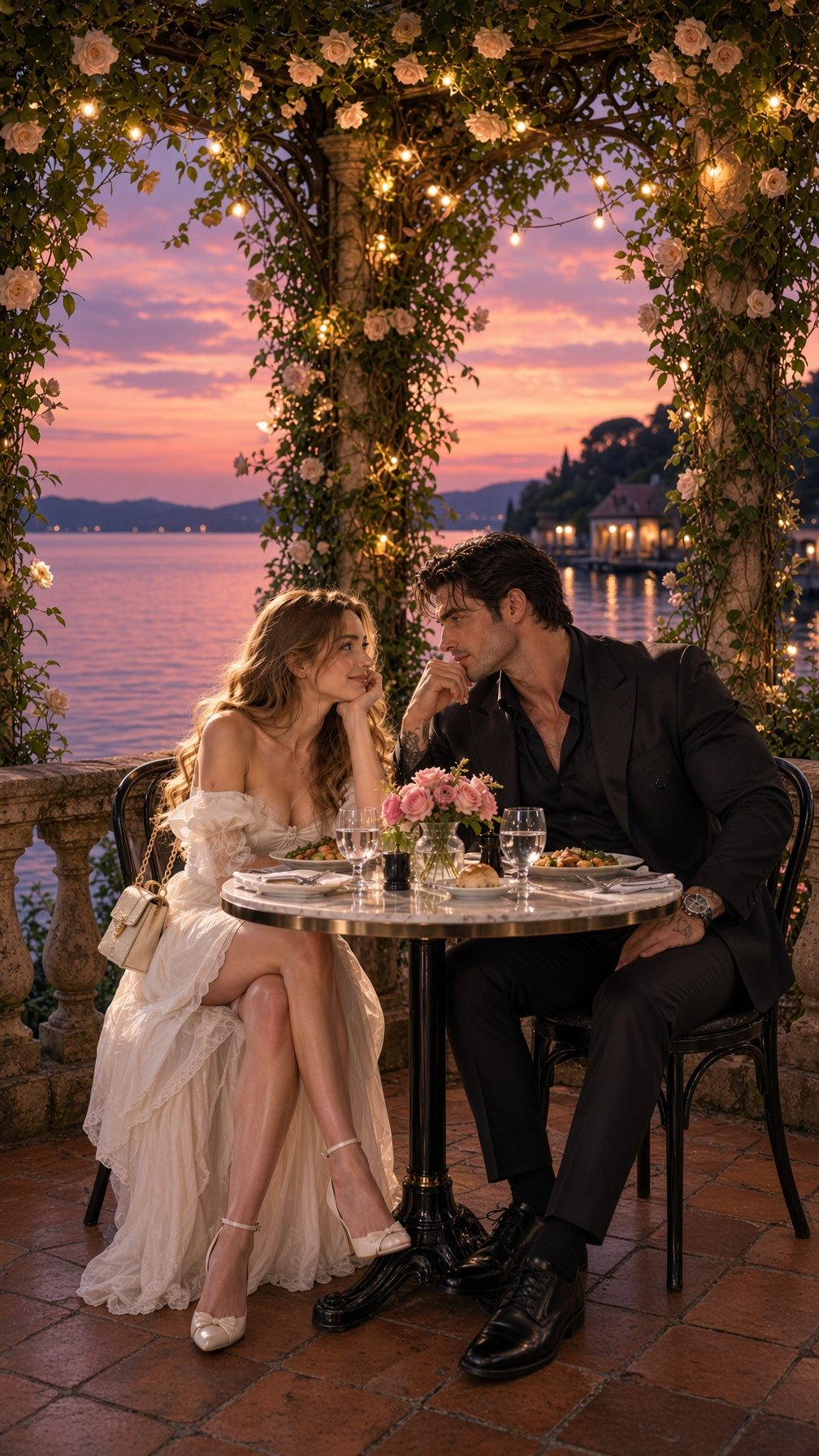
Months later, Anthony and I returned to the same restaurant.
Same Friday table.
Same brick wall.
Same candlelight.
The server offered us the table where we had first met.
Anthony pulled out my chair.
Then stopped.
Beside our table was the one he had originally occupied.
For a long moment, I stared at the empty seat across from it.
I could almost see my father there.
Older than the man I remembered.
Terrified.
Ashamed.
Trying, far too late, to come home.
I no longer needed to make him a hero.
I no longer needed to make him a villain.
He had loved me.
He had failed me.
Both things were true.
Maybe that was the hardest kind of forgiveness.
Not absolution.
Not forgetting.
Just finally allowing the dead to be human.
Anthony sat across from me.
No false name.
No hidden story.
No empty chair between us.
Outside, the city glowed through the rain.
I reached across the table.
He took my hand.
And somewhere deep inside me, the nine-year-old girl who had spent an entire Saturday waiting on the front steps finally picked up her backpack and went inside.
This time, when I looked across the table, the chair was not empty.