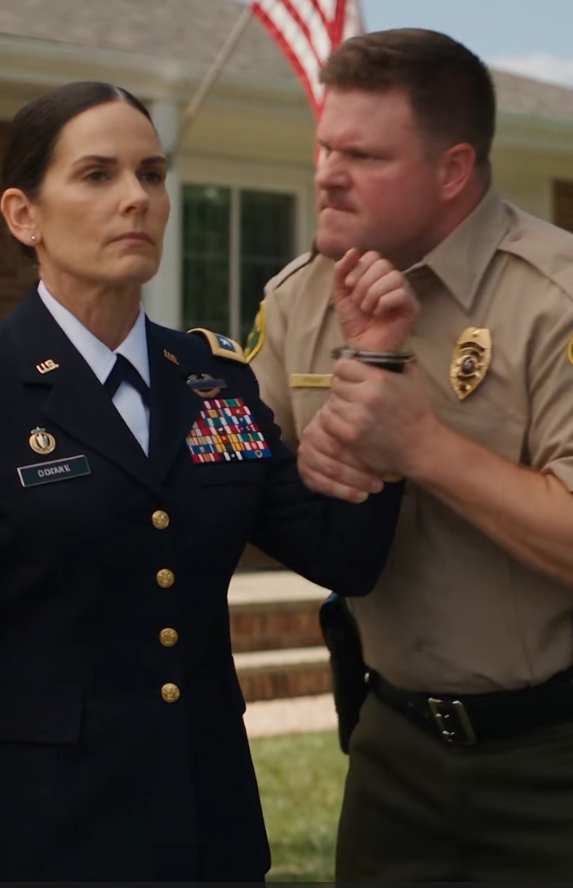
“This is yours personally?”
“Potentially.”
“And potentially evidence.”
“Yes.”
“You want to be present when it’s opened?”
“Yes.”
He studied me.
“Can you sit there as family and not as commander?”
I appreciated the question.
“Yes.”
“Then that’s what you are for the next hour.”
Inside the command station, the case was photographed before opening.
Every surface.
Every hinge.
Every marking.
Then a technician cut the old tape.
The lid lifted with a faint metallic scrape.
Inside were three sealed plastic document sleeves and a small cassette recorder wrapped in cloth.
No weapons.
No electronic devices.
No classified media.
At least none immediately visible.
The first sleeve contained photocopies of access logs from eighteen years earlier.
The second contained maintenance memoranda.
The third held a bundle of handwritten pages.
The technician looked toward General Harlan.
“Sir.”
Harlan nodded.
“Inventory before reading.”
I waited.
On the wall, a ventilation fan hummed.
Rebecca sat at the far end of the table beside Mercer.
Her hands had stopped shaking.
Mine had not.
Not visibly.
But I kept them clasped together anyway.
Twenty minutes later, Harlan slid one photocopied memorandum toward me.
“Read the signature.”
I looked down.
The memo concerned temporary reciprocal access for county emergency personnel during communications outages.
At the bottom was a civilian facilities supervisor’s name.
Walter Carter.
My father.
Below it was another name.
SPECIALIST THOMAS CARTER.
Thomas’s signature appeared beside a handwritten note:
OBJECTED. COUNTY CREDENTIALS NOT INDIVIDUALLY VERIFIED AT OUTER NODE. TEMPORARY PROCEDURE CREATES DUPLICATION RISK.
I read it again.
Harlan placed another sheet beside it.
Three weeks later, an unauthorized county credential had been used at the same outer access point.
The incident report listed Thomas as the primary person under investigation because his maintenance credentials had been used during system testing shortly beforehand.
A third document was a sworn statement signed by Thomas.
I ACCEPT RESPONSIBILITY FOR FAILURE TO MAINTAIN CONTROL OF ACCESS PROCEDURES DURING TESTING.
My jaw tightened.
“He confessed.”
Rebecca shook her head immediately.
“No.”
Every person in the command station looked at her.
She stood.
“He didn’t.”
I turned toward her.
“The signature is his.”
“Yes.”
“Then explain.”
Rebecca’s face had gone gray.
“Walter asked him to sign it.”
For a second, the hum of the ventilation system seemed louder.
“Why?”
“Because your father authorized the county access procedure.”
“That was poor judgment. Not necessarily criminal.”
“No.”
Rebecca looked down.
“But it wasn’t just paperwork.”
General Harlan’s voice stayed neutral.
“What happened, Mrs. Nolan?”
She looked at him.
Then at me.
“I used one of those credentials.”
I did not understand.
“Eighteen years ago?”
“Yes.”
“For what?”
She sat again.
“Your uncle—Derek’s father—had left. Derek was twenty-five and angry at everybody. Todd was still young. I was working county dispatch nights. There was a storm. We lost part of the county radio network.”
Her voice became steadier as she moved into facts.
“Walter had told us the reserve relay could patch emergency traffic during outages. It had been done before. Informally.”
Harlan glanced at the old memo.
Rebecca continued.
“I had a county access card. I went to the outer node because an ambulance crew couldn’t reach dispatch.”
“Were you authorized?”
“Not personally.”
“So Walter’s procedure allowed general county credentials.”
“Yes.”
“Thomas objected to that.”
“Yes.”
“Did you gain access?”
“To the outer relay only.”
“Did you damage anything?”
“No.”
“Remove anything?”
“No.”
“Then why did Thomas take responsibility?”
Rebecca looked at me.
“Because the card I used had been duplicated.”
I felt the pieces rearrange.
“Duplicated how?”
“They issued temporary emergency cards from a common pool. One of them was missing. Nobody knew for how long.”
Harlan leaned back.
“And later that missing credential was used in an unauthorized access attempt.”
Rebecca nodded.
“Thomas had warned them that could happen.”
“Why would that make him responsible?”
“It shouldn’t have.”
That answer came from the doorway.
My father stood there.
A security officer was behind him.
General Harlan rose.
“Who authorized Mr. Carter to enter?”
“I did,” Mercer said. “At his request. He has information relevant to the historical incident.”
I stared at my father.
Walter looked exhausted.
Not physically.
Structurally.
As if some internal frame he had relied on for decades had finally failed.
He entered the room.
His eyes went to the open metal case.
Then the recorder.
“I hoped that thing had rusted shut.”
I stood.
“What did you do?”
My father looked at me.
“I was scared.”
“That isn’t an answer.”
“No.”
He nodded.
“It isn’t.”
He pulled out a chair but did not sit.
“Thomas warned me that the county access arrangement was unsafe. I told him he was overthinking it. We needed the county and the reserve site to cooperate during outages. The formal process was too slow.”
“So you bypassed it.”
“Yes.”
“Then somebody exploited the weakness he warned you about.”
“Yes.”
“And you asked him to take responsibility.”
My father’s face tightened.
“I asked him to say the procedural failure happened during his test.”
“You asked him to lie.”
“Yes.”
Rebecca whispered, “Walter.”
He looked at her.
“No more.”
Then back at me.
“I told him I would correct it after I protected the civilian staff from being pulled into the investigation.”
“Meaning yourself.”
“And Rebecca.”
I felt Rebecca flinch behind me.
Walter continued.
“I thought it would be temporary.”
“Was it?”
“No.”
“What happened?”
“The review moved faster than I expected. Once Thomas’s statement went in, investigators treated it as an admission. He wanted to retract it.”
“And?”
“I asked him to wait.”
“How long?”
“Two days.”
I stared at him.
“You asked your son to carry blame for something he had warned you would happen, then when he tried to correct the record, you asked him to keep lying.”
“Yes.”
“Why?”
His voice dropped.
“Because I was a coward.”
Nobody moved.
Walter looked at the open case.
“Thomas told me he had made copies. Said if I didn’t tell the truth, he would.”
“What did you do?”
“I told him if he exposed everything, Rebecca could lose her job. I could lose mine. The county would be dragged into a federal investigation.”
“And his career?”
My father closed his eyes.
“I told myself his would recover.”
“Did you believe that?”
“No.”
That was the first answer that hurt cleanly.
No justification.
No softening.
Just no.
“What happened the night he left?”
“He came to the house. We fought.”
“I remember.”
Of course I remembered.
A door slamming downstairs.
My mother crying in the kitchen.
Thomas standing in the hallway with a duffel bag.
Me asking where he was going.
My father telling me to go upstairs.
Thomas looking back at me once.
I had spent eighteen years thinking that look meant shame.
Now I was no longer sure.
Walter continued.
“He said he was taking the records to the inspector general the next morning. I told him if he did, he wasn’t welcome back.”
My mother made a sound from somewhere behind us.
I had not realized Mercer had brought her too.
Linda stood in the doorway.
Her face was wet.
“Walter.”