Sorry you took it that way.
Sorry things got heated.
Sorry everybody’s upset.
This was different.
No explanation attached.
No demand for immediate forgiveness.
“I appreciate you saying it.”
“That’s it?”
“What do you want?”
“I don’t know.”
“Then don’t turn an apology into a transaction.”
He nodded slowly.
“That sounds like something a general says.”
“That sounds like something my brother would have said.”
His expression changed.
“Thomas.”
“Yes.”
“We weren’t supposed to talk about him.”
“I know.”
Derek looked toward the living room, where Rebecca sat alone.
“I barely remember him.”
“He remembered you.”
“How do you know?”
I had found another handwritten page in Thomas’s case.
Not classified.
Not part of the security records.
A page of names.
People Thomas worried would be hurt if the investigation expanded.
Rebecca.
Todd.
Derek.
My mother.
Me.
My father’s name had been at the bottom.
I took the folded photocopy from my pocket.
“He listed everyone he was trying to protect.”
Derek read the page.
His eyes stopped on his own name.
“He took the blame partly because of us?”
“Partly.”
Derek handed the page back.
“That doesn’t make me feel better.”
“It shouldn’t.”
He looked surprised.
“Thomas said protecting people isn’t the same as protecting them from consequences.”
Derek was quiet.
“So what happens to Mom?”
“I don’t know.”
“You could help.”
The request was soft.
There it was.
The harder choice.
Not on a battlefield.
Not inside a command center.
In my parents’ kitchen.
Family asking family to bend consequence in the name of loyalty.
I looked through the doorway.
Rebecca sat with her hands folded.
My father was somewhere upstairs.
My mother was washing dishes nobody had eaten from.
Eighteen years earlier, Thomas had been asked to protect the family by absorbing someone else’s mistake.
Now Derek was asking me, in a much smaller way, to do the same thing in reverse.
“I won’t interfere with Mercer.”
His face tightened.
“She’s your aunt.”
“I know.”
“She didn’t hurt anyone.”
“That will matter.”
“You’re a general.”
“Yes.”
“You could make one call.”
I held his gaze.
“That is exactly why I won’t.”
He looked away.
I continued.
“If I use my position to make your mother’s consequences disappear because she’s family, then everything Thomas said on that tape becomes meaningless.”
Derek’s mouth tightened.
“That’s easy when it isn’t your mother.”
“No.”
I looked toward Rebecca.
“It isn’t easy at all.”
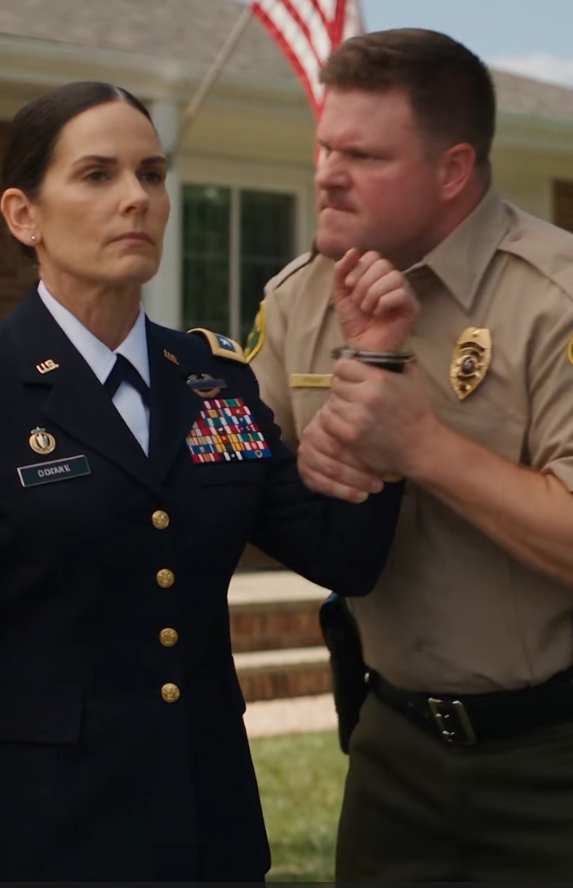
Then I walked outside.
Grandma Evelyn was sitting beneath the porch light.
She had refused to leave.
At seventy-six, she had developed the particular stubbornness of someone who had outlived enough people to stop pretending family discomfort frightened her.
She tapped the chair beside her.
I sat.
For a minute we listened to insects in the grass.
Then she said, “Your grandfather would have hated today.”
I smiled faintly.
“The handcuff?”
“The wasted steaks.”
I laughed.
She did too.
Then she looked at my wrist.
“Thomas never liked Derek’s father.”
“That feels less relevant than it probably is.”
“It is.”
She folded her hands over the cane.
“Your brother had a sharp tongue.”
“I remember.”
“He got it from your father.”
“I remember that too.”
Grandma looked toward the dark yard.
“Walter has punished himself for eighteen years.”
“I’m having trouble feeling sorry for him.”
“I didn’t ask you to.”
I turned toward her.
She had always been better at cutting through sentences than anyone in the family.
“He lied to me.”
“Yes.”
“He let me believe Thomas had disgraced himself.”
“Yes.”
“He stood there when I got into West Point knowing Thomas mailed my packet.”
“Yes.”
Each answer was calm.
“What am I supposed to do with that?”
“Whatever you decide.”
“That’s not helpful.”
“No.”
She smiled faintly.
“Helpful is overrated.”
I looked away.
After a while she said, “Your father confused shame with repentance.”
I said nothing.
“He thought feeling bad was the same as making it right.”
That sentence stayed with me.
Because I had seen the same mistake in soldiers, commanders, parents, spouses.
Private guilt could feel morally significant.
But if it never changed what you did next, it was only pain turned inward.
My father had carried pain for eighteen years.
Thomas had carried the consequence.
There was a difference.
Part V — The Record
Two days after Memorial Day, the Army confirmed what Thomas had been trying to prove.
The unauthorized county credential used eighteen years earlier had not originated with him.
Archived technical logs showed that Thomas had documented the access vulnerability before the incident.
His signed statement had mischaracterized his responsibility.
The old inquiry had been incomplete.
There was no evidence he had intentionally compromised the site.
No evidence he had stolen credentials.
No evidence he had assisted any unauthorized entrant.
His objection memo should have changed the investigation.
Instead, because he had signed the false responsibility statement, investigators had treated his warning as self-protection.
My father’s request had not merely hurt Thomas personally.
It had distorted the official record.
General Harlan called me into his office on Wednesday afternoon.
The recovered documents were spread across his conference table.
“You understand this doesn’t automatically erase everything.”
“Yes.”
“The Army can correct findings. It can amend records. It cannot reconstruct every decision people made eighteen years ago.”
“I know.”
“Your brother signed the statement voluntarily.”
“Under family pressure.”
“Yes. But voluntarily.”
“I understand.”
Harlan studied me.
“You’re not arguing.”
“Would it help?”
“No.”
“Then I’m saving us both time.”
He almost smiled.
Then he tapped the old memo.
“The meaningful part is this. Thomas’s warning predates the incident. His technical concern was valid. His allegation that the access system could be exploited was accurate.”
“Can the record state that?”
“I believe so.”
“And the allegation that he caused the breach?”
“Unsupported.”
I looked at the page.
For eighteen years, my family had treated Thomas’s name as something fragile and dangerous.
Now two typed words could restore what silence had taken.
Unsupported allegation.
It did not bring him back.
It did not return the years.
But truth did not become meaningless simply because it arrived late.
“What about my father?”
Harlan closed the folder.
“Civilian administrative responsibility from eighteen years ago is likely beyond practical disciplinary reach. The historical review will document his role.”
“He admitted falsifying the context of Thomas’s statement.”
“Yes.”
“Anything criminal?”
“That’s for counsel. Given the age of the conduct and the nature of the records, I wouldn’t speculate.”
I nodded.
“And Rebecca?”
“Current matter. Separate.”
Sheriff Mercer called me that evening.
Rebecca would face charges related to unauthorized credential use and attempted access to the restricted property, but investigators had confirmed she never crossed the gate and had no malicious or espionage-related intent.
Derek’s administrative investigation would continue.
Mercer asked whether I wanted to submit a statement regarding the backyard detention.
I almost said no.
Family instinct.
Keep it small.
Do not make things worse.
Then I remembered Thomas’s voice.
Protecting people and protecting them from consequences are not the same thing.