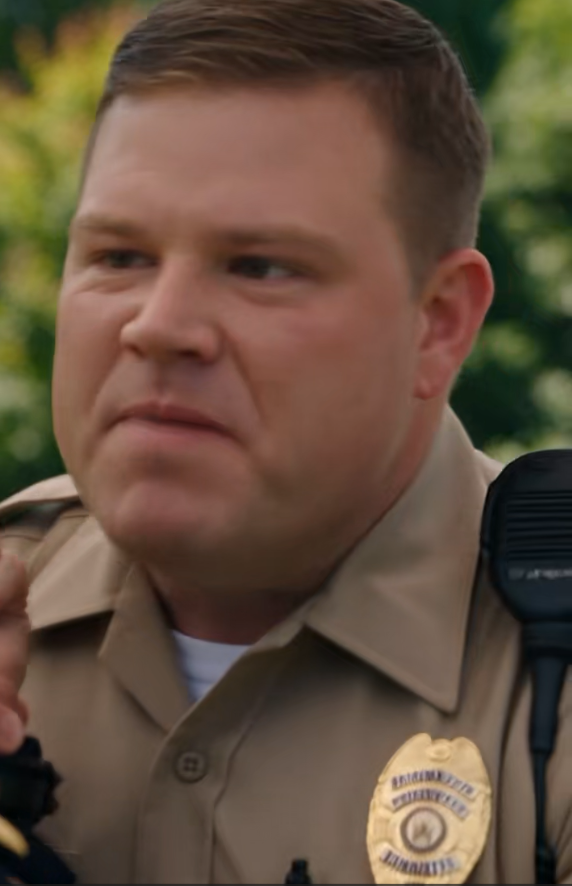
Part I — The Handcuff
The steel closed around my wrist with a hard, mechanical click.
“Maybe this will finally teach you some respect!”
Derek Nolan said it loudly enough for everyone in my parents’ backyard to hear.
That was the point.
My cousin had never been interested in simply winning an argument. He liked witnesses. He liked the moment after his voice rose, when everyone around him recalculated where they stood. At forty-three, with a broad frame, a county sheriff’s badge and a duty belt heavy enough to announce him before he entered a room, Derek had spent years building himself around the idea that authority was something other people could see.
That afternoon, the handcuff was part of the performance.
For half a second, I watched his thumb settle over the ratchet housing.
Then I looked at his face.
“You’re going to remove that.”
He gave me a tight smile.
“No, Rachel. For once, you’re going to stop telling everybody what to do.”
Behind him, my father’s grill smoked beneath the oak trees. A country song played from a speaker near the porch. My uncle Carl had stopped arguing about whether the steaks were overdone. My mother, Linda, stood beside the picnic table holding a serving spoon she no longer seemed to remember.
Nobody laughed now.
They had laughed earlier.
At the uniform.
At the ribbons.
At the stars.
I had arrived at my parents’ house shortly before noon wearing Army dress uniform because I was scheduled to speak at a Memorial Day remembrance ceremony later that afternoon. I had known what the family would do with it before I stepped out of my car.
Derek had looked me over and said, “They let office people wear all that now?”
Uncle Carl laughed.
Todd, my younger cousin, asked whether I was “basically an office manager for the Army.”
My father had stared at the grill.
My mother had changed the subject.
I had done what I usually did.
Nothing.
There were times when silence was restraint.
There were times when silence was exhaustion.
After enough years, it could become habit.
My family knew I had gone to West Point. They knew I had stayed in the Army. They knew I had moved often, deployed more than once and missed Christmases, birthdays and funerals because the government had sent me somewhere else.
What they did not know—because eventually I stopped volunteering information they always found a way to diminish—was almost everything else.
They did not know what my command actually was.
They did not know the size of the formation that reported through me.
They did not know why my phone sometimes rang at two in the morning.
They did not know why I had returned from one deployment with a scar below my left shoulder and an aversion to fireworks that lasted three years.
Most of all, they did not know my rank.
Not because I had lied.
Because they had stopped asking questions long before I stopped answering them.
When I graduated from West Point, Derek spent most of the dinner explaining why police work was more dangerous than what he called “college soldier stuff.”
When I took company command, Aunt Rebecca asked when I planned to get married.
When I deployed, my mother told neighbors I was doing administrative work.
When I came home, no one asked why I could not sleep.
Eventually they created a Rachel who made sense to them.
Rachel had a government job.
Rachel moved too much.
Rachel probably worked in an office.
Rachel never married because she cared more about her career than people.
Rachel thought she was better than everybody.
And because I rarely challenged any of it, their version hardened into fact.
Until 1:17 p.m. on Memorial Day.
Derek had spent lunch telling a story about arresting a drunken man outside a convenience store. He embellished it each time someone asked a question. By the third telling, the man had become six inches taller, considerably stronger and apparently capable of threatening three deputies at once.
I made the mistake of asking one question.
“Was he armed?”
Derek’s expression changed.
“No.”
“Then why did three deputies need to put him on the pavement?”
His fork stopped halfway to his mouth.
The table went quiet.
“I didn’t say we needed three.”
“You said three of you did it.”
“You weren’t there.”
“No.”
“So maybe don’t judge things you don’t understand.”
I took a drink of water.
“I asked a question.”
He leaned back.
“That’s what you always do.”
“What?”
“That tone.”
Todd glanced at me, then at Derek.
I set down the glass.
“What tone?”
“Like everybody in the room is beneath you.”
My grandmother Evelyn said, “Derek.”
He kept looking at me.
“You show up twice a year, sit there in your fancy costume, barely tell anybody what you do, then act like you’re the only competent person in the family.”
“I didn’t say that.”
“You don’t have to.”
He stood.
I stayed seated.
That bothered him more.
Derek came around the table and planted his index finger inches from my face.
“You’ve been doing this your whole life.”
“Move your hand.”
He laughed.
“You see? Orders.”
“Derek.”
This time it was my father.
Derek ignored him.
I touched Derek’s wrist and moved his finger away from my face.
He reacted immediately.
He shoved my hand aside, reached toward his belt and said, “You just put your hands on a law-enforcement officer.”
I stood.
“No. I moved your hand away from my face.”
“You’re interfering with an officer.”
“Off duty, at a family barbecue?”
His cheeks flushed.
That was when the handcuff appeared.
Aunt Rebecca gasped.
Someone laughed nervously.
Derek snapped one side around my wrist.
And then a black government SUV turned into the driveway.
The vehicle rolled past the mailbox and stopped behind my sedan.
The driver’s door opened.
Sergeant First Class Marcus Reed stepped out in full dress uniform carrying a sealed red folder.
Three words were printed across one corner.
COMMAND EYES ONLY.
The backyard became completely still.
Marcus walked up the driveway.
He saw my parents.
He saw Derek.
Then his eyes dropped to my wrist.
His face changed by less than an inch.
Anyone who did not know him would have missed it.
I did not.
Marcus and I had crossed paths for almost fifteen years. He had been a specialist when we first worked together, the sort of young soldier who learned the person’s job on either side of him because he could not tolerate being useless. By the time I became a brigadier general, Marcus had become one of the people I trusted when situations began moving faster than official channels.
He stopped three feet in front of me.
Came to attention.
“General Carter, ma’am.”
The words crossed the lawn like a physical object.
My cousin’s hand loosened on my arm.
Behind him, someone drew a breath.
Grandma Evelyn stared at the stars on my shoulders.
“General?”
I looked at her.
“Yes, Grandma.”
Derek stared at Marcus.
Then at me.
Then back at Marcus.