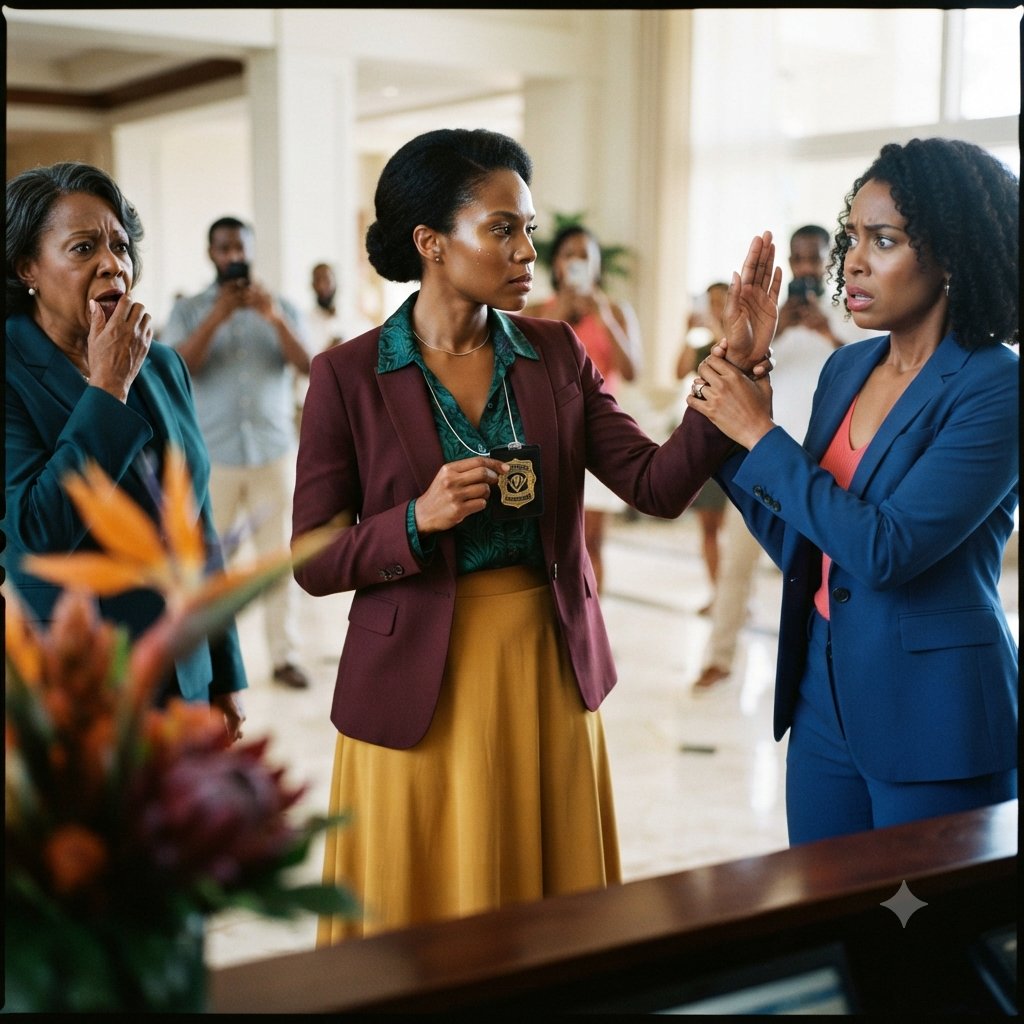
I crossed the hallway in four steps and knelt down in front of her.
Her face was very still.
That particular stillness she got when she was working something out, turning it over carefully the way she handled things she wasn't sure were safe to hold.
"Is Daddy in trouble?" she asked.
"Come here." I picked her up.
She was getting heavy for it but she let me, wrapping her legs around my waist and her arms around my neck the way she had when she was three.
I carried her to the sofa and sat down with her still against me.
"Is he going to jail?" she asked into my shoulder.
"I don't know yet, sweetheart."
She pulled back and looked at me.
"Did he know Grandma put the peanut butter in my cake?"
I held her face in both hands.
Seven years old, and she was asking me a question I didn't know how to answer without taking something from her that she would never get back.
"Yes," I said.
"He knew."
She looked at me for a long time.
"Okay," she said finally, in a voice that was too small and too careful and broke something in me completely.
She curled back against my chest.
I held her and didn't say anything.
Outside, a car passed on the street.
The house was very quiet.
After a while her breathing slowed and I thought she had fallen asleep.
Then she said, "Mommy.
I don't want to go to Grandma's house anymore."
"You won't," I said.
"I promise."
She nodded once, satisfied, and this time she did sleep.
I sat there with her weight against me and I thought about Daniel standing in my kitchen saying *it wasn't supposed to go that far*, as if the distance between intention and consequence was something I was supposed to forgive him for.
As if nearly losing our daughter was a miscalculation rather than a choice.
I thought about every time I had second-guessed myself in that family.
Every eye-roll from Evelyn I had absorbed quietly.
Every dinner where Daniel had laughed along with his mother's comments about my anxiety, my overprotectiveness, my inability to relax.
Every time I had wondered if they were right.
I had not been overprotective.
I had been the only one protecting her.
---
I met Patricia Holt at a coffee shop two days later.
She was in her mid-forties, composed in the way that people who have spent a long time being disbelieved learn to be composed.
She shook my hand and sat down and ordered tea and looked at me steadily.
"Marcus called me," she said.
"He told me what happened to your daughter.
I'm sorry."
"He told me about you," I said.
"I'm sorry too.
That you weren't believed."
She wrapped both hands around her mug.
"I knew what happened.
I knew it the second time, when I recognized the feeling — the tightness, the way my face went hot.
I had been tested for allergies twice before that and come back clear both times.
But I knew."
"What did Marcus say when you told him?"
"He said I was looking for an excuse to leave.
That his mother would never do something like that.
That I had always had a problem with her." She paused.
"He wasn't wrong that I had a problem with her.
But that wasn't why I was ill."
"He knows that now," I said.
"I know he does." She looked at her tea.
"It doesn't undo two years of thinking I was losing my mind."
"No," I said.
"It doesn't."
She looked up.
"Detective Reyes told me your evidence is strong.
The messages, the recording." A pause.
"Is it enough?"
"She thinks so.
For Evelyn, definitely.
For Daniel — she's less certain."
Patricia was quiet for a moment.
"Can I ask you something?"
"Yes."
"Did you love him?
Before all this?"
I thought about it honestly.
"I loved who I thought he was.
I'm not sure those are the same person anymore."
She nodded slowly, as if that was an answer she recognized.
We sat for another hour.
By the time I left, I had given Reyes's office her formal agreement to provide a supporting statement.
It wouldn't be the primary case.
But it would show a pattern.
And patterns, Reyes had told me, were what made prosecutors confident.
---
That evening Daniel's lawyer called mine.
He was offering a full written statement against Evelyn in exchange for consideration on his own charges.
My lawyer, a woman named Grace Chen who had come recommended by a colleague and who had the particular quality of never sounding surprised by anything, relayed this to me over the phone.
"He wants to cooperate," Grace said.
"What does he get in return?"
"That's what they're negotiating.
His attorney is suggesting he had limited foreknowledge — that he knew his mother intended a minor incident but had no knowledge of the quantity used or the severity of the risk."
"He was standing in the kitchen with her."
"I know.
The recording shows proximity but not conversation.
His attorney will argue he didn't know what she was doing in that specific moment." Grace paused.
"Sarah, I want to be honest with you.
If he cooperates fully and the DA accepts the limited foreknowledge argument, he may avoid criminal charges.
He would likely face civil liability in the divorce proceedings instead."
I sat with that.
"What do you recommend?"
"I recommend we let the criminal process run its course independently and focus our energy on the divorce and custody filing.
The criminal outcome for Daniel is the DA's decision, not ours.
What we can control is Sophie's safety going forward, and the financial settlement."
"Custody," I said.
"What are we looking at?"
"Given the recording, the messages, and his own admission to you — which I'd like you to document in writing as soon as possible — I believe we have strong grounds for primary custody with supervised visitation only, at least initially." Another pause.
"He put his daughter at risk to manage his mother's opinion of his wife.
A family court judge will not look at that kindly."
I exhaled slowly.
"Document the admission," I said.
"I'll write it out tonight."
"Good," Grace said.
"And Sarah — you're doing the right things.
All of them."
I hung up and sat at the kitchen table.
From upstairs I could hear Sophie's music, the little Bluetooth speaker she kept on her nightstand that played the same three songs on rotation every night while she fell asleep.
I opened my laptop and began to type.
I wrote down everything Daniel had said, word for word, as accurately as I could remember it.
The time.
The date.
What he had been wearing.
Where he had stood.
I wrote it all down before it could soften in my memory into something more bearable.
Then I saved the document, emailed it to Grace, and closed the laptop.
The music upstairs was still playing.
I listened to it until it stopped.