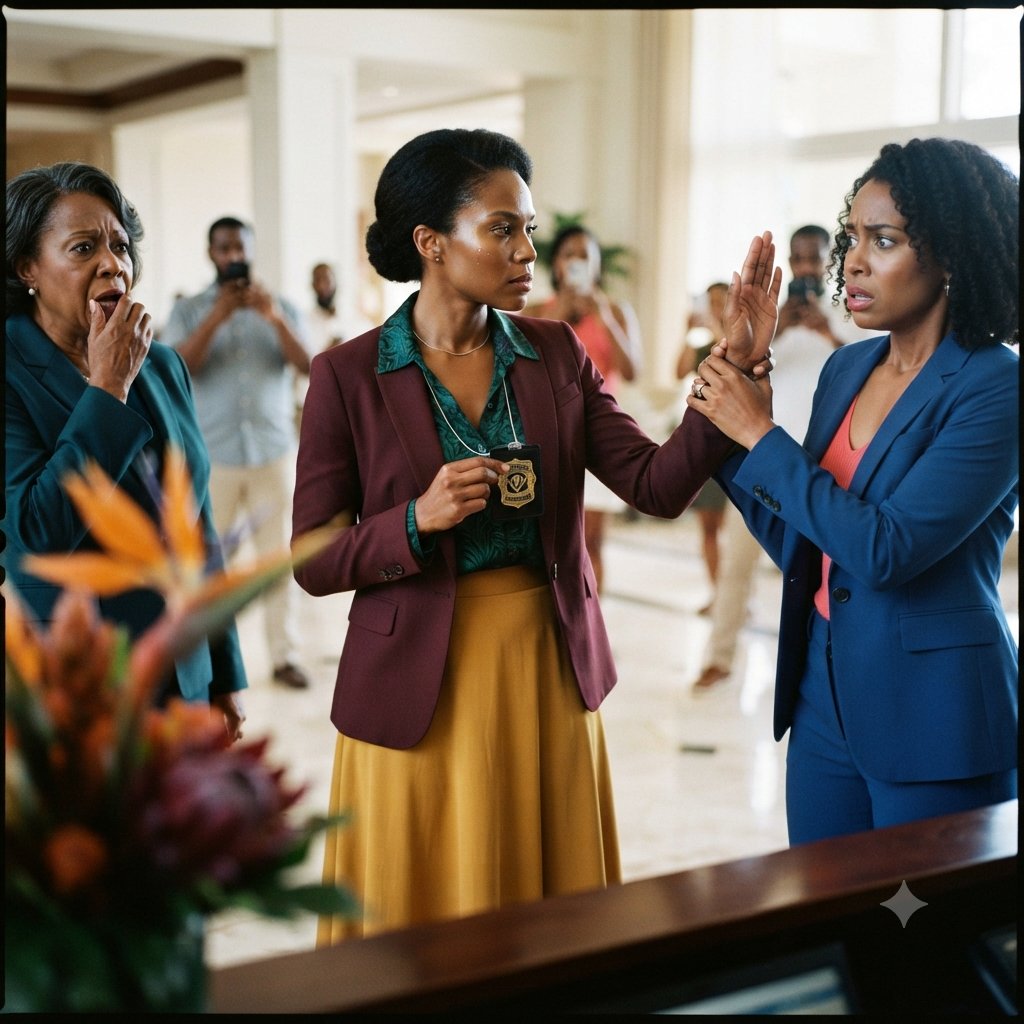
Serena was waiting by my locker.
Not with the composed, calculated stillness of before.
She was leaning against the wall with her arms crossed, and she looked like someone who had made a decision and wasn't entirely sure it was the right one.
"My mother got a call this morning," she said.
"I know."
"From Jonathan Carter's office.
A real meeting.
Next week."
"I know."
She studied me.
"Why?"
"I already told you why."
"You said you'd ask him to look at it.
You didn't say you'd build a full case and walk it into his study."
"The work was good enough to deserve it."
Serena was quiet for a moment.
The hallway moved around us — students, noise, the ordinary machinery of a school day.
"She cried," Serena said finally.
"My mother.
When she got the call.
She doesn't cry in front of me.
She hasn't since my father left." A pause.
"I just thought you should know that."
I didn't say anything.
There wasn't anything to say that wouldn't make it smaller.
"I owe you an apology," Serena said.
"What I did — pointing Madison at you — I told myself it was about my mother.
About fairness.
But it wasn't fair to you.
You hadn't done anything."
"No," I said.
"I hadn't."
"I'm sorry."
She said it the same way Madison had — not performed, not managed.
Just said.
"Okay," I said.
"Okay?"
"Yeah.
Okay."
She looked at me like she was still waiting for something harder.
I was starting to understand that people expected harder from me, and I wasn't sure what that said about them or about me.
"There's one more thing," Serena said.
She reached into her bag and pulled out a folded piece of paper.
"I wrote this out last night.
It's a statement — what I told Madison, when I told her, what I said.
I signed it.
If the disciplinary review needs it, you can give it to the principal."
I looked at the paper without taking it.
"You'd do that?"
"I already did it.
Whether you use it is up to you."
I took the paper.
Folded it once and put it in my jacket pocket.
"Serena."
"Yeah?"
"If your mother's meeting goes well — if something comes of it — that happened because her work was good.
Not because of anything I did."
Serena nodded slowly.
"I know."
"Make sure she knows that too."
The bell rang.
Serena pushed off the wall.
She walked away without looking back — but the set of her shoulders was different.
Something had been put down that she'd been carrying for a while.
I went to class.
At lunch I sat at a table near the window.
Not alone — Ryan was there, and two other students I'd started to recognize by name.
The cafeteria was loud and ordinary.
Someone dropped a tray near the far wall and everyone laughed.
I ate my sandwich and didn't think about the bucket.
After school, Dad called.
"Patricia Walsh's proposals," he said.
"I had my intake director pull the original submissions.
They were received, logged, and assigned to an associate who left the company eight months ago.
They fell through the gap."
"So it was a process failure."
"It was a process failure.
I'm fixing the process." A pause.
"Her meeting is confirmed for Thursday.
I read the third proposal twice."
"Graham said the location analysis was sharp."
"Graham is right." Another pause.
"You spoke to Ryan's father before you came to me."
"I needed to know the work was solid before I asked you to take it seriously."
"You didn't trust me to evaluate it fairly."
I thought about that.
"I trusted you to evaluate it fairly once it was in front of you.
I wasn't sure it would get in front of you if I just handed you a USB drive and said a girl at school gave it to me."
Silence.
"That's fair," he said.
"I know."
He almost laughed.
I could hear it not quite happening.
"Emily."
"Yeah?"
"I'm proud of you.
Not for the real estate part.
For all of it."
I looked out the window at the school grounds.
The groundskeeper was gone.
The leaves were raked into a neat pile near the path.
"Thanks, Dad."
"I'll see you tonight."
I put my phone in my pocket and picked up my bag.
Ryan was waiting near the front entrance.
"How'd it go?" he said.
"Good, I think." I handed him his jacket — freshly washed, folded.
"Thank you.
For this.
For all of it."
He took it.
"You would have figured it out."
"Maybe.
But it would have taken longer."
He smiled — the first real one I'd seen from him, not the urgent, protective expression from the cafeteria but something easier.
"Same time tomorrow?" he said.
"Same time tomorrow," I said.
We walked out into the afternoon.
The air was cool and the sky was the particular pale blue that only happens in Texas in October.
Somewhere behind us the school doors closed.
I didn't look back.
I'd walked in that building not knowing a single person, wearing jeans and white sneakers, wanting to be known before the money was.
By the end of it, I was.
---
*Sometimes the cruelest moments end up teaching us exactly who we are — and who we're capable of becoming.
Have you ever been underestimated, or watched someone rise above a moment that was meant to break them?
Share your story in the comments — we'd love to hear it.*